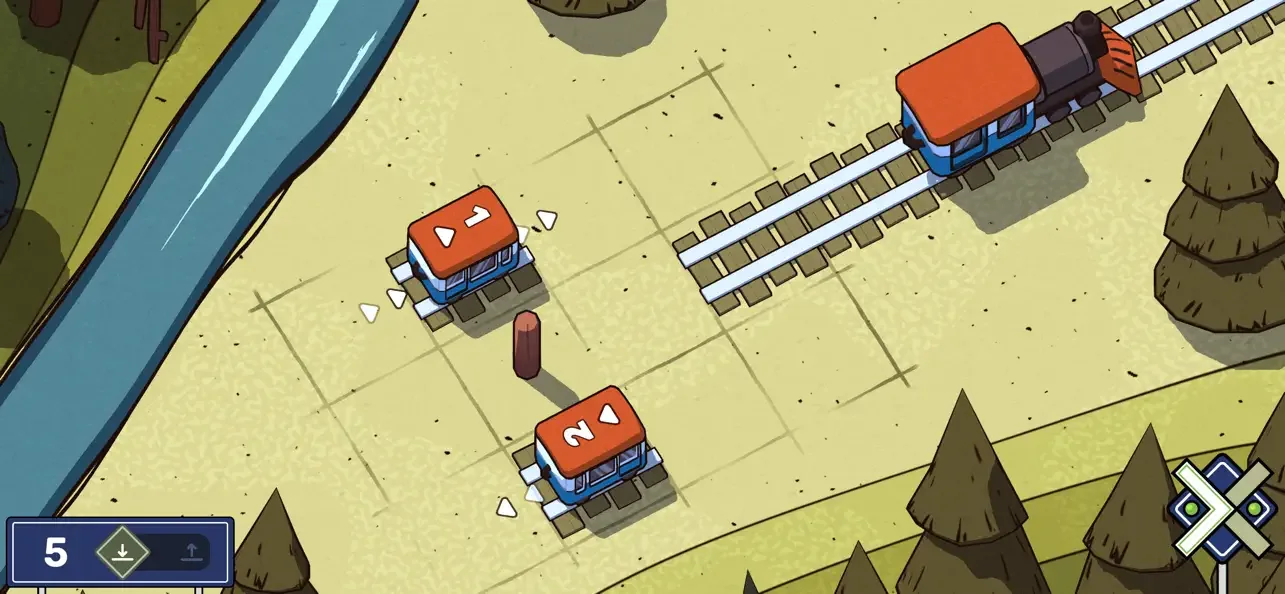
Players draw rail lines that pick up color-coded passengers and deliver them without dead ends or impossible pathing.
Why it may be useful
Every route is an ordering problem: pick up the wrong passenger first and the right one has nowhere to sit. That is real sequential planning under a hard constraint, though it stays a grid abstraction with no connection to any subject beyond itself.
Keep in mind
The interface is English only, and the later puzzles demand real planning that many players find genuinely hard without any in-game hints.
Written 2026-09-15 · editorial assessment, not a measured effect · how we rate →
What the game is
Cosmic Express is a small route-drawing puzzle game by Alan Hazelden, Benjamin Davis and Tyu, published by Draknek and Friends in March 2017. Each level is a single screen: a grid of empty space with a track entrance on one edge, an exit on another, a few aliens waiting and a house for each of them. Your job is to draw the track that joins the two ends and collects everyone on the way.
There is no timer, no score and no failure. You drag a line across the grid, watch the train run it once, and see where it goes wrong. The art is flat and bright, a handful of shapes on a colored field, and the whole thing runs happily in a window. The Steam page offers hundreds of levels, grouped into clusters that unlock as you go.
Steam lists English as the only language. It is a one-time purchase with no advertising and nothing to buy inside.
What you actually do
You click and drag to lay track, square by square, from the entrance to the exit. The train runs the route once and stops for anything beside it: an alien standing next to your track boards, and a house next to your track lets a matching passenger off. The catch is capacity. Early on the train has room for one passenger at a time, so the order of your route decides everything, and picking up the wrong alien first leaves the right one with nowhere to sit. Later levels add more colors, more cars and tighter grids, and the track can never cross itself. Getting better looks like planning the drop-offs before the pick-ups, and spotting the one square that has to carry two passes.
What it exercises
Plans an ordered sequence where each step limits what the next one can be
Reads a grid and counts how many squares a route can afford
Works backward from a required end state to the moves that reach it
Notices the single constraint that rules out every obvious solution
Tests a plan, watches it fail, and changes one thing rather than starting over
Why we rate it Low Worksheet score 46 / 100
FitHow much real knowledge or skill does the play itself make you use?45weight 45%
Scored 45. Nothing in this game exists except the planning: no story, no reflexes, almost no reading. Ordering a sequence of actions under a hard constraint is the one thing you do, and a level only opens when that ordering is right. It sits in the middle because that one skill, however cleanly isolated, is the entire domain on offer, with nothing else to work with.
TransferWill what you practise here work outside the game?30weight 30%
Scored 30, near the bottom of its range. Ordering steps so each one leaves the next possible is the shape of real planning, from packing a bag to writing a program, and the game strips that down to something you can see whole. But it stays a grid abstraction with no story or context, and no research connects this kind of puzzle to planning skill used anywhere else.
PracticeDoes the game make you use that skill again and again, as it gets harder?65weight 25%
Scored 65. Hundreds of levels repeat the same ordering task in a new shape, and the later ones cannot be brute-forced, so the same decision comes back again and again at rising difficulty. It falls short of the top because the game is short enough to finish in a handful of sittings, and the levels stop rather than continuing to escalate indefinitely.
What the evidence says
Editorial onlyNobody outside our desk has checked this. It is our reading of how the game plays.
This is Editorial only. The sources are the Steam listing and the game's own site, checked in August 2026, with Steam re-read here. Together they confirm the three credited developers, the March 2017 release, the English-only interface and the claim of hundreds of levels. Neither says anything about what solving those levels does for a player. This assessment rests on the observation that sequential planning under a hard constraint is the only activity the game offers, and we found no research linking this game, or grid-route puzzles as a group, to planning skill used away from a screen.
Editorial assessment - not a measured scientific effect.
Fit
45/100
Transfer
30/100
Practice
65/100
Why it makes the cut
PASS - It is a crisp route-planning puzzle game rather than a themed lesson.
Editorial only
This is our own reading of the mechanics, checked against the Steam listing and the game's own site, which confirm the developers, release date and English-only interface. Neither source, nor any study we found, addresses what solving these puzzles does for a player.
Prices are US store listings in USD, last refreshed 2026-09-25; regional prices and sales differ.
No subscription requirement was found on the verified PC route.
Steam currently verifies interface support for the listed locales. Full audio is captured only where Steam explicitly marks it; subtitle coverage remains unknown unless a platform source states it separately.
Ordering pickups and drop-offs under a hard capacity limit is the entire game, practiced hundreds of times, but it stays a grid abstraction that no research connects to planning away from a screen.