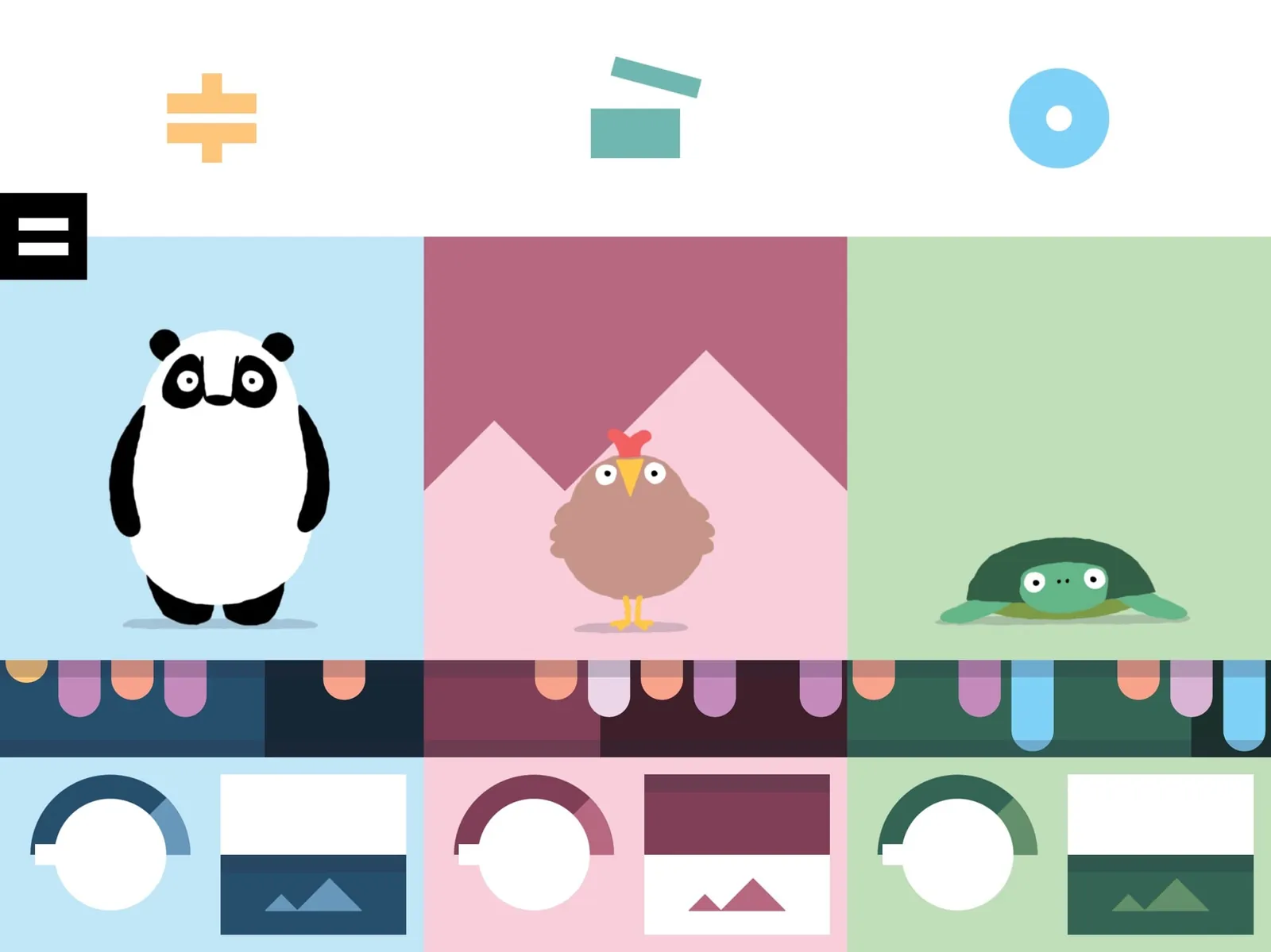
Children pick from a board of 18 activities: sorting bugs from buttons on a moving conveyor belt, completing colour patterns with buttons and yarn, picking apples while dodging bees, playing tic-tac-toe against a dragonfly, tilting the device to guide a bug through a maze, and simple counting and memory games; most activities quietly get harder as the child succeeds.
Why it may be useful
The eighteen activities teach sorting, patterns, matching, and counting through drag, pinch, and tilt, and self-leveling keeps each one near the edge of what a child can already do. It plays more like a box of small puzzles than one game, and a few of the activities are thin.
Keep in mind
It is a 2011 design kept running rather than reimagined, so it looks dated next to newer apps, several activities are thin, and the App Store rating rests on only a few dozen ratings.
Written 2026-09-15 · editorial assessment, not a measured effect · how we rate →
What the game is
Bugs and Buttons is a collection of eighteen small activities for young children, made by Little Bit Studio and first released in 2011. The main screen is a board of picture tiles; a child taps one and lands straight in a game. Nothing has to be read, because each activity opens with a short animation showing what to do.
The subjects are sorting, patterns, counting, matching, and a little fine motor control, all handled by dragging, pinching, and tilting the device. Most activities quietly raise their own difficulty as a child succeeds, so a three-year-old and a five-year-old meet different versions of the same game. It is a one-time purchase with no advertising and no in-app purchases, it uses a parental gate, and the developer states that it collects no data. The app was updated in 2025 and now needs a recent version of iOS.
What you actually do
A child picks a tile and plays for two or three minutes. In one game a conveyor belt carries a mix of bugs and buttons past, and only one of the two goes in the jar. In another, a row of buttons on a thread has a gap, and the child drags in the button that continues the color pattern. There is apple picking with bees to avoid, tic-tac-toe against a dragonfly, and a maze a bug walks through as the device is tilted. When a child does well the belt speeds up, the pattern gets longer, or the maze grows; when they struggle, it eases back. Then they tap back to the board and choose something else.
What it exercises
Sorts objects by a single attribute at speed
Continues a color or shape pattern by choosing the missing item
Counts a small set and matches it to a numeral
Uses drag, pinch, and tilt to place an object precisely
Holds a simple rule in mind while things move on screen
Why we rate it Low Worksheet score 43 / 100
FitHow much real knowledge or skill does the play itself make you use?40weight 45%
Fit sits at 40. The skills are the games rather than a reward attached to them: a child sorts because sorting is what wins, and self-leveling keeps each activity near the edge of what a child can already do, which is the right place for practice. The score is not higher because several of the eighteen activities are thin, and a few are pure reflex tests with no thinking in them.
TransferWill what you practise here work outside the game?40weight 30%
Transfer also sits at 40. Sorting, patterning, and counting are exactly the preschool ideas that show up in early school math, so the content lines up well. What is missing is the part that makes practice stick at this age, talking about it: a tablet cannot ask a child why two buttons belong together, so carryover depends on an adult nearby.
PracticeDoes the game make you use that skill again and again, as it gets harder?50weight 25%
Practice reaches 50. Eighteen activities and short sessions mean a child returns to the same handful of skills many times, and self-leveling means the tenth attempt differs from the first. The ceiling is that the activities are fixed: once a child has topped out, the app has nothing further to offer, and most children outgrow it by six.
What the evidence says
Editorial onlyNobody outside our desk has checked this. It is our reading of how the game plays.
The evidence level is Editorial only: our assessment of the activities, based on Little Bit Studio's own page and the App Store listing, both checked in September 2026. Those sources confirm the eighteen activities, the design target of ages three to five, the single purchase price, the absence of advertising and in-app purchases, the parental gate, the developer's statement that no data is collected, and the 2025 update with its raised iOS requirement. No study looks at this app. The claim that it gives practice in sorting, patterning, and counting comes from watching what each activity asks a child to do.
Editorial assessment - not a measured scientific effect.
Fit
40/100
Transfer
40/100
Practice
50/100
Why it makes the cut
The games are played for the bugs, the mischief and the achievements; the skills are the material the games are made of rather than a lesson attached to them.
Editorial only
Editorial only: our assessment of the activities against Little Bit Studio's own page and the App Store listing, since no study looks at this app.
Prices are US store listings in USD, last refreshed 2026-09-25; regional prices and sales differ.
The App Store description states the app is designed for ages 3-5, has no in-app purchases or third-party advertising, and uses a parental gate; the developer's page adds that it collects no data.
The app was updated in October 2025 and requires iOS 16 or later.
Age guidance
Ages 3-6
Topics
Logic & strategy
Play styles
Single-player, Puzzle
Tags
No reading · Ad-free · One-time purchase · Mini-games · Short sessions
The skills are the games themselves: sorting because sorting is what wins, and self-leveling keeps each activity near what a child can do. Several of the eighteen activities are thin reflex tests.