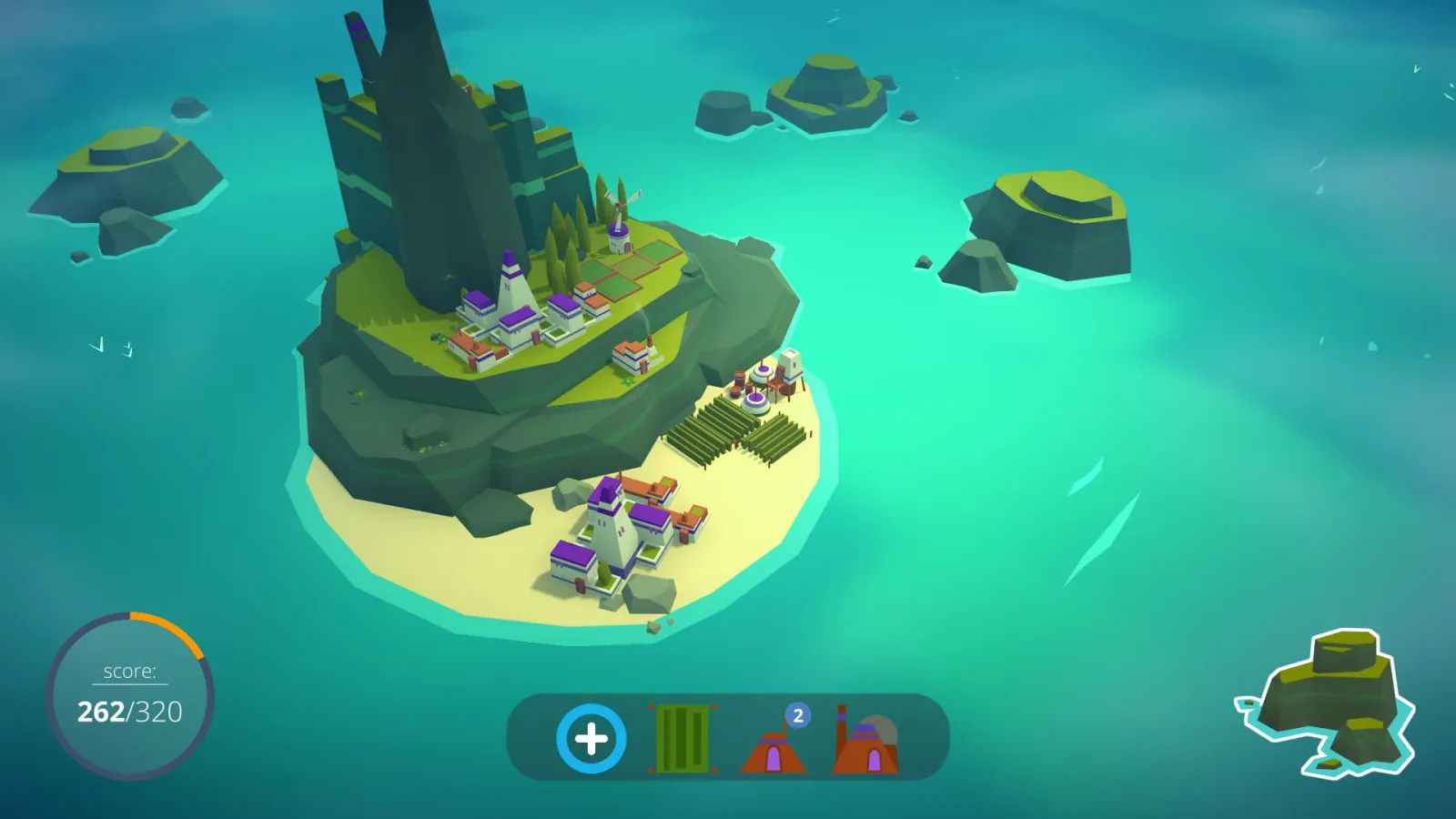
Players draw hex tiles, rotate and place them to extend forests, rivers, villages, tracks, and fields while completing quests that earn more tiles.
Why it may be useful
Every tile is the same spatial decision: does this fit what is already here, and what does it cost you later. That is real planning practiced hundreds of times, though the landscape is a pure abstraction with nothing that models an actual settlement or ecosystem.
Keep in mind
Its landscapes are abstract puzzle systems, not a realistic model of settlement design, ecology, or transport planning.
Written 2026-09-15 · editorial assessment, not a measured effect · how we rate →
What the game is
Dorfromantik is a tile-laying puzzle by Toukana Interactive, a Berlin studio founded by four students whose thesis project it originally was. It grew out of a game-jam prototype in 2020, spent a year in early access, reached full release on PC in April 2022, and came to Nintendo Switch later that year.
You get a stack of hexagonal tiles and an empty table. Each tile holds a mix of terrain, forest, field, village, river, railway or water, and you rotate it and set it against what is already down. Matching edges scores points and, more importantly, earns more tiles. The camera is a gentle overhead view of a small green world that spreads outward as you play, with birdsong and almost no interface.
Quests appear on tiles: a village asking for a number of neighboring houses, a river asking to be extended. Meeting them earns more tiles, and a run ends when the stack runs out. Alongside that classic mode there is a creative mode with unlimited tiles, a custom mode where you set the rules, and monthly challenges with leaderboards.
What you actually do
Every turn is the same decision: here is the next tile, where does it go. Place it so forest meets forest and rails meet rails, and you score and draw more tiles. Place it badly and you leave a dead edge you can never repair, because nothing moves once it is down. That is the whole tension, since a placement that scores well now can block the river you will need twenty tiles later. Quests raise the stakes by asking for a specific number of something next to one tile, so you have to reserve space for a shape you cannot yet see. Getting better looks like keeping options open and reading the board rather than the tile in your hand.
What it exercises
Judges how a placement now limits the placements available later
Matches edges and rotations to fit a piece into an existing pattern
Reserves space on a board for a requirement not yet met
Weighs an immediate score against keeping a route open
Accepts an irreversible decision and plans around the consequence
Why we rate it Low Worksheet score 42 / 100
FitHow much real knowledge or skill does the play itself make you use?35weight 45%
Scored 35. There is exactly one action in this game, deciding where a tile goes, and every decision is a real trade-off between an immediate fit and what it costs later. That is genuine spatial reasoning, but it runs on an invented hex grid with no real subject underneath: no ecology, no settlement logic, nothing beyond the shapes matching, which keeps this well short of a genuine domain.
TransferWill what you practise here work outside the game?22weight 30%
Scored 22, near the floor. Thinking a move ahead, and refusing an easy score that closes off a route, is a habit worth having and shows up anywhere from chess to packing a car. But nothing in the game names or models a real landscape, ecology or transport network, so what a player takes away is a general planning reflex rather than any subject knowledge.
PracticeDoes the game make you use that skill again and again, as it gets harder?80weight 25%
Scored 80, by far the highest of the three. A run lasts fifteen minutes to an hour and consists of nothing but the same decision, several hundred times over, and players return for months chasing a better score. Creative mode, custom rules and monthly challenges keep the same skill in play, which is why repeated practice is the clear strength of this game.
What the evidence says
Editorial onlyNobody outside our desk has checked this. It is our reading of how the game plays.
This is Editorial only. Toukana's own page for the game plus the Steam and Nintendo listings, checked in August 2026 and the studio page re-read here, confirm the four-person Berlin team, the game-jam origin, the early access period and the April 2022 full release, and they list the classic, creative, custom and monthly-challenge modes. None of them makes an educational claim. This assessment treats repeated practice as the clear strength, since a single decision repeats hundreds of times in a run, and holds the wider value low because a hex grid models nothing about a real landscape. We found no research on this game.
Editorial assessment - not a measured scientific effect.
Fit
35/100
Transfer
22/100
Practice
80/100
Why it makes the cut
The pleasure of tile placement, high-score chasing, and creative landscape building stands on its own without a meaningfulness frame.
Editorial only
This is our own reading of the mechanics, checked against Toukana's own page and the Steam and Nintendo listings, which confirm the classic, creative, custom and monthly-challenge modes. None of them makes an educational claim, and no study of this game exists.
Prices are US store listings in USD, last refreshed 2026-09-25; regional prices and sales differ.
Official sources currently point to PC and Nintendo Switch, mapped here to the canonical platform IDs pc and console.
Steam page shows full release on 2022-04-28 and current live reception data checked on 2026-08-19.
Age guidance
Ages 9+ · PEGI 3
Topics
Logic & strategy
Play styles
Single-player, Puzzle, Strategy, Creative
Tags
Tile placement · Relaxing · Spatial planning
There is exactly one action, fitting a tile to what is already down while weighing what it costs later, repeated hundreds of times a run, but the hex grid models nothing about a real landscape.