Written 2026-09-15 · editorial assessment, not a measured effect · how we rate →
What the game is
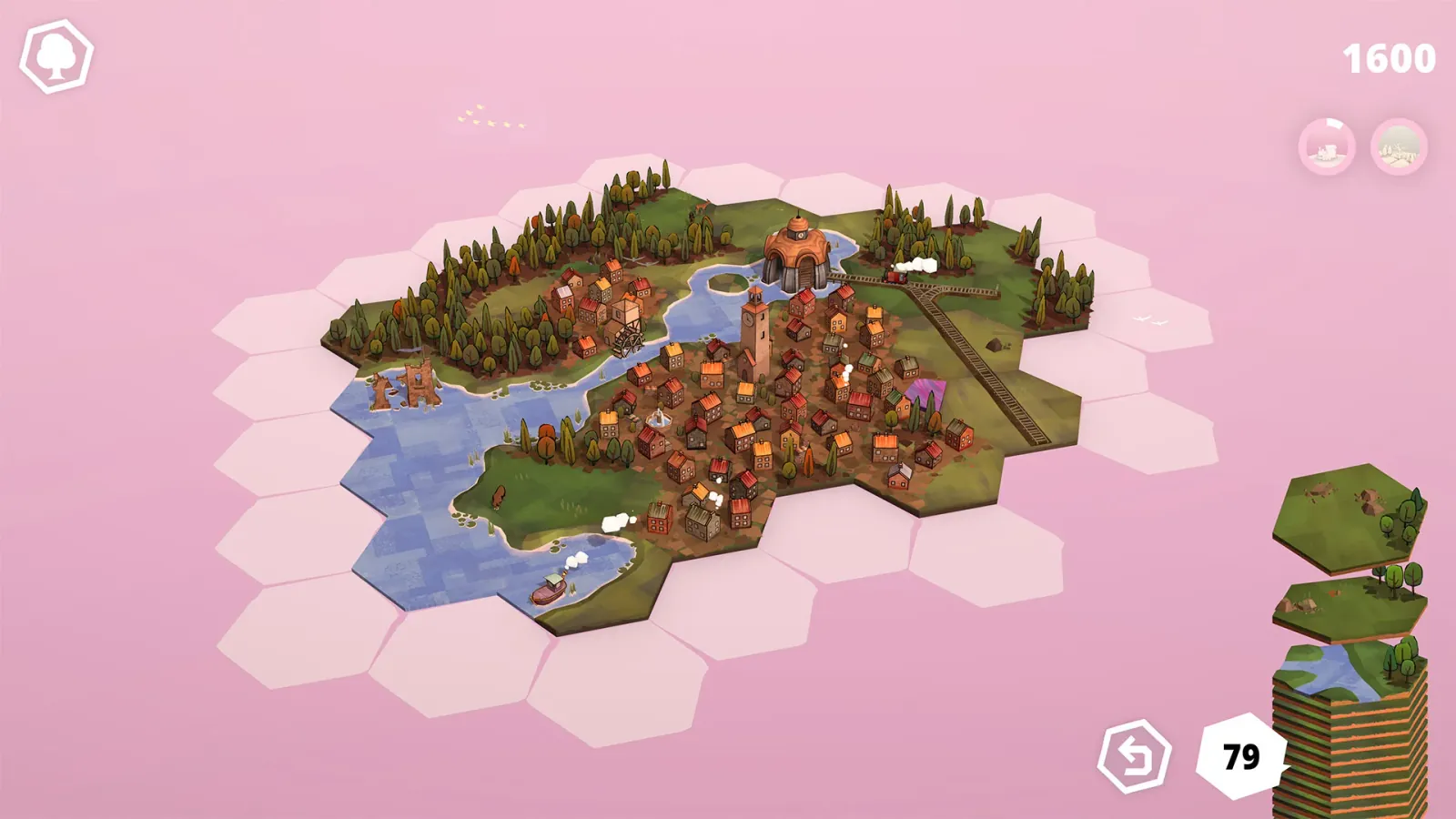
ISLANDERS is a small city-building score game released in 2019, credited on Steam to Coatsink, GrizzlyGames and Stage Clear Studios, and published by Coatsink. A run starts on a bare procedurally generated island, with some grass, some rock and a stretch of forest, and a short list of buildings to place.
Each building scores by what stands near it. A lumberjack hut wants trees. A mansion wants other mansions and dislikes industry. Placing well earns points, points unlock more buildings, and enough points let you leave for a new island carrying your score with you. Run out of buildings before reaching the next threshold and the run ends.
Everything is soft, low-poly and quiet: pastel islands on a flat sea, no characters, no timers, no failure beyond the end of a run. Steam lists it at a low price with twelve interface languages, single player only, and states plainly that there are no microtransactions, no loot boxes and no online modes. A run lasts as long as you take over each placement.
What you actually do
You pick one of two or three offered building packs, then place its contents one at a time. Before you commit, the game draws a circle around the cursor and shows a running number: this is what the building will score here. Move it two steps left, next to the forest, and the number climbs. Put a factory beside a house and it drops.
So every placement is a small optimization with a consequence. A good spot used now is a good spot no longer available later, and a cluster built for one bonus can block another. As the island fills, the easy points run out and you start hunting for a corner that still works. Getting better means thinking two or three placements ahead and leaving room, instead of taking the biggest number in front of you.
What it exercises
Reads a live score preview to compare placements before committing
Plans layouts several pieces ahead on a shrinking amount of space
Balances buildings that reward each other against ones that penalize
Adapts a plan when the next set of buildings is not the one wanted
Judges when to bank a score and move on rather than fill an island
Why we rate it Minimal Worksheet score 34 / 100
FitHow much real knowledge or skill does the play itself make you use?30weight 45%
Fit lands at 30. The thinking is the whole game: there is no content to learn and nothing to read, and the only real activity is weighing one placement against another under a shrinking amount of space. That is a clean, narrow fit for spatial planning, but there is no real subject or discipline underneath it, only invented scoring rules, which keeps the number low.
TransferWill what you practise here work outside the game?18weight 30%
Transfer is the lowest score, at 18. What is practiced is genuine planning behavior: looking ahead, counting the cost of spending a good spot now, accepting a smaller gain to keep options open. But it is exercised entirely on invented rules with no real content behind them, so the route to schoolwork or real design work is indirect at best.
PracticeDoes the game make you use that skill again and again, as it gets harder?60weight 25%
Practice is the strongest dimension at 60. Islands are procedurally generated and effectively endless, so the same placement judgment recurs indefinitely on new terrain, which is real, repeated exercise. The counterweight is sameness: the building set is small, and a player who finds one reliable pattern can repeat it, which turns practice into routine after a few hours.
What the evidence says
Editorial onlyNobody outside our desk has checked this. It is our reading of how the game plays.
The evidence level is Editorial only. The Steam page confirms the 2019 release, the developers and publisher, the low price, procedural island generation, the rule that a building scores by what is near it, single-player only play, twelve interface languages, and the explicit absence of microtransactions, loot boxes and online modes. Nothing on that page speaks to learning. No study specific to this game is known to us, and none is claimed. The meaningfulness case here reflects a reading of the mechanic, repeated constrained placement with an immediate numeric consequence, and what that plausibly exercises.
Editorial assessment - not a measured scientific effect.
Fit
30/100
Transfer
18/100
Practice
60/100
Why it makes the cut
PASS - Its minimalist placement puzzle is clearly played for pleasure first.
Editorial only
Editorial: no study of ISLANDERS exists, so the reasoning follows only from what repeated constrained placement with an immediate numeric consequence plausibly exercises, not from any measured outcome.
Prices are US store listings in USD, last refreshed 2026-09-25; regional prices and sales differ.
No subscription requirement was found on the verified PC route.
Steam currently verifies interface support for the listed locales. Full audio is captured only where Steam explicitly marks it; subtitle coverage remains unknown unless a platform source states it separately.
Age guidance
Ages 8+
Topics
Logic & strategy
Play styles
Single-player, Strategy, Creative, Sandbox
Tags
Spatial planning · Minimalist city building · Score optimization
It rates minimal because weighing one placement against another under a shrinking amount of space is real planning, but the rules are invented and unexplained, so almost nothing here carries into a real design problem.