Players travel between ruins, inspect inscriptions, guess meanings, revise those guesses over time, and make story decisions that depend on how the language is being interpreted.
Why it may be useful
It may help you practice inference, revision, and careful interpretation, because the game rewards updating a hypothesis rather than treating a first guess as certain.
Keep in mind
The game is English only on every platform, which matters more than usual here since reading and decipherment are the entire mechanic.
Written 2026-09-15 · editorial assessment, not a measured effect · how we rate →
What the game is
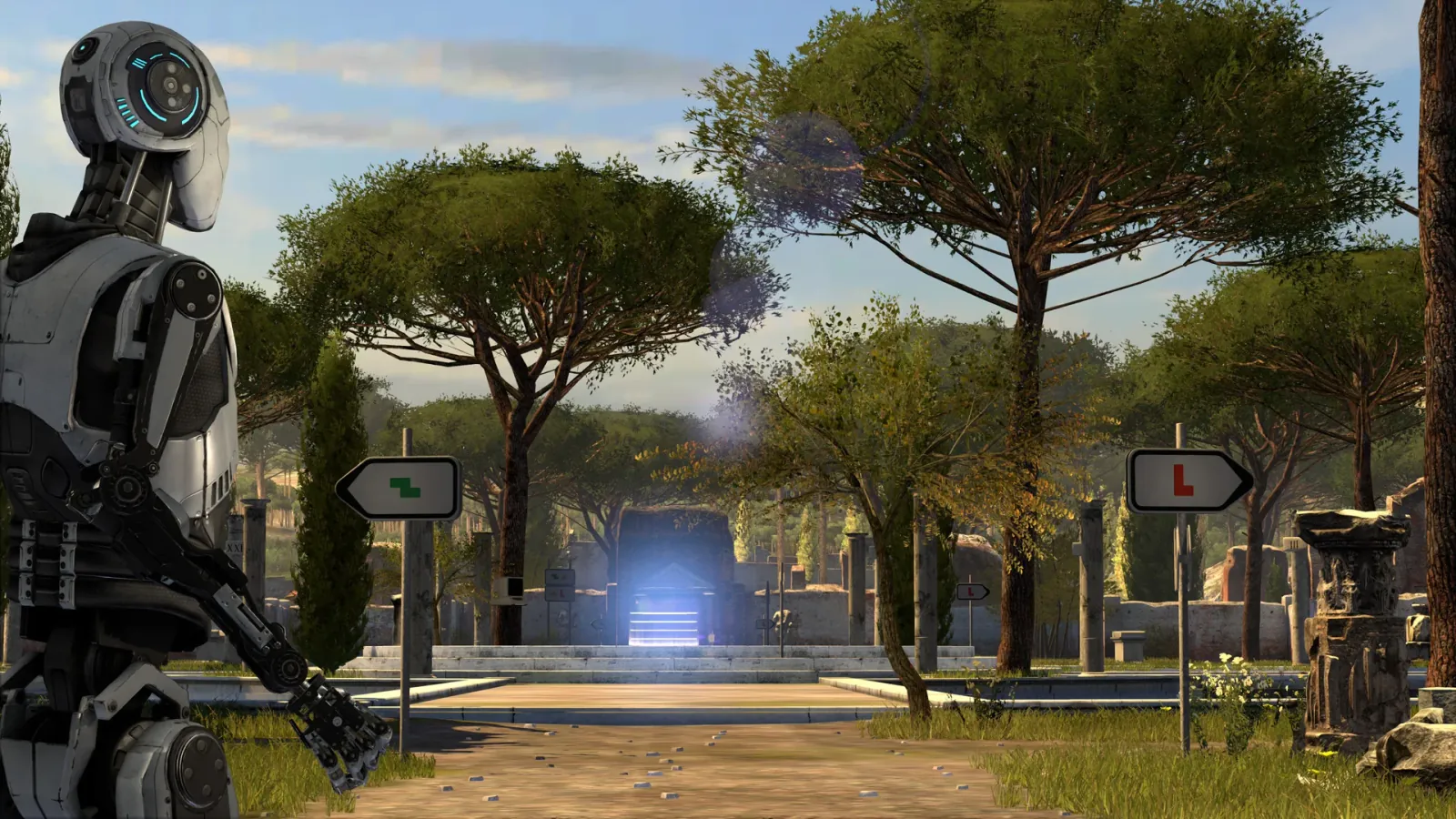
Heaven's Vault is an archaeology game about reading. You play Aliya Elasra, an archaeologist from a nebula where people sail wooden ships along rivers that run between moons, sent to find a missing roboticist. Her companion is a robot called Six. What you actually spend the game doing is looking at inscriptions on walls, pots and wreckage, and working out what they say.
The language is invented but real in the way that matters: it has a consistent grammar and a set of hieroglyphs that combine, so a symbol met on a doorframe in the second hour turns up inside a longer phrase in the ninth. inkle, the British studio behind 80 Days, released it in 2019 for PC, Switch and PlayStation. The studio describes translation as a puzzle with a twist, where solutions carry the story forward but a wrong reading can send you down the wrong track. The catch for many players is that it is English only on both Steam and the Nintendo store.
What you actually do
You find an inscription and the game offers a guess: several possible readings for the phrase, based on what you currently believe each symbol means. You pick one, and it enters your dictionary as a working hypothesis marked unconfirmed. Later inscriptions test it, and when a word keeps producing nonsense the game lets you know and you revise. Between inscriptions you sail between moons, walk through ruins and talk to Six, and the conversation choices are timed, so the story moves on whether or not you have finished thinking. Getting better means treating every translation as provisional and being willing to overturn a reading you have leaned on for hours.
What it exercises
Forms a hypothesis about a symbol's meaning from a handful of examples.
Tests a reading against a new inscription and revises it when it fails.
Uses context and word position to narrow the possible meanings.
Holds a large set of provisional facts without treating them as settled.
Notices that a confident early guess has been quietly wrong for hours.
Why we rate it Low Worksheet score 50 / 100
FitHow much real knowledge or skill does the play itself make you use?55weight 45%
Fit lands at 55. Decipherment is close to the entire game: no combat, no timer on the puzzles, and no way to advance except by reading and guessing. It tracks how confident you are in each word and lets you stay wrong for a long time, which makes it a genuine inference loop. It falls short of a higher score because the language is invented, so there is no real domain underneath the guessing, only its shape.
TransferWill what you practise here work outside the game?42weight 30%
Transfer sits at 42. Forming a hypothesis, testing it against new evidence and abandoning it when it fails is the shape of scientific and historical reasoning, and the game asks for exactly that hundreds of times. What holds the number down is that the language itself is invented, so no real script, vocabulary or method is learned along the way, only the habit of revising a guess.
PracticeDoes the game make you use that skill again and again, as it gets harder?50weight 25%
Practice reaches 50. Inscriptions keep arriving for the whole game, each reusing symbols already met, so the same inference gets performed many times over. What holds it to the middle of the scale is that one run eventually exhausts the supply, the story does not loop, and most players finish it only once, so the practice stops when the plot does.
What the evidence says
Editorial onlyNobody outside our desk has checked this. It is our reading of how the game plays.
The evidence level is Editorial only: a reading of the mechanics, checked against inkle's official site and press kit and the Steam and Nintendo listings. There is no study of Heaven's Vault, and we will not borrow research on language learning, because the language here is invented and no real script is taught. The claim is about the shape of the reasoning: the game requires a guess, records it as provisional, tests it against later evidence and lets it be overturned, which is a rare and faithful model of inference. The listings support the platforms, the developer and the English-only support.
Editorial assessment - not a measured scientific effect.
Fit
55/100
Transfer
42/100
Practice
50/100
Why it makes the cut
Its language-deciphering mystery is inherently game-first for players who enjoy discovery.
Editorial only
Editorial: no study of Heaven's Vault exists, and its invented language rules out borrowing research on real language learning, so the case follows only from what the decipherment mechanic requires a player to do.
Prices are US store listings in USD, last refreshed 2026-09-25; regional prices and sales differ.
Single-player play is supported.
Deciphering an invented language and reading large amounts of dialogue are central to the exact appeal of the game.
Steam currently lists English only, and Nintendo's current store page likewise identifies only British English support. This is a material worldwide-access caveat, not a minor detail.
Age guidance
Ages 7+ · PEGI 7
Topics
Logic & strategy, History & society
Play styles
Single-player, Narrative, Puzzle
Tags
Language decipherment · Interpretation · Narrative archaeology
It rates low because forming a hypothesis about an invented language and revising it under new evidence is genuine inferential practice, but the language itself is fictional, so no real script or content travels with it.