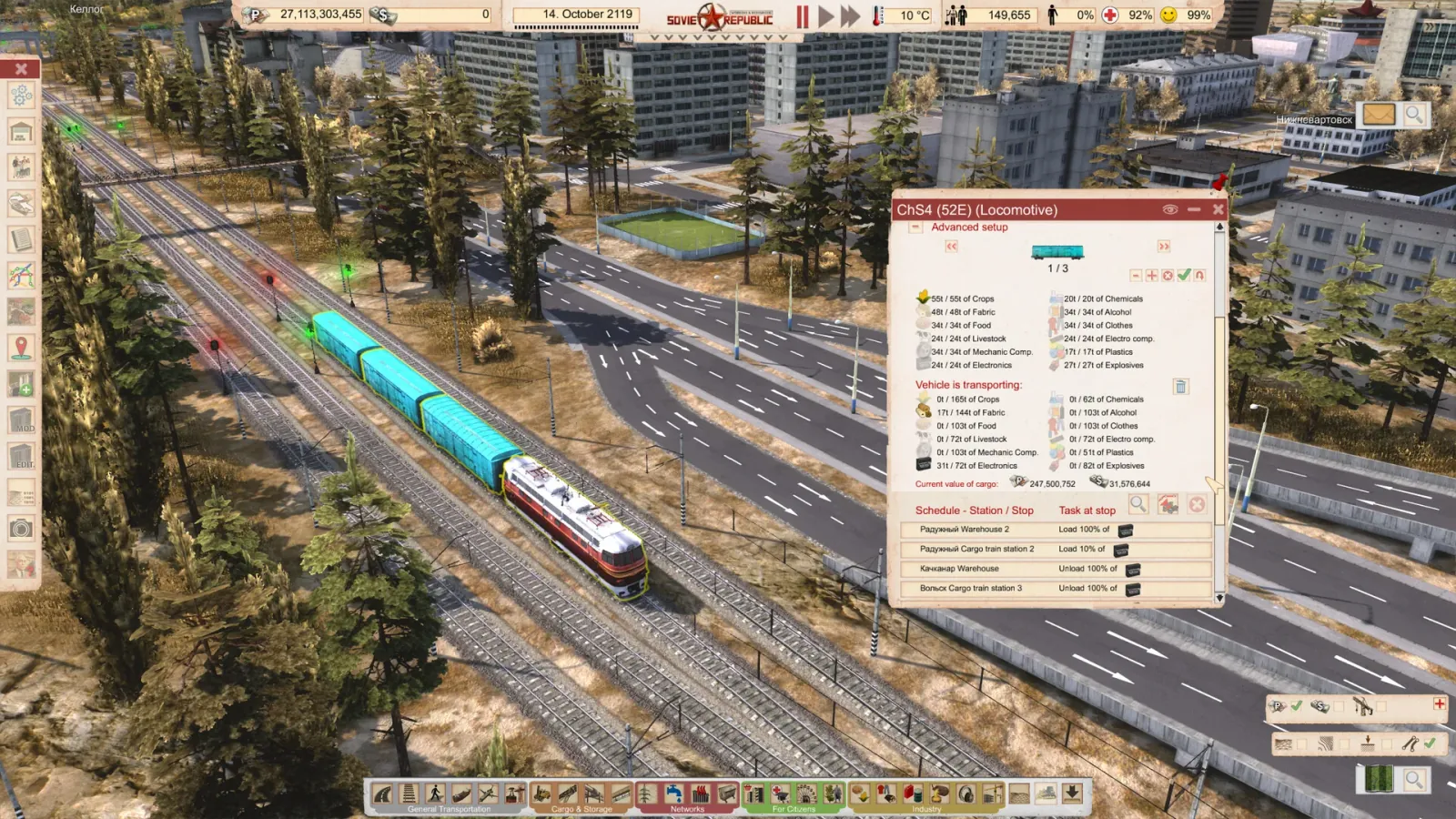
Players build tracks, stations, bridges, and tunnels, assign trains, and grow a company.
Why it may be useful
You manage a rail network as supply chains, timetables and competition, tracing goods from mine to mill to market. The economics are simplified and the payoff is modest: expect a feel for logistics, not transferable business knowledge.
Keep in mind
The game centers an entrepreneurial model and simplifies the social consequences of railway expansion.
Written 2026-09-15 · editorial assessment, not a measured effect · how we rate →
What the game is
Railway Empire 2 is a railway tycoon game from Gaming Minds Studios, published by Kalypso Media in May 2023 for PC and consoles. It starts in 1830 and runs forward through the industrial expansion of the nineteenth century. You look down on a landscape of towns, farms, mines and mills, connect them with track, bridges, tunnels and stations, then buy locomotives and decide what each one carries where.
There are two very large maps, one covering the United States and one covering continental Europe, plus smaller regional maps. Structures include a five-chapter campaign, fourteen scenarios with specific goals, a free-play mode you configure yourself, a relaxed construction mode with the business pressure removed, and co-op for up to four players running one company together. You pick a company head from six characters with different strengths, research new technology, and compete against computer rivals for the same routes.
What you actually do
You find a town that wants something and a place that produces it, and you build the line between them. Then you discover the mill needs coal before it can make anything the town wants, so you build a second line to a mine. Industry chains stack up like this, and most of the game is spent deciding which link to build next with limited money. Stations take up to eight tracks and bridges up to four, so capacity is a design decision rather than an afterthought. Signals are placed automatically, which keeps attention on the network. Getting better means seeing the chain three links ahead.
What it exercises
Traces a supply chain from raw material to the town that wants the finished goods.
Chooses which route to build first when money only covers one.
Sizes a station and a bridge for traffic that has not arrived yet.
Reads a map's terrain to find where a line will be cheap to build.
Balances borrowing against income across a long campaign.
Why we rate it Low Worksheet score 47 / 100
FitHow much real knowledge or skill does the play itself make you use?42weight 45%
Fit sits at 42. Building the network does force you to trace supply chains and weigh limited money against competing routes, which is genuine reasoning. But the economic model underneath is thin, and automatic signaling removes the operational layer, so most of what you are managing is a simplified spreadsheet dressed as nineteenth-century track, closer to scenery than to an economics course.
TransferWill what you practise here work outside the game?35weight 30%
Transfer scores 35. Weighing one investment against another under a tight budget is a real habit, and it does carry over in a loose way. But the historical setting is thin enough that nothing about actual nineteenth-century railways, their economics or their social cost travels with it, so what a player keeps is a general feel for trade-offs rather than subject knowledge.
PracticeDoes the game make you use that skill again and again, as it gets harder?70weight 25%
Practice reaches 70. A single campaign chapter runs the survey, connect and expand cycle dozens of times, and two large maps, fourteen scenarios and open-ended free play mean the same reasoning about routes and capital keeps recurring for as long as anyone wants to play. Co-op gives a further reason to return. What keeps this below the top band is that the underlying skill stops deepening once the pattern is learned.
What the evidence says
Editorial onlyNobody outside our desk has checked this. It is our reading of how the game plays.
The record is Editorial only: our reading of the mechanics, not a measured outcome. The official game page and the store listings confirm the developer, the publisher, the May 2023 release, the maps, the modes, the co-op player count and the player reception figures cited elsewhere on this page. No research exists on this game, and none was found on tycoon games as a group, so nothing external supports the rating. What can be observed directly is that the game requires repeated reasoning about supply chains and about spending limited money on one route rather than another; the historical content around it functions as scenery rather than as subject matter.
Editorial assessment - not a measured scientific effect.
Fit
42/100
Transfer
35/100
Practice
70/100
Why it makes the cut
Route planning and company management form a full strategy game.
Editorial only
This is our editorial reading of the mechanics, based on the official game page and store listings. No study has examined tycoon games as a group, so nothing external supports the assessment above.
Prices are US store listings in USD, last refreshed 2026-09-25; regional prices and sales differ.
Age guidance
Ages 10+ · ESRB E10+
Topics
Logic & strategy, History & society
Play styles
Single-player, Strategy, Simulation
Tags
Railways · 19th century · Management
The economics you manage are simplified rather than modeled, and automatic signaling removes the operational side, leaving a network puzzle with real repetition but a thin subject underneath.