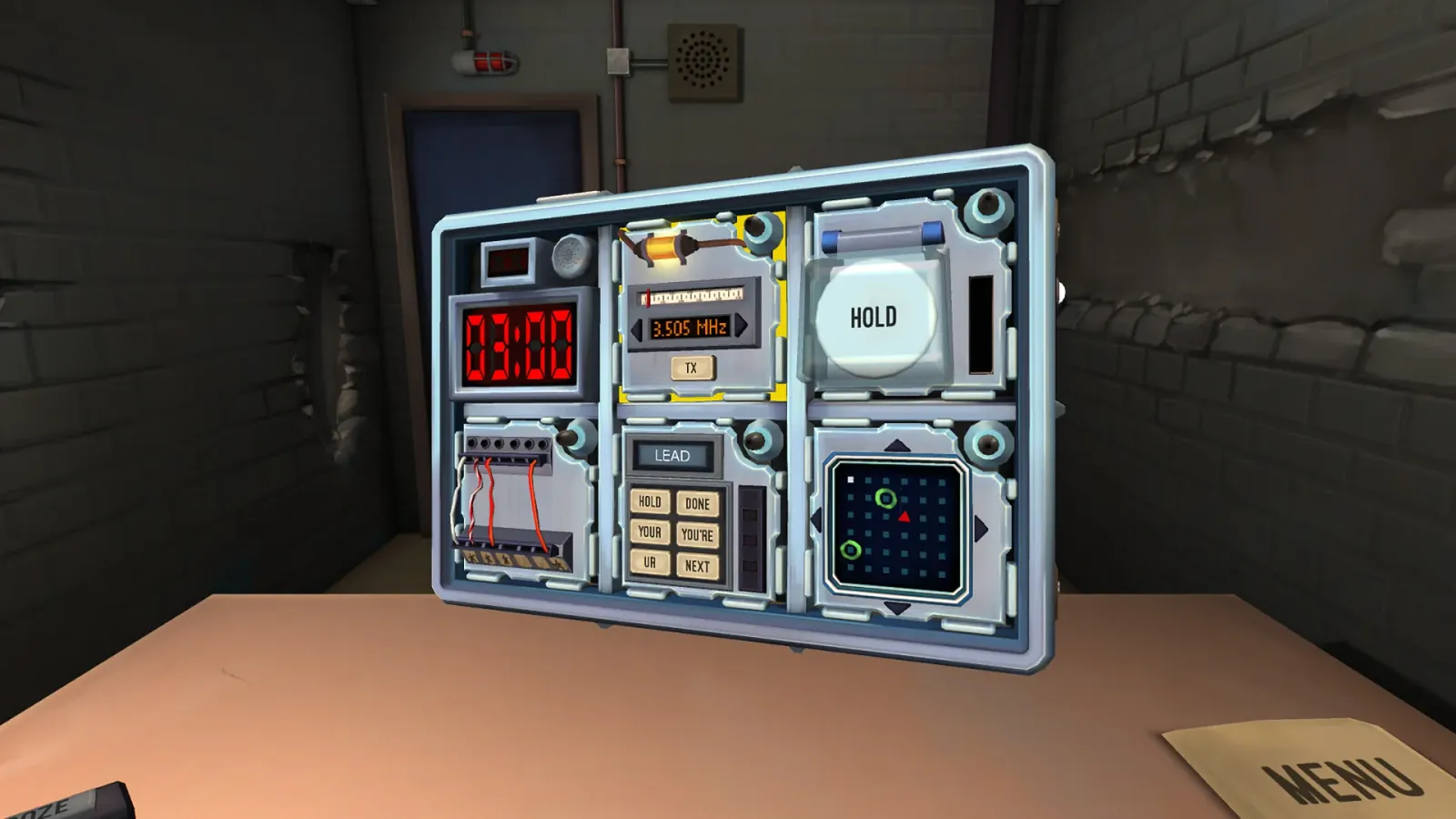
Two players split roles between a field agent and a hacker, narrating screens to each other and solving linked puzzles that cannot be completed alone.
Why it may be useful
Success depends entirely on describing what you see precisely enough for a partner who cannot see it. That habit is real and transfers well, though the practice here is bounded by a short, one-time set of missions.
Keep in mind
The value is real but narrow: once a puzzle's trick is known, replaying teaches little new, and the whole game still requires voice chat between two devices.
Written 2026-09-15 · editorial assessment, not a measured effect · how we rate →
What the game is
Operation: Tango is a two-player cooperative spy game from the studio Clever Plays, published with Team17 in June 2021. It is built around a split that never closes: one player is the Agent, moving through hotels, vaults, airports and server rooms, and the other is the Hacker, sitting behind a wall of screens. Neither ever sees the other's view, so the game is played through your voice. The Agent stands at a keypad they cannot read; the Hacker holds the reference table but not the keypad.
Every puzzle places the information on one screen and the ability to act on the other, and the only bridge is a spoken description. It runs on PC and consoles, is online only with no split-screen, and requires a microphone. A Friend Pass lets one owner invite a partner to play the whole game free, so one purchase covers a pair. It carries a PEGI 12 rating, lists eleven interface languages, and adds a challenge mode once the missions are done.
What you actually do
You talk, constantly. A typical exchange runs like this: the Agent reads out a row of symbols with no obvious names, the two of you agree what to call the one shaped like a bent arrow, the Hacker finds the matching entry and reads back a sequence, and the Agent enters it before an alarm timer fills. Some rooms make both of you act at once, so the Hacker disables a camera while the Agent walks past it. Failure usually comes from a description that was almost right. Getting better is not about reflexes; it is about naming things precisely and confirming your partner heard what you meant.
What it exercises
Describes an unfamiliar shape or screen precisely enough for someone who cannot see it
Invents and agrees shared names for symbols that have none
Confirms a partner understood before acting on it
Asks a clarifying question rather than guessing when a description is ambiguous
Splits one problem between two people holding different halves of the information
Why we rate it Minimal Worksheet score 38 / 100
FitHow much real knowledge or skill does the play itself make you use?38weight 45%
Fit sits at 38. There is no way to route around the talking, since the Agent cannot see the code and the Hacker cannot press the button. But the puzzles themselves are simple pattern-matching once described, so the skill being exercised is narrow: clear description, not much else.
TransferWill what you practise here work outside the game?35weight 30%
Transfer is 35. Naming a thing before describing it, checking that a partner heard you, and asking instead of assuming show up in any handover, from a school project to giving directions. It is held down because a game with a partner you already like is a friendlier setting than most real ones ever offer.
PracticeDoes the game make you use that skill again and again, as it gets harder?40weight 25%
Practice is 40. Every puzzle returns to the same describe, confirm, act cycle, and swapping roles on a second run does rehearse the other half of the skill. But there are not many missions, and once each one's trick is known there is little reason to repeat it.
What the evidence says
Editorial onlyNobody outside our desk has checked this. It is our reading of how the game plays.
The evidence is editorial only. The cited sources are the Steam page, the developer's FAQ and a PlayStation Blog post. Between them they confirm the two roles, the online-only structure, the microphone requirement, the Friend Pass, cross-play and its Switch exception, the console subscription requirements and the PEGI 12 rating. None of them says anything about communication skills, and no study of this game is cited. The claim that it exercises precise description is an argument from what the split-information design demonstrably requires, not a measurement, and it is a narrow claim: one skill, rehearsed across a short set of missions that do not renew themselves once solved.
Editorial assessment - not a measured scientific effect.
Fit
38/100
Transfer
35/100
Practice
40/100
Why it makes the cut
PASS - Its asymmetrical spy puzzle loop is clearly game-first.
Editorial only
This is our reading of the mechanics: the split-information design demonstrably forces precise description, but no study of Operation: Tango or its communication effects exists that we can cite.
Prices are US store listings in USD, last refreshed 2026-09-25; regional prices and sales differ.
The game is online co-op only and requires a microphone / voice communication.
At least one player must own the full game unless both players are only using the limited demo mission.
The official FAQ says PlayStation and Xbox players need the relevant online subscription service.
The official FAQ notes that Switch Friend Pass cross-play is an exception to otherwise broad cross-play support.
Current PC availability is directly verified on Steam. The official FAQ confirms the Friend Pass model, cross-play, online-only structure, and PlayStation/Xbox subscription requirements; it also lists Steam, Epic Games Store, PlayStation 4/5, Xbox One, and Xbox Series X|S as supported platforms for the full game or free trial route.
Age guidance
Ages 12+ · PEGI 12
Topics
Logic & strategy, Mind & well-being
Play styles
Co-op, Puzzle
Tags
Asymmetrical co-op · Information handoff · Voice coordination
Talking precisely is the only way to win, since neither role alone has enough information, but the puzzles are short and one solved trick rarely needs relearning.