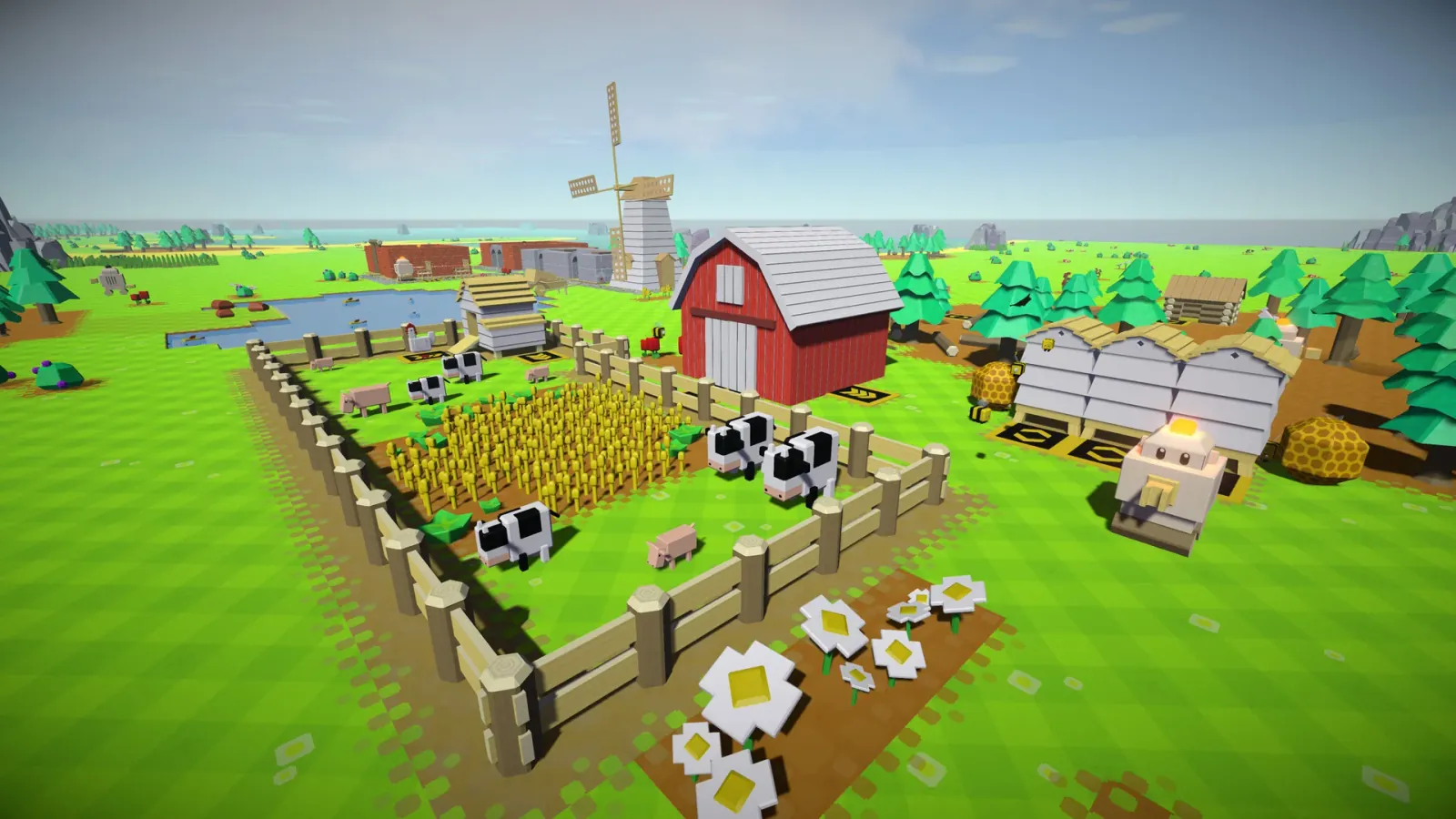
Players extract, cut, rotate, paint, stack, route, and balance shapes through expanding conveyor systems, then rebuild layouts as goals grow more complex.
Why it may be useful
The whole game is dependency analysis: no combat, no story, no timer, so the only thing that moves you forward is working out what a target shape requires and building the chain that supplies it.
Keep in mind
Browser access without owning the game is a limited demo, easy to mistake for the full version, and the interface grows dense once wiring and logic gates appear.
Written 2026-09-15 · editorial assessment, not a measured effect · how we rate →
What the game is
shapez is a factory game with the fighting removed. You stand on a flat, infinite plain scattered with patches of simple shapes and colors, and a HUB in the middle asks you for a shape. You build miners on a patch, run conveyor belts back to the HUB, and deliver. Then the HUB asks for something harder.
Getting something harder means processing. A cutter splits a shape into pieces, a rotator turns a piece, a stacker presses two pieces together, and a painter colors one using paint you have mined and mixed yourself. Each requested shape is a recipe, and the factory is a machine that produces it continuously. There are no enemies, no timers and no resource limits, so nothing can go wrong except your own layout.
It was built largely by one developer, Tobias Springer, and released in June 2020. Later stages unlock a wiring layer with logic gates. Steam lists twenty-four supported languages and offers a free demo, and the browser version at shapez.io is a limited demo unless you own the full game on Steam and sign in.
What you actually do
You read the shape the HUB wants and work backward. A circle with two colored quarters needs a circle mined, cut into quarters, some of them painted, and the pieces stacked back together in the right order, so you build that chain out of belts and machines. Then you discover it produces one shape every few seconds when the HUB wants far more. From there the work is finding the bottleneck: which machine is starved, which belt is full, where the line splits badly. You widen it, and the next stage starves. Getting better means building for throughput from the start instead of patching a chain that works once.
What it exercises
Decomposes a target output into the steps that produce it
Finds the bottleneck in a chain by looking for a starved machine
Builds for throughput rather than for a single working example
Reworks a layout that no longer scales instead of patching it
Uses logic gates to make a machine decide what to produce
Why we rate it Moderate Worksheet score 61 / 100
FitHow much real knowledge or skill does the play itself make you use?58weight 45%
Fit scores 58. The whole game is dependency analysis. Nothing else happens: no combat, no story, no timer, so the only thing that moves you forward is working out what a target requires and building the chain that supplies it. That singular focus is why the number sits this high, short of the very top because the game leaves out cost and quality entirely.
TransferWill what you practise here work outside the game?45weight 30%
Transfer scores 45. Thinking in throughput, dependencies and bottlenecks is a real engineering habit that turns up in manufacturing, software and logistics, and shapez drills it without the noise a real system carries. It is not higher because the abstraction is total: no cost, no maintenance, no people, so what travels is a way of reasoning rather than any transferable fact.
PracticeDoes the game make you use that skill again and again, as it gets harder?85weight 25%
Practice scores 85. The same act, decompose, build, measure, find the bottleneck, rebuild, repeats at every level and gets harder each time, and the map is infinite so there is always room to redo a factory properly. Players return to the same skill for dozens of hours as the challenge keeps escalating, which is exactly what this band is meant to capture.
What the evidence says
Editorial onlyNobody outside our desk has checked this. It is our reading of how the game plays.
The evidence level is Editorial only. Two sources are listed: the official site at shapez.io and the Steam page. They confirm Tobias Springer and tobspr Games, the June 2020 release, the price, the twenty-four supported languages, the absence of enemies, timers and resource limits, the infinite map, the mining, cutting, rotating, stacking and painting machines, the HUB delivery structure, the optional wiring and logic layer, and the free demo. They also confirm the access catch: the browser version is a demo unless you own the Steam version. No study has measured what factory games do for anyone.
Editorial assessment - not a measured scientific effect.
Fit
58/100
Transfer
45/100
Practice
85/100
Why it makes the cut
Optimizing a factory is satisfying game play in itself, with no lesson delivery required.
Editorial only
This is our editorial reading of the official site and the Steam listing. No study has measured what factory games like this one do for a player's reasoning.
Prices are US store listings in USD, last refreshed 2026-09-25; regional prices and sales differ.
Age guidance
Ages 12+
Topics
Logic & strategy, STEM
Play styles
Single-player, Sandbox, Strategy, Simulation
Tags
Automation · Production lines · Optimization
Nothing else happens besides dependency analysis, no combat, no story, no timer, which is why fit is unusually high, while the total abstraction of cost, maintenance and people caps how far it actually travels.