What the game is
Dyson Sphere Program is a factory-automation game by the small Chinese studio Youthcat Studio, released into Steam early access in January 2021 for Windows. It has more than ninety thousand reviews and sits among the best-reviewed games on the store.
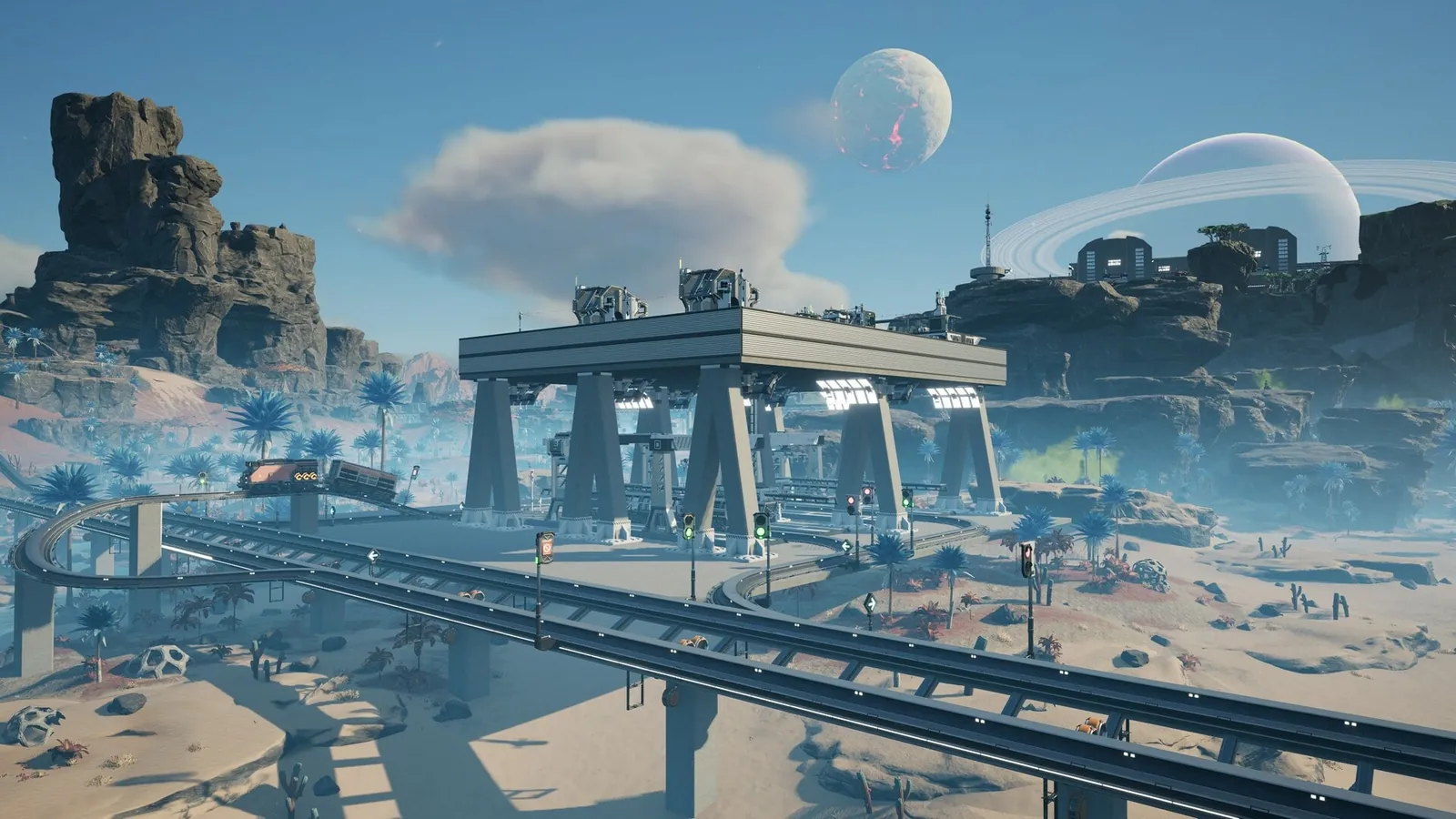
You are an engineer sent by a space alliance to build megastructures that power a vast computer. The camera sits close behind a hovering mech on a curved planet surface, so belts bend over the horizon, and it pulls back to show the whole planet, then the star system, then a galaxy of systems you can travel between. The palette is dark space and cool machine light. There is no story to speak of; the arc is entirely the growth from a hand-fed smelter to an interstellar supply network and, eventually, a lattice closing around a sun.
What you actually do
You place a mining drill, run a belt to a smelter, and feed the ingots to an assembler. Then you notice the assembler is idle half the time, so you add a second smelter, and now the ore runs out, so you find another vein. That loop, spot the starved machine, work backward, fix the ratio, is what the next hundred hours are made of. Research unlocks faster belts, better recipes and interstellar logistics vessels, so old sections get torn out and rebuilt. Getting better looks like planning a block before building it, laying belts you can extend, and thinking in items per minute rather than in machines.
What it exercises
- Calculates how many machines are needed to feed the next stage
- Finds a bottleneck by following an empty belt backward
- Budgets electrical generation against total consumption
- Designs a layout that can be copied and extended
- Plans a supply route across planets and star systems
Why we rate it Moderate Worksheet score 62 / 100
FitHow much real knowledge or skill does the play itself make you use?60weight 45%
Fit is 60. Every failure in this game is a rate mismatch made visible on a belt, and the only way forward is reasoning about how many of one machine feed how many of another, which is genuine engineering-style reasoning. It sits mid-scale rather than higher because the domain is reduced to a small set of levers, ore, belts, power, and the real complexity of an actual factory, tolerances, safety, cost, never enters the picture.
TransferWill what you practise here work outside the game?45weight 30%
Transfer drops to 45. The habit of thinking in rates and bottlenecks is real and does carry into other systems, but the astronomy is pure scenery: nothing about stellar physics or orbital mechanics is modeled, so the space setting teaches scale and nothing else. What travels is a general planning habit rather than any subject knowledge.
PracticeDoes the game make you use that skill again and again, as it gets harder?85weight 25%
Practice is the strongest axis at 85. The same ratio and bottleneck reasoning recurs at every tier of technology and on every new planet, across a save that easily runs past a hundred hours, with the challenge rising as belts and recipes grow more complex. Few games ask the same core judgment this many times without it going stale.
What the evidence says
Editorial onlyNobody outside our desk has checked this. It is our reading of how the game plays.
The evidence level is Editorial only, resting on the Steam listing, checked on 10 September 2026, which confirms the automation systems, interstellar logistics, the Dyson sphere construction, the blueprint tools, the added combat, and the ongoing early-access status, along with the review figures already noted. No educational claim appears anywhere on the listing, and no study of this game exists. The rating rests on one observation: production ratios and bottleneck analysis are not decoration here, they are the only thing that makes a factory work, while the space and star setting stays decoration throughout, which is why the astronomy earns the game far less credit than the factory logic does.