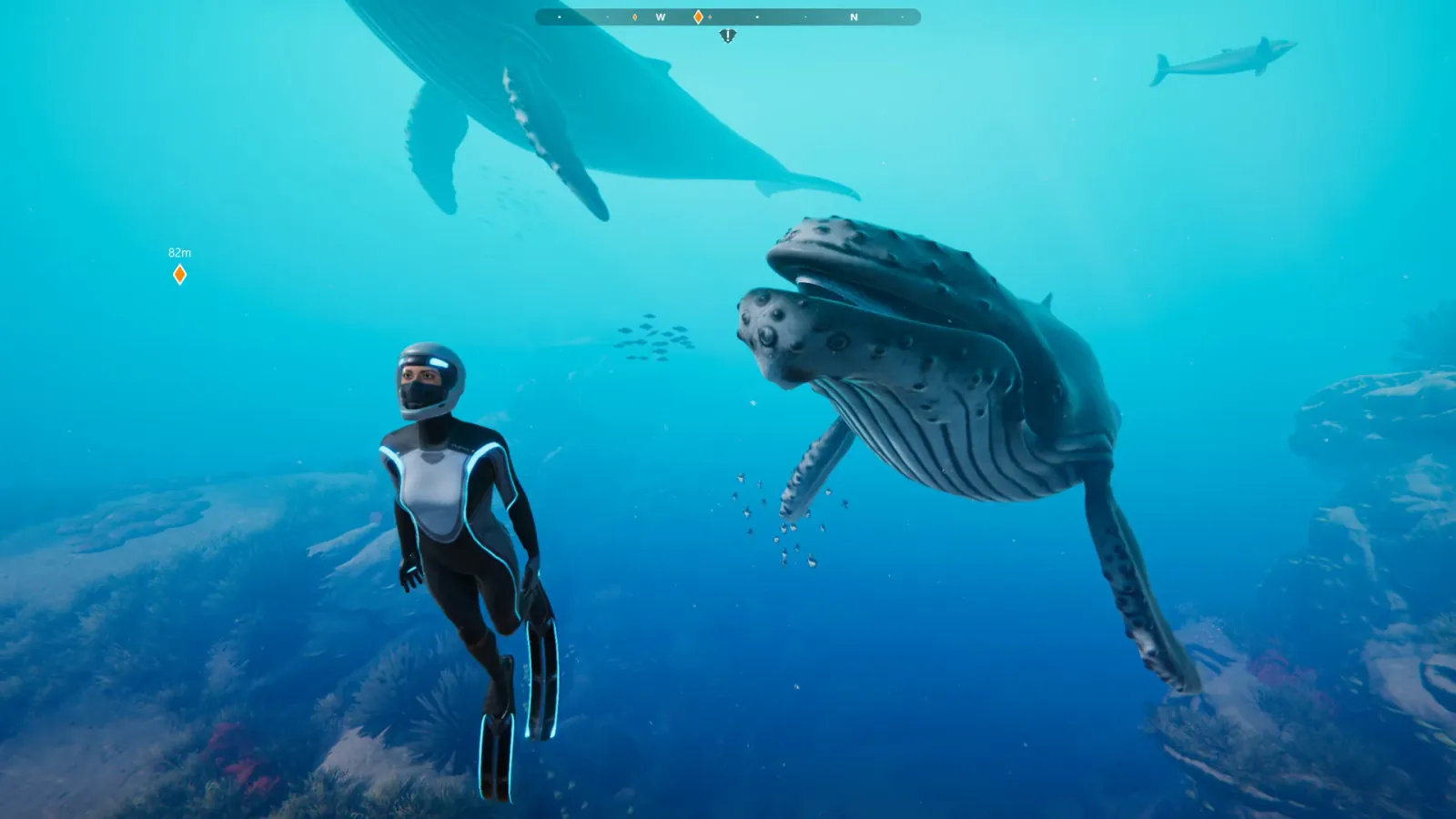
Players dive through ocean regions, scan and catalog sea life, gather discoveries in solo and story modes, and optionally join shared expeditions to explore with other divers.
Why it may be useful
Scanning teaches you to notice what separates one sea creature from another, and hours of cataloging build real names and shapes you will recognize elsewhere. The catalog mixes real animals with invented ones, so treat it as a starting point, not a reference.
Keep in mind
The creature catalog mixes real, extinct, and mythical beings, and its science stays broad and observational rather than rigorous or deeply ecological.
Written 2026-09-15 · editorial assessment, not a measured effect · how we rate →
What the game is
Endless Ocean Luminous is a diving game published by Nintendo for the Switch in May 2024, following earlier games in the series on the Wii. There is no combat, no oxygen meter and no way to drown. You swim through a stretch of water called the Veiled Sea, scanning whatever you find, and a catalog fills up as you go.
The map is generated fresh for each dive, so reefs, trenches and wrecks are rearranged every time and the creatures in them change. Nintendo's page puts the catalog at more than five hundred species, including some presumed extinct and some outright mythical. Scanning one opens an entry with a short description, and the collection is the progression.
There are three ways to play. Solo expeditions are a dive on your own. Research expeditions are a single-player story about saving something called the World Coral. Shared expeditions put up to thirty divers in the same water at once, which needs a paid Nintendo Switch Online subscription; the solo modes do not.
What you actually do
You swim, steering with the stick and boosting with a trigger, and point a scanner at anything that moves. A scan identifies the animal, adds it to the catalog and gives you a paragraph about it. Some species only appear at certain depths, in certain zones, or once you have found enough others, so a dive becomes a search for the gaps in your list. Salvage and coins on the seabed unlock cosmetic gear. In shared expeditions the other divers cannot speak or type to you, so the social part is simply finding the same rare animal at the same moment. Getting better means learning where things live rather than swimming faster.
What it exercises
Searches systematically for what is missing from a list
Notices the features that separate one species from a similar one
Navigates a three-dimensional space and keeps track of depth
Reads short factual entries and connects them to what was just seen
Why we rate it Low Worksheet score 44 / 100
FitHow much real knowledge or skill does the play itself make you use?40weight 45%
Fit is 40. Scanning is the only action in the game, so looking at animals is at least the whole activity rather than a side reward. But the scan does the identifying work for you: point, and the game names the species, so the actual noticing a player does is lighter than real identification would ask for.
TransferWill what you practise here work outside the game?42weight 30%
Transfer is 42. Spending hours filling a species catalog does leave someone with names and shapes they will recognize later, at an aquarium or in a book. But the catalog mixes real animals with extinct and mythical ones without much separating them, and the game never asks anyone to identify a creature unaided, so what carries over is patchy.
PracticeDoes the game make you use that skill again and again, as it gets harder?55weight 25%
Practice is 55. Every dive is the same search-and-scan cycle on a freshly arranged map, which repeats for as long as anyone keeps playing, and the catalog gives a real reason to return. It stays in the middle because the task never gets harder, and the late hunt for rare species turns into waiting for luck rather than skill.
What the evidence says
Editorial onlyNobody outside our desk has checked this. It is our reading of how the game plays.
The evidence level is Editorial only. All three sources are Nintendo's own, the store page and two news posts, checked in August 2026, with the store page re-read here. Together they confirm the May 2024 release, the price, a catalog of more than five hundred species including extinct and mythical ones, the rearranged Veiled Sea, the solo and story modes, shared expeditions with up to thirty divers, and the subscription needed to dive together. None of it addresses learning. The rating rests on an editorial reading of the mechanics: scanning is the whole action, which keeps the play tied to observation, but the scan itself does the identifying, and real and invented species share one catalog with no clear signal between them.
Editorial assessment - not a measured scientific effect.
Fit
40/100
Transfer
42/100
Practice
55/100
Why it makes the cut
It stands comfortably as a soothing exploration game even if the marine-learning angle is stripped away.
Editorial only
Editorial only, based on three of Nintendo's own product and news pages; none of them makes any claim about marine-science learning or identification skill.
Prices are US store listings in USD, last refreshed 2026-09-25; regional prices and sales differ.
Nintendo's official store page confirms the current Switch release date of May 2, 2024.
Nintendo's current product and news pages confirm both solo expeditions and online group diving with up to 30 players.
No public exact-entity aggregate player rating was found on the current Nintendo pages checked for this title.
Age guidance
Ages 8+ · ESRB E
Topics
STEM
Play styles
Single-player, Co-op
Tags
Marine life · Calm exploration · Creature catalog
It sits in the low range because scanning does the identifying for the player, the catalog blends real and invented animals without a clear signal between them, and the search-and-scan loop never gets harder.