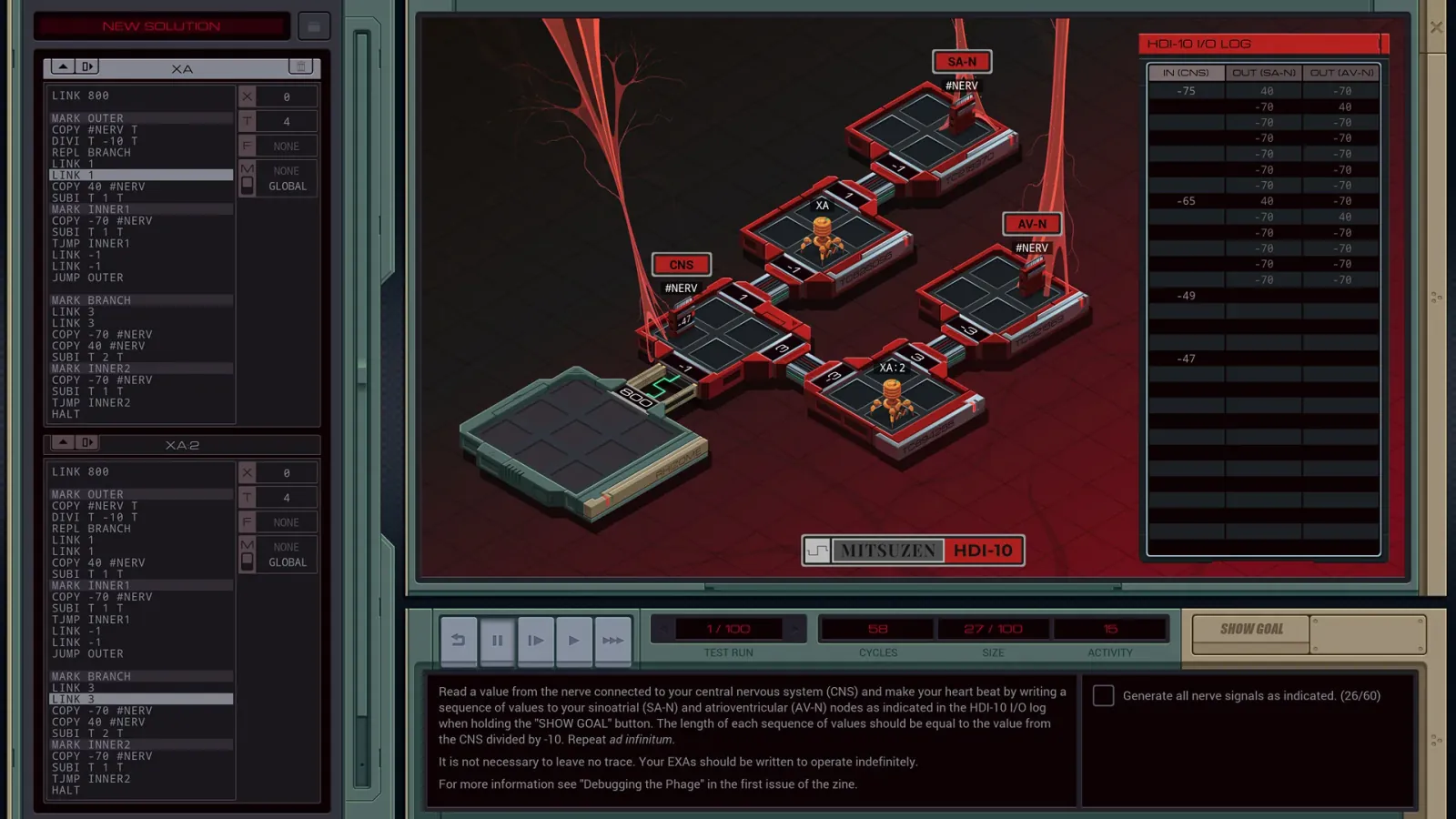
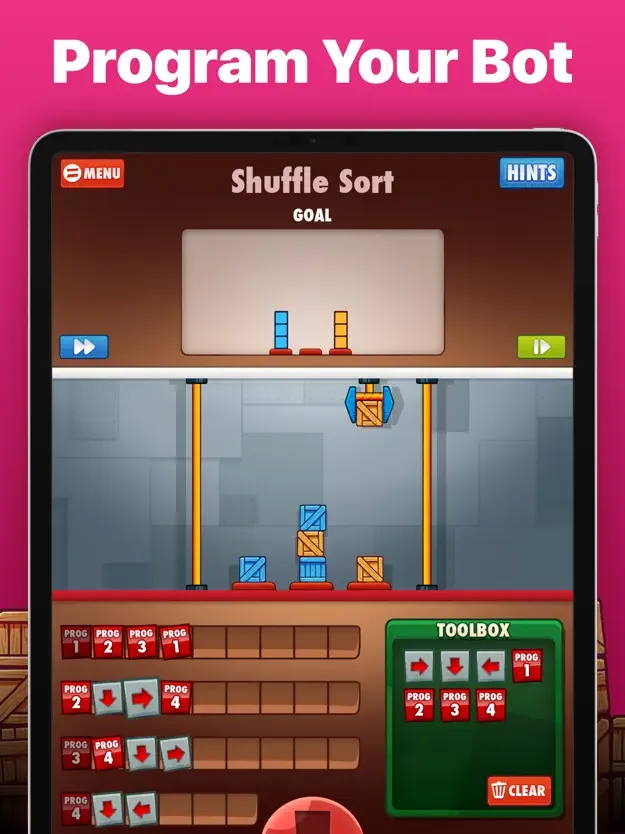
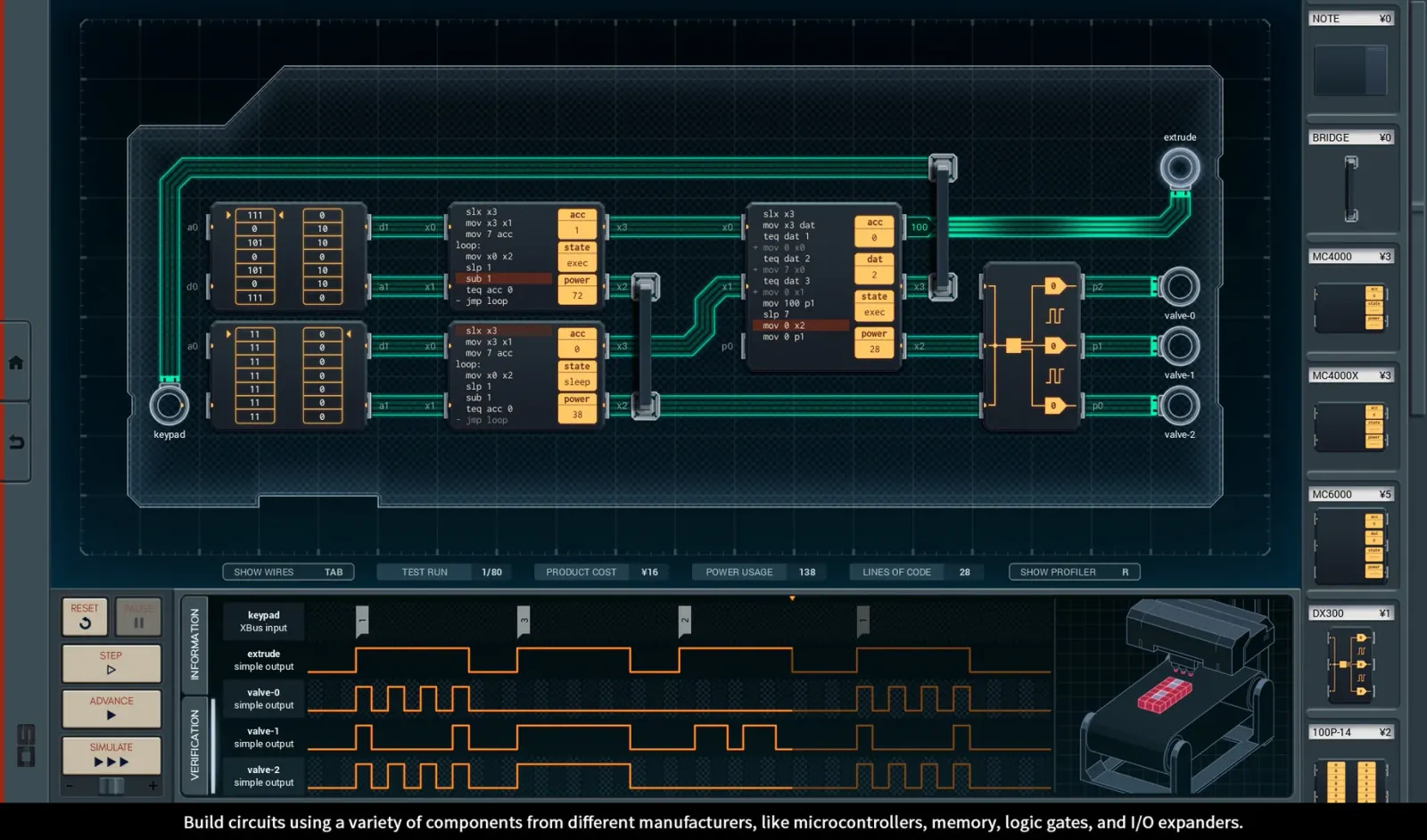
Players write little instruction sets for groups of office workers, test them, debug failures, and optimize solutions across increasingly complex levels.
Why it may be useful
Writing, running and debugging a small instruction set is the entire puzzle here, not a theme layered over it. What carries over is a method: break a task down, run it, fix the failing step, rather than a real programming language.
Keep in mind
Its office satire and invented language are not direct programming practice; transfer is strongest at problem decomposition and debugging habits, not at learning a production language.
Written 2026-09-15 · editorial assessment, not a measured effect · how we rate →
What the game is
7 Billion Humans is a programming puzzle game from Tomorrow Corporation, released in 2018 and sold on Steam, the Nintendo eShop and Google Play. It follows the same studio's Human Resource Machine. The setting is a satirical future office where almost all work is automated, and you write the instructions the remaining human workers follow.
Each of the sixty-plus levels is a small tiled floor holding some workers, some data cubes and a set of exit tiles. You build a program from instruction tiles, run it, and watch. The difference from the earlier game is that every worker on the floor runs the same program at the same time, so a solution has to work no matter where an individual worker happens to be standing.
Short cartoon scenes with dry office comedy sit between levels. Menus come in about a dozen languages, and the store page advertises hint and skip systems for players who stall. It is one paid purchase per platform, with no ads.
What you actually do
You read the floor, work out what the workers need to do, then drag instruction tiles into a script and press play. When it fails, you watch which worker went wrong and on which line, change one thing, and run it again. Early levels need a few steps in order. Later ones need conditions, memory, and rules that stop workers colliding or duplicating each other's work. Getting better looks like writing a shorter program that handles every starting position, and reaching for the hint button less often than you did a month ago.
What it exercises
Writes a sequence of instructions and predicts the result before running it
Uses conditions and repetition to cover cases the author cannot see in advance
Debugs by stepping through an execution and isolating the line that fails
Reasons about many agents running identical instructions at the same time
Rewrites a working solution to use fewer instructions or fewer steps
Why we rate it High Worksheet score 71 / 100
FitHow much real knowledge or skill does the play itself make you use?75weight 45%
No lesson is bolted onto the side: the puzzle is the program, and nothing moves until instructions exist, judged only on whether they run. Sequencing, conditions and debugging are the only tools on offer, so progress requires using all three. The score sits at 75 rather than higher because the fiction is played for laughs and never asks you to reason about a real system beyond the invented office.
TransferWill what you practise here work outside the game?62weight 30%
The instruction language is invented and small, so nobody finishes able to write Python. What travels is the method: split a task into steps, run it, watch where it breaks, change one thing. That method matters and shows up in block coding and spreadsheet formulas, but the number sits at 62 because the game never names the method or asks you to apply it outside its own tiles.
PracticeDoes the game make you use that skill again and again, as it gets harder?75weight 25%
Sixty-plus levels ask for the same thing: write a program, watch it fail, fix it, so the central move is rehearsed dozens of times. Optional challenges to solve a level in fewer instructions or fewer steps give a real reason to return to solved puzzles and rewrite them. It holds at 75 because the difficulty plateaus once the parallel-worker trick is learned.
What the evidence says
Editorial onlyNobody outside our desk has checked this. It is our reading of how the game plays.
The evidence level is Editorial only: our reading of the mechanics, checked against the Nintendo, Google Play and Steam listings, which confirm the sixty-plus levels, the parallel instruction language, the link to Human Resource Machine, and the hint and skip systems. We found no study of this game and cite none. General research on block-based programming environments concerns other tools, not this one, so we have not dressed it up as evidence here. The case rests on something plainer and verifiable by playing: the game cannot be finished without writing and debugging instruction sets.
Editorial assessment - not a measured scientific effect.
Fit
75/100
Transfer
62/100
Practice
75/100
Why it makes the cut
The puzzle design is compelling in its own right and would remain satisfying even if the programming interpretation vanished.
Editorial only
Our reading of the mechanics, checked against current Nintendo, Google Play and Steam listings that confirm the level count, the parallel-worker structure and the hint system. No independent study of this game exists.
Prices are US store listings in USD, last refreshed 2026-09-28; regional prices and sales differ.
Nintendo, Google Play, and Steam confirm current console, mobile, and PC availability, and the store pages describe the game as the followup to Human Resource Machine.
Age guidance
Ages 10+ · ESRB E
Topics
STEM, Logic & strategy
Play styles
Single-player, Puzzle
Tags
Programming logic · Automation · Debugging
The puzzle and the program are the same thing, so sequencing and debugging are unavoidable, but the invented language never connects to a real one and the challenge levels off once the core trick is learned.