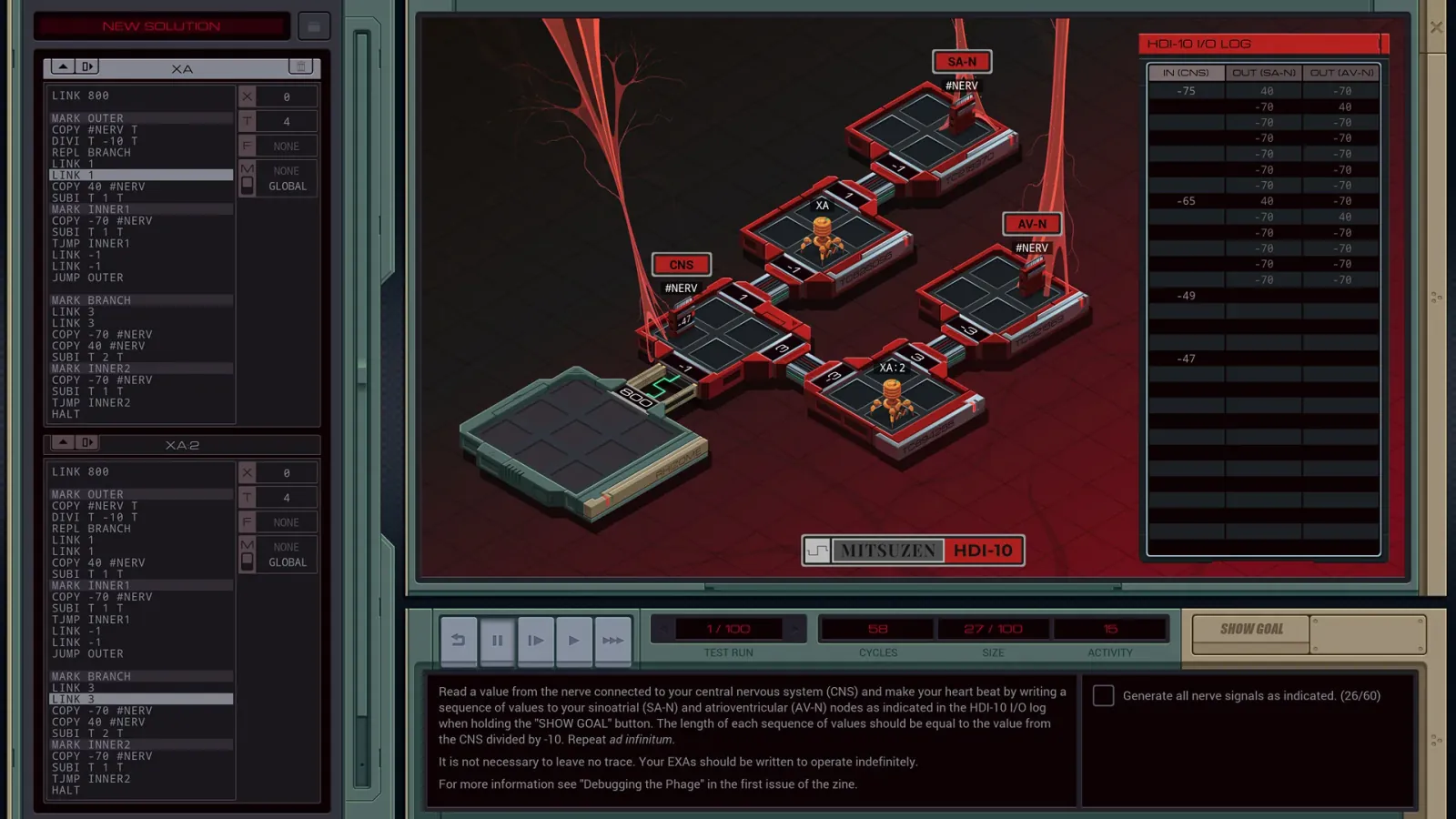
Players connect chips and displays, write assembly-like instructions, test outputs, and revise circuits until exact behavioral requirements are met.
Why it may be useful
Every task is a specification you satisfy by writing and debugging code against real constraints, with documentation you are expected to read first. That cycle, not a lesson wrapped around it, is what embedded programming work actually consists of.
Written 2026-09-15 · editorial assessment, not a measured effect · how we rate →
What the game is
SHENZHEN I/O casts you as an engineer who has moved to Shenzhen to work for a small electronics firm. Each assignment arrives as an email from your boss: a client wants a device that does one specific thing, and you have to build it. Zachtronics released it in November 2016, and it is a paid PC download.
Building means dragging chips onto a board, microcontrollers, memory, logic gates and small LCD screens, wiring their pins together, and writing code for each chip in a compact assembly language where any instruction can be made conditional. Space on the board is limited, and so is the number of lines each chip will hold.
The manual is the other half of the game. It runs to more than thirty pages of datasheets and reference diagrams written like real component documentation, and the game expects you to keep it beside you. When a solution works, a histogram shows how your cost, power use and line count compare with everyone else's. There is also a sandbox for your own devices.
What you actually do
You read the specification, work out what goes in and what has to come out, and decide how to split the job between chips. Most of the time goes on the second part: a chip runs out of instruction slots, so you move some logic elsewhere; two chips fight over a shared line, so you add a handshake between them. You step through execution watching registers change, find the instruction that fires one cycle too early, and fix it. A solution that merely works is the beginning, because then you look at the histogram and go back to make it smaller, cheaper or faster.
What it exercises
Reads a datasheet to find out what a part actually does
Splits a problem across several components with limited capacity each
Steps through execution to locate the instruction that misbehaves
Reworks a working solution to use less space or less power
Writes precise instructions under a hard size limit
Why we rate it High Worksheet score 82 / 100
FitHow much real knowledge or skill does the play itself make you use?85weight 45%
Fit scores 85. There is no gap between the puzzle and the skill: every task is a specification you satisfy by writing and debugging code against real constraints, and reading documentation is required rather than optional. Specification, constraint, manual, test, that is what embedded work consists of, and what the game consists of, which is why the number sits this high.
TransferWill what you practise here work outside the game?75weight 30%
Transfer scores 75. The assembly language is invented, so no syntax carries over directly. What does carry over is heavier: reading a datasheet before writing anything, budgeting scarce resources, isolating a fault by stepping through it, and treating a first working version as something to improve rather than finish. Those habits belong to engineering generally, which is why this scores well short of a perfect number but comfortably in the upper band.
PracticeDoes the game make you use that skill again and again, as it gets harder?85weight 25%
Practice scores 85. Every assignment runs the same cycle of read, plan, build, debug and optimize, and the optimization pass invites going back to puzzles already solved for a smaller or cheaper answer. The sandbox and the leaderboards extend that further. Repetition here is deliberate: the game is built to be replayed for a better solution, not merely completed once and left behind.
Where it has been used in teaching
Documented cases of this game being used with learners. Each one links to its source.
School programZachtronics · Secondary school · 2019
Zachtronics runs Zachademics, a free institutional license program for public schools and school-like nonprofits; SHENZHEN I/O is currently listed among the eligible games. The company says its games need adult scaffolding and are not designed as teaching tools; no specific school's use is reported.
Practice-backedNo published study, but people who answer for the outcome use it: schools, clinics, museums, research labs.
The evidence level is Practice-backed. Zachtronics runs Zachademics, a free institutional license program for public schools and school-like nonprofits, and this game is currently listed among the eligible titles, which is documented use rather than our own reading. The company is explicit that its games need adult scaffolding and were not designed as teaching tools, and no specific school's use of this one is reported. The Steam listing separately confirms Zachtronics as developer and publisher, the November 2016 release, the two supported languages, the invented assembly language, the components, the manual of datasheets, the sandbox and the leaderboards.
Editorial assessment - not a measured scientific effect.
Fit
85/100
Transfer
75/100
Practice
85/100
Why it makes the cut
PASS - It is plainly a beloved design puzzle game first and not a thin coding drill.
Practice-backed
Zachtronics runs a free school licensing program that currently lists this game as eligible, which lifts the level above our own reading of the mechanics, though the company itself says its games need adult guidance.
Prices are US store listings in USD, last refreshed 2026-09-28; regional prices and sales differ.
No subscription requirement was found on the verified PC route.
Steam currently verifies interface support for the listed locales. Full audio and subtitle support are only marked where a current Steam source states them explicitly.
Every task is a specification satisfied by writing and debugging code against hard constraints, and reading documentation before touching anything is required rather than optional, which is unusually close to real embedded work.