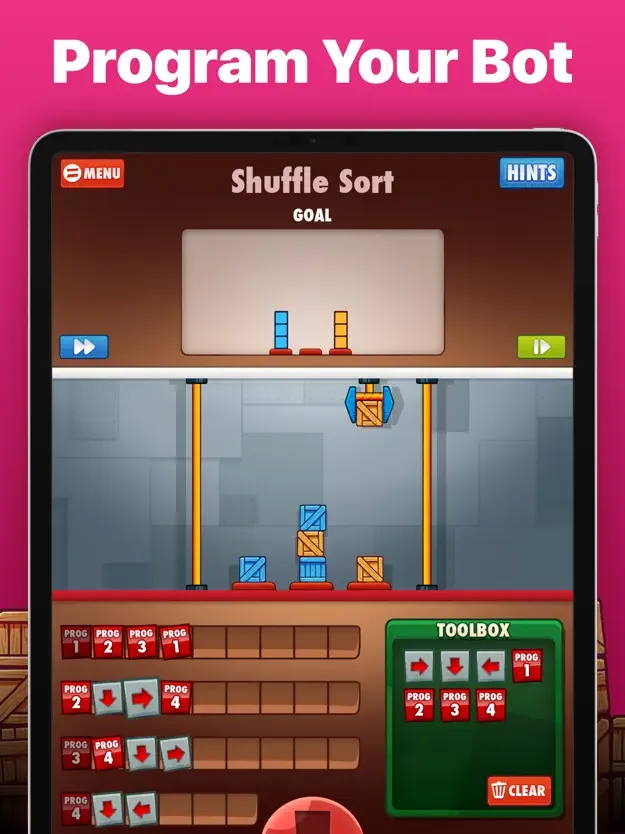
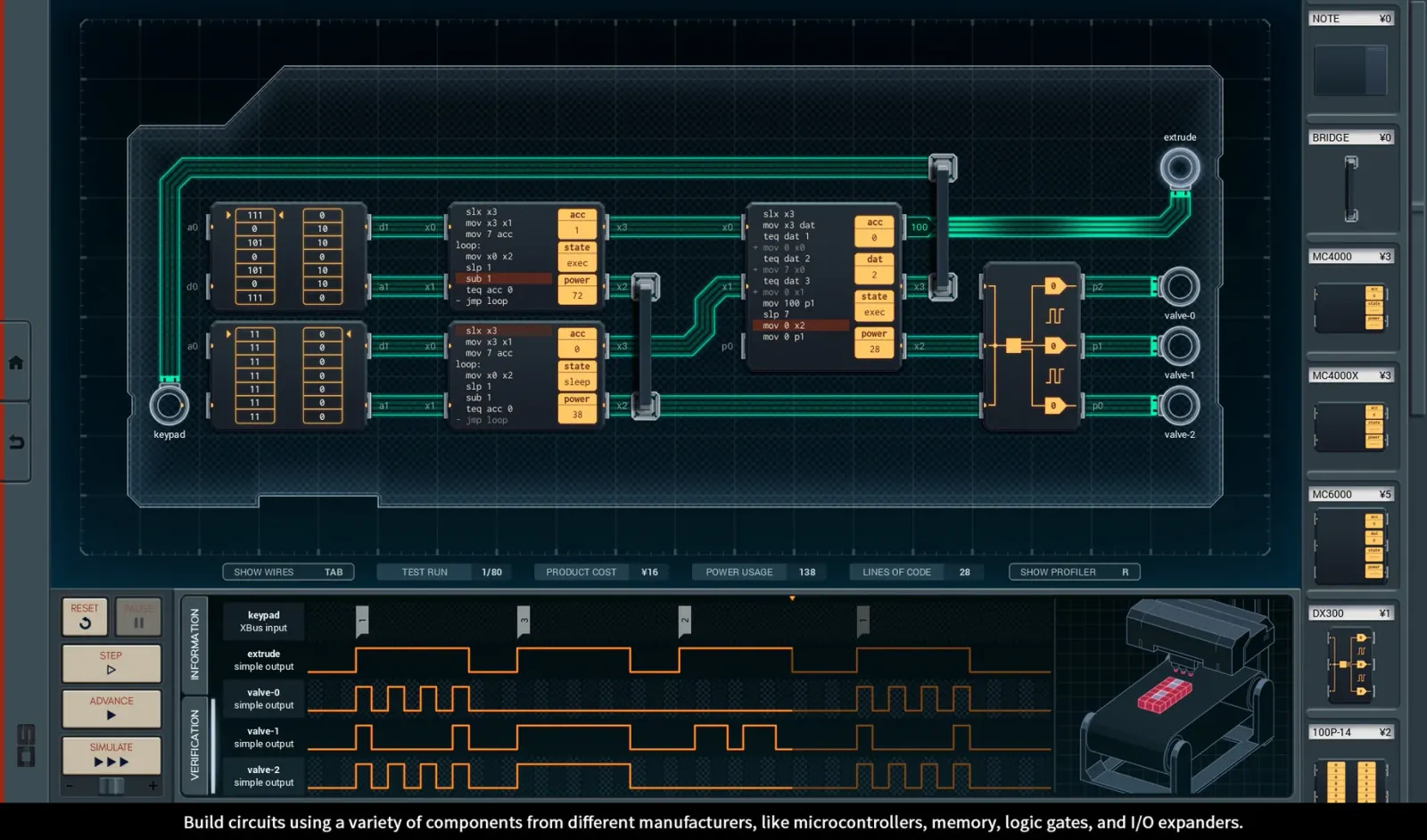
Players write compact instruction sets for virtual agents, test failures, split tasks across multiple bots, and refine solutions for correctness, speed, or elegance.
Why it may be useful
Writing and debugging short assembly-style programs to break into fictional systems is real decomposition and debugging practice. Registers, conditional jumps and race conditions carry into an actual systems or assembly course, though the syntax itself does not.
Written 2026-09-15 · editorial assessment, not a measured effect · how we rate →
What the game is
EXAPUNKS is a programming puzzle game from Zachtronics, released on Steam in October 2018. It is set in an alternate 1997 where you are a former hacker infected with a disease called the phage, which slowly turns your body into machinery. A supplier trades one dose of medicine for one hack. The fiction is a frame for the real object on screen: a diagram of connected machines, and a text editor where you write short programs.
Those programs run on EXAs, small agents that move between machines, read and write files, and pass values to each other. Each puzzle names a target, from a bank or a university to a highway sign, a games console or your own bloodstream, and a goal such as copying a file out or changing a value. Instead of a tutorial, the game hands you issues of TRASH WORLD NEWS, a photocopied in-game hacker magazine that teaches the instruction set. Around the campaign sit a solitaire game, an arcade puzzle called HACK*MATCH, a fictional handheld you can write homebrew for, and matches where your program runs against a friend's.
What you actually do
You write assembly-style programs a few lines long: copy a value, add two numbers, test a condition, jump, link to the next machine, or clone the agent that is running. Then you press run and watch every agent step through its code at the same time. Most puzzles need two or more agents cooperating, which means they collide, deadlock, or arrive in the wrong order, and the fix usually comes from reading the trace rather than starting again. When a solution finally works, the game shows histograms of your cycle count, instruction count and traffic against other players', which turns a solved puzzle into an optimization problem you can return to.
What it exercises
Writes short programs in an assembly-style instruction set with registers and jumps.
Debugs by stepping through a running program and finding where it diverged.
Splits one task across several agents that must not collide or deadlock.
Rewrites a working solution to use fewer cycles or fewer instructions.
Reads dense technical documentation and turns it into a working procedure.
Why we rate it High Worksheet score 84 / 100
FitHow much real knowledge or skill does the play itself make you use?85weight 45%
Fit is 85. There is no quiz layer and no credit for effort: the only way forward is to write a correct program and make it run, so decomposition, control flow and debugging are literally the moves of the game rather than a lesson attached to it. It falls short of the very top because the instruction set and machine model are Zachtronics' own invention, not a real production language.
TransferWill what you practise here work outside the game?76weight 30%
Transfer is 76, high for a puzzle game. The instruction set is invented, but registers, conditional jumps, loops, concurrency and race conditions are exactly what a first systems or assembly course covers, and someone who has fought a deadlock here recognizes one later. What does not carry over is syntax, libraries, or how to structure a whole real-world program, which is why this stops short of the top band.
PracticeDoes the game make you use that skill again and again, as it gets harder?90weight 25%
Practice is 90, near the top of the scale. Dozens of puzzles reuse the same instruction set, and the optimization histograms invite going back to solutions that already work to shave off cycles or instructions. The solitaire game, HACK*MATCH and the head-to-head battles add still more hours on the same mental machinery, which is why this sits close to the ceiling even though the puzzles are finite.
Where it has been used in teaching
Documented cases of this game being used with learners. Each one links to its source.
School programZachtronics · Secondary school
Zachtronics offers free institutional licenses for EXAPUNKS, alongside eight other Zachtronics titles, to public schools and school-like nonprofits for installation on school-owned computers; the developer notes the games need instructor scaffolding and does not report how many schools use the program.
Practice-backedNo published study, but people who answer for the outcome use it: schools, clinics, museums, research labs.
Evidence here is Practice-backed. Zachtronics runs a program called Zachademics, offering free institutional licenses for EXAPUNKS and eight other Zachtronics titles to public schools and school-like nonprofits, for installation on school-owned computers, though the developer notes the games need instructor scaffolding and does not report how many schools actually use them. No study has looked at EXAPUNKS or at Zachtronics puzzle games as a group, so nothing here rests on a measured outcome. What is structural is that the game requires writing, running, tracing and revising real programs, the same actions a beginning programmer performs. Whether that practice makes anyone better at writing real software is untested. The Steam listing supports the October 2018 release and the strongly positive reception.
Editorial assessment - not a measured scientific effect.
Fit
85/100
Transfer
76/100
Practice
90/100
Why it makes the cut
It is a strong hacking-flavored puzzle game even before any transfer claim is attached.
Practice-backed
Practice-backed: Zachtronics offers free institutional licenses for EXAPUNKS to public schools through its Zachademics program, though the developer notes the games need instructor scaffolding and does not report how many schools use it.
Prices are US store listings in USD, last refreshed 2026-09-28; regional prices and sales differ.
Single-player play is supported.
The game assumes comfort with reading dense instructions, pseudo-code thinking, and iterative debugging.
Age guidance
Ages 15+
Topics
STEM, Logic & strategy
Play styles
Single-player, Puzzle
Tags
Programming logic · Debugging · Optimization
It sits high because decomposition, control flow and debugging are literally the moves of the game, and registers, jumps and race conditions map onto real systems programming, though the syntax and story stay entirely invented.