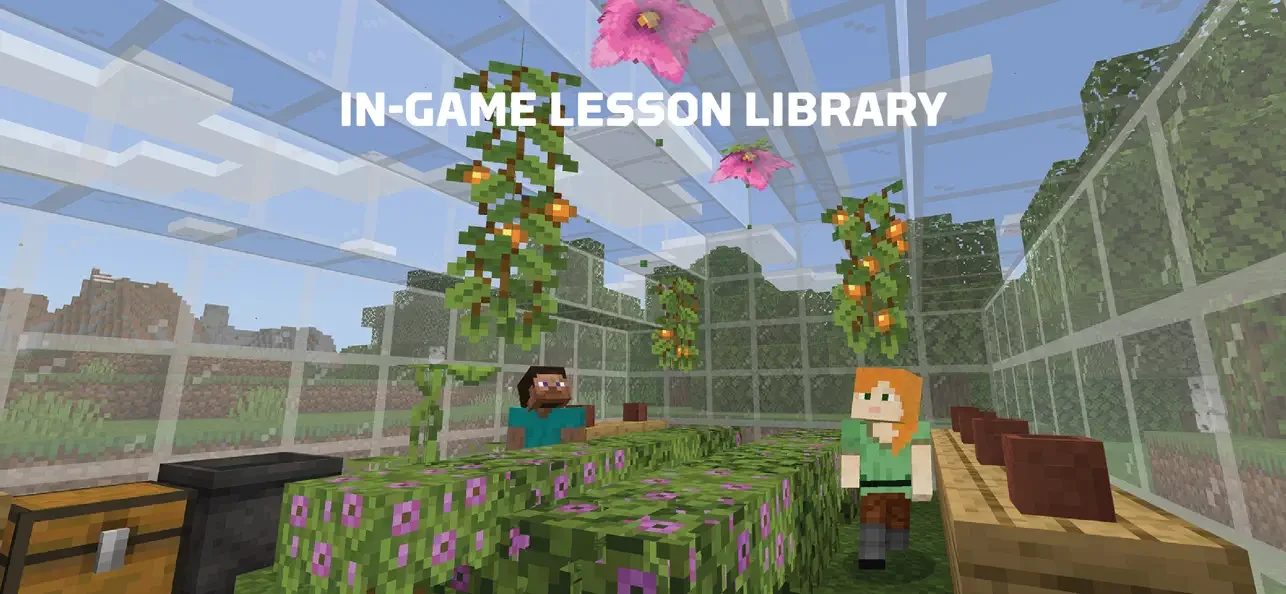
Players mine and gather materials, craft tools, build structures block by block, farm, explore caves and fight creatures at night, alone or with friends; Creative mode removes survival pressure, and redstone circuits let them wire doors, traps and simple machines.
Why it may be useful
Building spatially in a three-dimensional world and planning resource chains give you long, self-directed practice in spatial reasoning and systems thinking, though the clearest measured research is on the separate school edition and shows only modest, uneven gains.
Used in teaching
3 documented cases ↓Dublin City University, with Technological University of the Shannon Midwest and Microsoft Ireland · Murdoch University (Perth), with two Perth metropolitan secondary schools
Keep in mind
A large randomized trial of the school edition found no overall spatial-thinking gain, and the consumer game itself absorbs enormous amounts of time with no natural stopping point.
Written 2026-09-15 · editorial assessment, not a measured effect · how we rate →
What the game is
Minecraft is the block-building sandbox that Mojang released in 2011 and that Microsoft now owns. The world is made of cubic blocks of stone, dirt, wood and ore, generated endlessly in every direction, and almost every block can be broken, carried and placed somewhere else. There is no plot and no ending you are pushed toward; there is a world and a set of consistent rules.
Two ways of playing come in the box. In Survival you start with nothing, punch a tree for wood, craft a pickaxe, and try to build shelter before night brings zombies and skeletons. Hunger, health and daylight all matter. In Creative you have every block, you fly, and nothing can hurt you, so the game becomes pure construction. Between them sits redstone, an in-game wiring system of dust, levers, pistons and repeaters that lets players build doors, traps, elevators and working calculators.
It runs on phones, tablets, PCs and consoles, is paid on every platform, and players can play together on shared worlds or public servers. This entry covers the consumer game; Minecraft Education is a separate school product with its own page. The consumer version also carries an in-game Marketplace selling skins, worlds and texture packs for a virtual currency.
What you actually do
A first Survival evening is a scramble: gather wood, make a crafting table, make tools, dig into a hillside, block the door. After that the game becomes whatever the player decides it is. Some set up farms and mine for diamonds. Some spend months on a castle. Some dig to bedrock, some breed animals, some go after the ender dragon, some build machines out of redstone that open a hidden staircase.
The loop underneath all of it is the same: notice a limitation, work out what resource would remove it, plan the chain of steps to get that resource, and build. Difficulty is self-set, which is the game's great strength and its risk. Getting better looks like planning further ahead, from one shelter to a supply chain, and from placing blocks by hand to designing a system that does the work.
What it exercises
Builds and navigates in a three-dimensional world, including underground and at scale
Plans a chain of steps to reach a resource that is several stages away
Wires simple logic with redstone and debugs it when the circuit misfires
Manages limited inventory and decides what is worth carrying
Coordinates a shared build with other players, including who does what
Why we rate it Moderate Worksheet score 57 / 100
FitHow much real knowledge or skill does the play itself make you use?50weight 45%
Fit is scored 50 because building, planning and redstone wiring are the game itself rather than an add-on, and the world responds to a player's own goals rather than to set tasks. It sits at the middle of the scale because self-direction cuts both ways: a player can spend a hundred hours in Minecraft and mostly wander, dig and chat without ever getting into the deeper systems.
TransferWill what you practise here work outside the game?45weight 30%
Transfer is scored 45 because the plausible gains, spatial reasoning, planning, collaboration, are exactly the ones the measured research treats most cautiously: a large randomized trial of a Minecraft Education program found no overall improvement in spatial thinking, and reviews describe a broadly positive but uneven and mixed body of work. That uncertainty is why the score sits below what the mechanics alone would suggest.
PracticeDoes the game make you use that skill again and again, as it gets harder?85weight 25%
Practice is scored 85, the highest axis, because nothing else in this catalog is returned to as often or for as long: a player comes back to the same building, planning and problem-solving hundreds of times across years, and the world keeps generating new terrain and new reasons to plan. Almost nothing here caps the repetition, which is why the axis sits near the top of the scale.
Where it has been used in teaching
Documented cases of this game being used with learners. Each one links to its source.
StudyDublin City University, with Technological University of the Shannon Midwest and Microsoft Ireland · Mixed ages · 2025
Researchers systematically reviewed 29 pre-post intervention studies (through February 2024) of Minecraft used with children, adolescents and young adults, finding positive but bias-prone evidence for gains in spatial thinking, creativity, critical thinking, mathematics, science and language.
StudyMurdoch University (Perth), with two Perth metropolitan secondary schools · Secondary school · 2015
Researchers Megan and Grant Pusey trialled MinecraftEdu, a classroom mod of Minecraft, in three science classes of 13- to 14-year-olds at two Perth secondary schools alongside regular teaching; student surveys showed more interest in science and classroom ICT afterwards.
StudyUniversity of Agder and Sámi University of Applied Sciences, Norway · Mixed ages · 2024
University of Agder and the Sámi University of Applied Sciences studied 17 pre-service teachers in a Sámi teacher-education program who used Minecraft during classroom practice periods with primary pupils, for Sámi-language and cultural instruction. The study reports on their preparedness and experiences, not measured learning outcomes.
Research-backedPublished research has studied this game, or the exact mechanic it is built on.
The evidence level is Research-backed, meaning outcomes have been measured, not that they came out well. A cluster-randomized trial with 885 primary pupils tested a Minecraft Education spatial-thinking program and found no overall gain, though a mixed-methods side reported engagement and some subgroup signals. A 2025 systematic review of 29 studies describes a broadly positive but uneven, methodologically mixed body of work. Two smaller classroom studies add detail, not certainty: Australian teachers using a classroom Minecraft mod with thirteen and fourteen year olds reported more interest in science, and Norwegian researchers studied student teachers using Minecraft in practice sessions without measuring pupil outcomes. Most of this concerns structured classroom use, not a player building at home, so treat the score as an honest research record, not proof of an outcome.
Editorial assessment - not a measured scientific effect.
Fit
50/100
Transfer
45/100
Practice
85/100
Why it makes the cut
The best-selling video game ever, played for the joy of building and surviving; its educational uses came after the fact.
Research-backed
Research-backed: a cluster-randomised trial of 885 pupils found no overall spatial-thinking gain from a Minecraft Education program, and a 2025 systematic review of 29 studies together with individual classroom studies report broadly positive but mixed-quality findings across spatial, creative and academic measures.
Prices are US store listings in USD, last refreshed 2026-09-25; regional prices and sales differ.
This record covers the consumer game (Bedrock Edition on phones and tablets). Minecraft Education is a separate, school-oriented product with its own record.
It settles in the middle because the world responds to a player's own goals rather than set tasks, and the measured research on its plausible benefits is genuinely mixed.