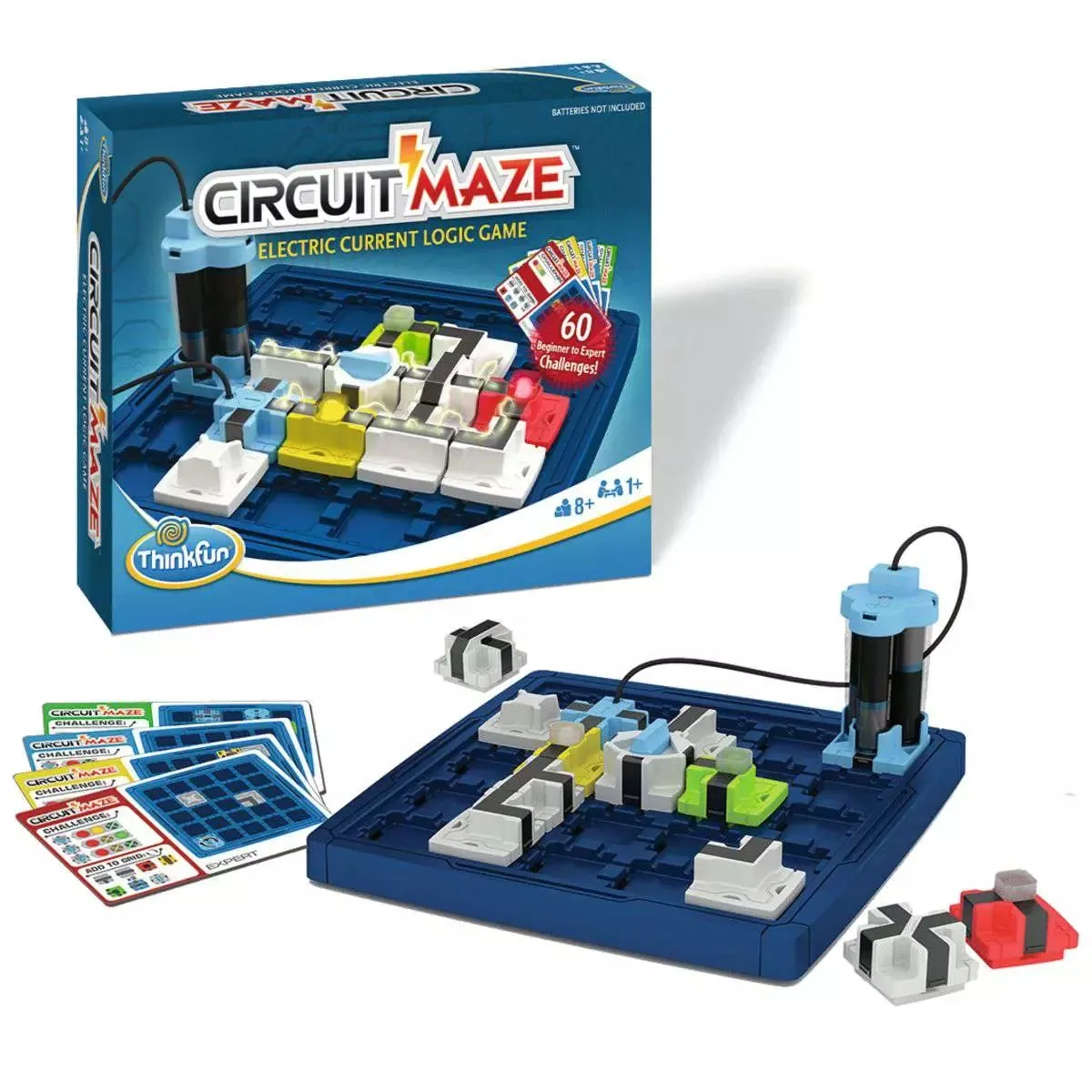
A challenge card shows a grid with some tokens already placed and tells you which extra pieces to add. You set them out, work out where the mirrors, beam splitters, the double mirror, the checkpoint and the cell blocker have to go, then switch on the laser tower and see whether the beam reaches every target.
Why it may be useful
Reflection stops being a diagram and becomes something you aim: a real beam of light gives immediate, physical confirmation that the angle in equals the angle out. Beam splitters push you to plan two paths from one source, a real if narrow slice of optics.
Keep in mind
It is a single-player puzzle with a real, if low-powered, laser, so players need the same rule as with any laser pointer: never aim it at anyone's eyes.
Written 2026-09-15 · editorial assessment, not a measured effect · how we rate →
What the game is
Laser Maze is a single-player logic puzzle from ThinkFun, now a Ravensburger brand. The box holds a white plastic game grid, sixty challenge cards running from beginner to expert with solutions on the back, and eleven tokens: one laser, five target mirrors, two beam splitters, one double mirror, one checkpoint and one cell blocker. Two LR44 batteries are included, and the publisher lists it for ages eight to ninety-nine.
Everything happens on a small tray on a table. Tokens sit on raised squares and can be rotated to face any of four directions. The laser is a genuine low-power light source, so when you press the button a visible red beam crosses the grid and bounces. The publisher notes it as a winner of a Good Housekeeping Best Toys award. A challenge takes a few minutes, which makes it a good after-school or waiting-room puzzle rather than an evening's activity.
What you actually do
You set the grid up as the card shows, then look at the pieces the card tells you to add. The question is always where they go and which way they face. You trace the beam in your head from the laser, following each reflection, until you have a path that reaches every target the card demands. Then you press the button and find out. Beam splitters are where it gets interesting, because one beam becomes two and both have to arrive somewhere useful. The expert cards give fewer clues and more pieces, so the search space grows and guessing stops working.
What it exercises
Predicts a reflected path before switching the laser on
Rotates a piece mentally to see where its face will point
Follows two beams at once after a splitter divides the light
Works backward from a target to find the reflection it needs
Checks a full solution before testing it
Why we rate it Moderate Worksheet score 55 / 100
FitHow much real knowledge or skill does the play itself make you use?58weight 45%
Fit lands at 58. A wrong guess is not judged by a rule but by whether the beam physically arrives, which is unusually direct feedback for a puzzle. It stays in the middle of the range because the underlying skill is narrow: predicting one kind of reflection on a fixed right-angle grid, not optics more broadly.
TransferWill what you practise here work outside the game?52weight 30%
Transfer sits at 52. Reflection and straight-line propagation are standard science-curriculum ideas, and having aimed a real beam gives those words something concrete to attach to. What does not travel as far is the puzzle-solving itself, which is spatial reasoning that generalizes mostly to similar grid puzzles rather than to optics as a subject.
PracticeDoes the game make you use that skill again and again, as it gets harder?55weight 25%
Practice reaches 55. Sixty graded cards exercise the same reasoning many times over, and the difficulty rises smoothly from beginner to expert. It settles here rather than higher because the challenges are fixed and finite: once all sixty are solved there is no built-in way to generate more.
What the evidence says
Editorial onlyNobody outside our desk has checked this. It is our reading of how the game plays.
The evidence level here is editorial only. The single source is the publisher's product page, which confirms the component list, the sixty challenge cards across four difficulty levels, the stated age range, the single-player count, the included batteries and a Good Housekeeping award mentioned in the description. It also makes a general claim about encouraging critical thinking, which we treat as marketing rather than evidence. No study of this puzzle exists that we could find, so the rating rests on the fact that feedback here comes from real reflected light rather than from any rule the game states.
Editorial assessment - not a measured scientific effect.
Fit
58/100
Transfer
52/100
Practice
55/100
Why it makes the cut
Players pick it up because switching the laser on and seeing the beam bounce is satisfying in itself, which is why it has stayed on shop shelves for years.
Editorial only
This rating is editorial only, checked against the publisher's own product page, which lists the components, the age range and the sixty graded challenges but makes no measured claim; the assessment rests on the fact that feedback here comes from real reflected light.
ThinkFun is now a Ravensburger brand. Two LR44 batteries are included.
Laser Maze Junior uses a safer light source and easier cards for younger children.
Age guidance
Ages 8+
Topics
STEM, Logic & strategy
Play styles
Single-player, Puzzle
Tags
1 player · 60 challenges · Optics · Batteries included
A wrong arrangement is not marked wrong by a rule; the beam simply misses and shows the actual path it took, which is about as direct a feedback loop as a physical puzzle can offer.