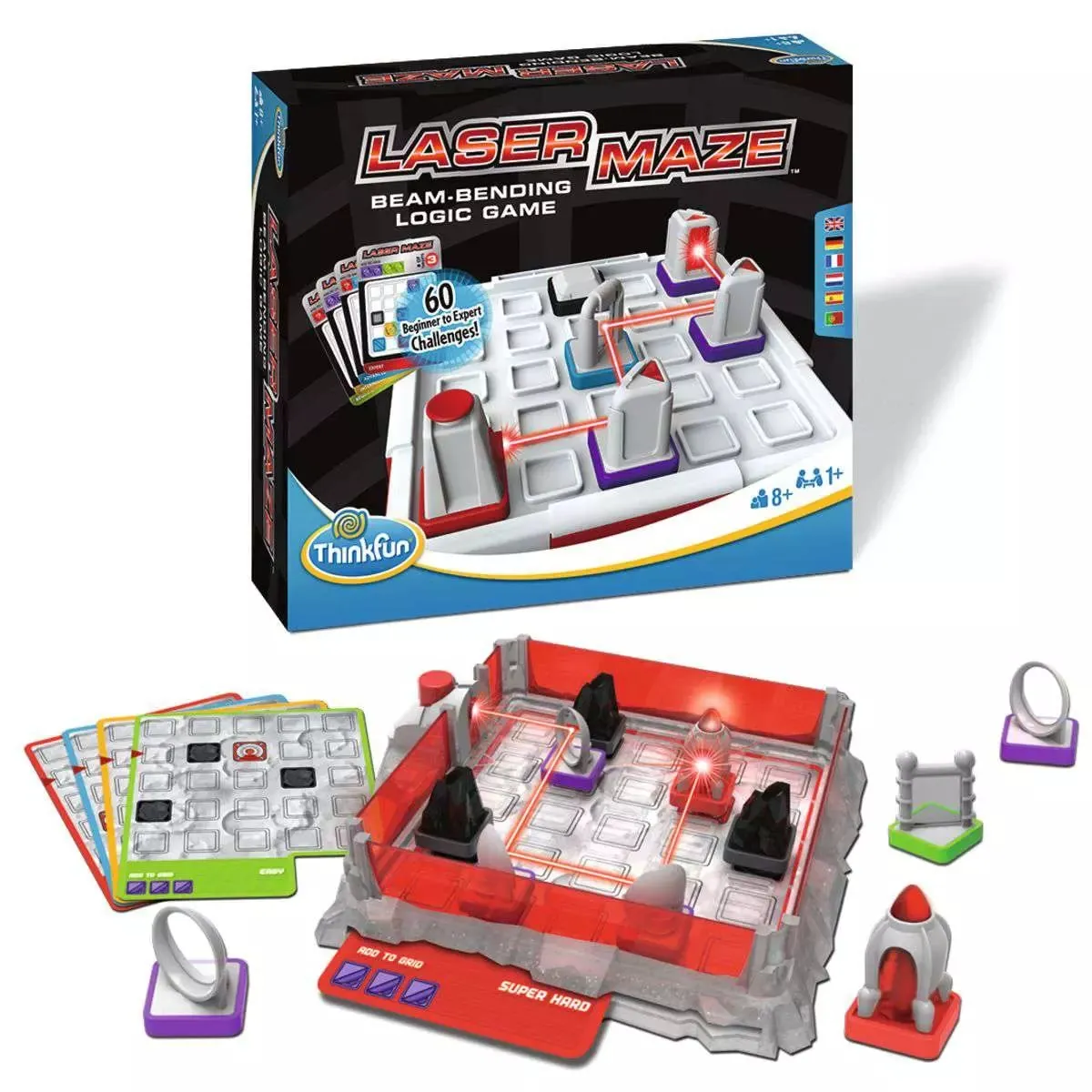
You set the grid up as a challenge card shows, then add the tokens it gives you: straights, corners, T-shapes, bridges, a switch and a blocker. When the layout forms a complete path from the power supply through the right beacons and back, the beacons light up. If it does not, nothing happens and you look for the break.
Why it may be useful
You learn that current needs a complete loop to do anything, handling series paths, parallel paths and a switch with your own hands rather than a diagram. It is a solid first physics lesson, not a path into real electronics.
Keep in mind
It is a single-player puzzle with sixty fixed challenges and needs three AAA batteries that are not in the box, so the first evening can end before it starts.
Written 2026-09-15 · editorial assessment, not a measured effect · how we rate →
What the game is
Circuit Maze is a single-player logic puzzle from ThinkFun, now part of Ravensburger. The publisher describes the goal as arranging tokens to create a real circuit that lights up colored beacons, and lists it for one player aged eight to ninety-nine with sixty challenges from beginner to expert.
The box contains a blue plastic game grid, the sixty challenge cards with solutions, instructions, and a set of tokens: a two-part power supply that holds the batteries, three LED beacons, straights, bridges, double corners, T-shapes, corners, a switch and a blocker. Three AAA batteries are needed and are not supplied. Everything sits on a table and takes a few minutes to set up. A challenge is short, so it suits a rainy afternoon or a stretch of quiet time rather than a whole evening.
What you actually do
You place the pieces the card starts you with, then work out where the remaining tokens go so that current can leave the power supply, pass through the beacons the card names, and return. The pieces are shaped paths, so the puzzle is partly spatial, but the constraint is electrical: a route that reaches a beacon but has no way back does nothing. Later cards add the switch and the blocker and demand that only some beacons light, which forces a player to think about which parts of the circuit are on the same path. The grid is the marker, since a correct layout lights up and a wrong one stays dark.
What it exercises
Traces a complete path from the power source through a load and back
Distinguishes a route that looks joined from one that actually conducts
Uses a switch to open and close part of a circuit deliberately
Works out which components share a path and which are on separate ones
Checks a layout methodically instead of swapping pieces at random
Why we rate it Moderate Worksheet score 59 / 100
FitHow much real knowledge or skill does the play itself make you use?62weight 45%
Scored 62 because the electricity itself checks your work: a complete circuit lights up and an incomplete one stays dark, with no answer key to consult while you play. That is real feedback from real current. It stays in the moderate band because the tokens reduce a circuit to a handful of shaped levers you snap together, closer to a mechanical puzzle than to actually building or measuring one.
TransferWill what you practise here work outside the game?58weight 30%
Scored 58. Understanding that a circuit needs a complete loop is genuinely useful groundwork for a first electricity lesson, and doing it with your hands at eight makes the classroom version land sooner. The score stays in the middle of the range because voltage, resistance and current as measurable quantities never appear, so what carries over is one core idea, not a working vocabulary of electronics.
PracticeDoes the game make you use that skill again and again, as it gets harder?55weight 25%
Scored 55. Sixty graded challenges repeat the same electrical reasoning at rising difficulty, which is real practice, but the set is fixed: once you finish it there is no generator for new challenges, and free building is capped by how many tokens the box includes. The practice runs out well before the underlying skill would need it to.
What the evidence says
Editorial onlyNobody outside our desk has checked this. It is our reading of how the game plays.
This is Editorial only: the single source is the publisher's own product page, checked on 10 September 2026. It confirms the component list, the sixty beginner-to-expert challenges with solutions, the stated age range of eight to ninety-nine, the single-player count, and the description of the goal as building a real electrical circuit. The page also calls it a wonderful introduction to electrical engineering, which is marketing rather than evidence. No independent study of this puzzle exists, so the rating rests on the observable fact that a real circuit either conducts or it does not.
Editorial assessment - not a measured scientific effect.
Fit
62/100
Transfer
58/100
Practice
55/100
Why it makes the cut
The reward is a beacon lighting up on your table, and players rearrange the pieces for the pleasure of that moment rather than to be told they are right.
Editorial only
This is our own reading of the mechanics, checked against the publisher's product page, which confirms the components, the age range and the sixty graded challenges. No independent study of this puzzle exists.
ThinkFun is now a Ravensburger brand. Three AAA batteries are required and are not included.
Age guidance
Ages 8+
Topics
STEM, Logic & strategy
Play styles
Single-player, Puzzle
Tags
1 player · 60 challenges · Electricity · Batteries not included
Real current through real components marks your work by lighting up or staying dark, though the lesson stays narrow and the challenge set is fixed and finite.