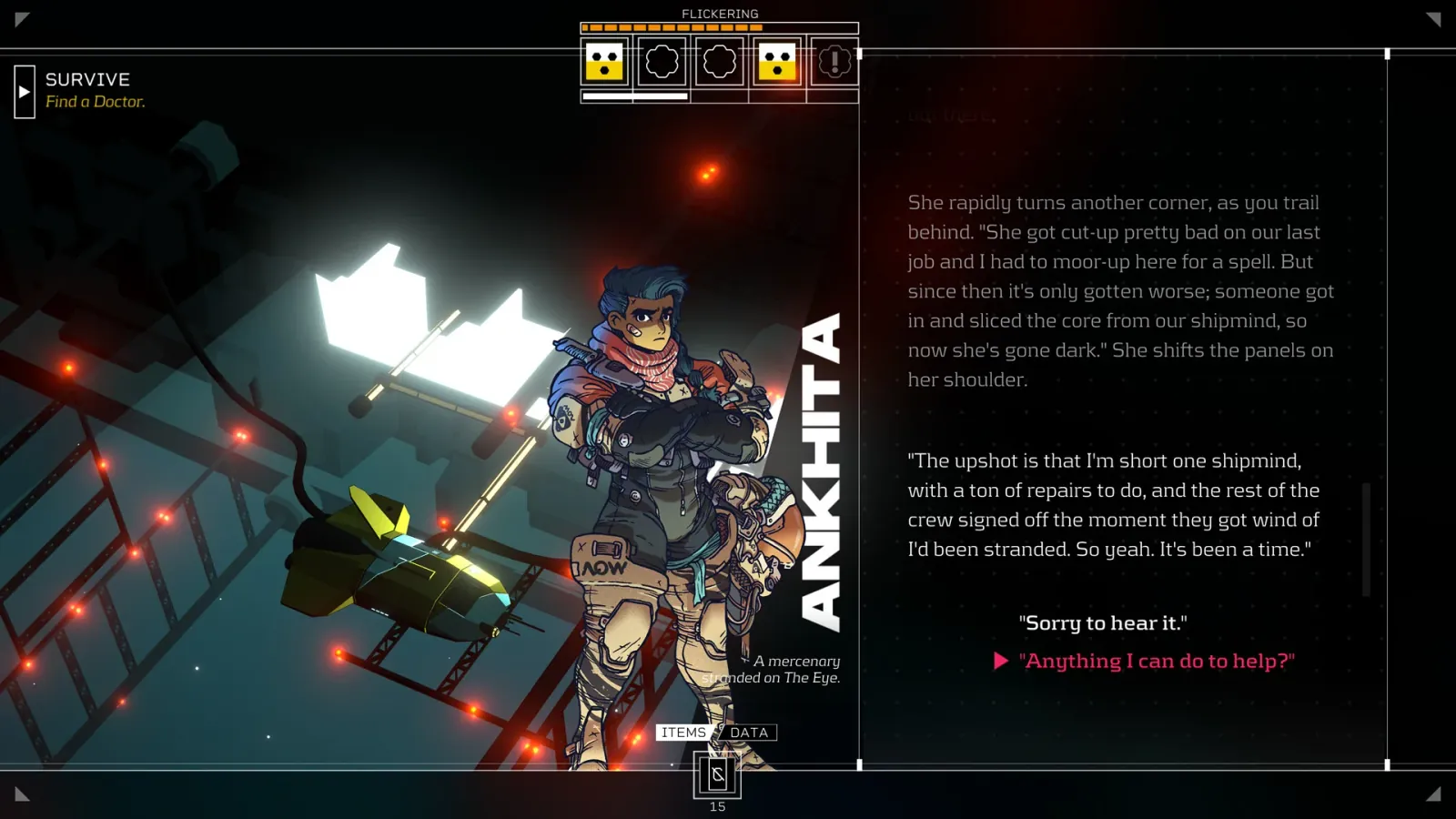
Players steer, shoot, shield, and manage engines from different stations inside one shared ship while rescuing creatures and improvising around enemy pressure.
Why it may be useful
More stations than people is a hard constraint, so every second of play is a decision about who covers what, and calling out a role change under pressure is genuine coordination practice. The pressure is artificial and short, so a group never has to sustain a plan for long.
Keep in mind
The coordination is real, but solo play, driven by a computer-controlled pet, is a compromise version that loses most of the point.
Written 2026-09-15 · editorial assessment, not a measured effect · how we rate →
What the game is
Lovers in a Dangerous Spacetime is a couch co-op action game released in September 2015 by Asteroid Base. You and up to three other people share one spaceship, and the ship is drawn as a cutaway: a big neon circle with rooms inside it, all visible at the same time.
Each room is a station. Four turrets sit around the rim, a shield can be pointed at one side, a map console shows where to go, and a wheel steers the whole ship. Only one person can use a station at a time, and there are always fewer of you than there are jobs, so somebody has to leave a gun to raise the shield.
The ship flies through randomized levels, shooting through waves of enemies and rescuing small captured creatures. Steam lists one to four players, local shared-screen co-op with no online multiplayer, and a solo mode in which a computer-controlled space pet mans a second station. It is sold on Steam for PC and on the Nintendo eShop for Switch, in eleven languages.
What you actually do
Somebody shouts. That is the honest description. Enemies come from one direction, so one player spins the shield to cover it while another runs to the turret facing that way and a third holds the wheel and keeps the ship moving. Then something arrives from behind, and everybody has to move again.
The ship rewards a plan and punishes a fixed one. Handing out permanent jobs fails, because the threat rotates and the person on the far turret is useless for the next ten seconds. What works is calling out what you are doing and reading where the others are, so stations get covered without two people arriving at the same one. Levels are randomized, so the answer changes every run, and getting better looks like a group that talks less and covers more.
What it exercises
Calls out a change of role so a partner knows which station is free
Chooses which of several urgent tasks to do first under pressure
Tracks where teammates are and moves to where they are not
Reassigns roles mid-fight when the threat changes direction
Splits attention between a personal task and the state of the whole ship
Why we rate it Minimal Worksheet score 30 / 100
FitHow much real knowledge or skill does the play itself make you use?25weight 45%
Fit sits at 25. The coordination is enforced by the layout: one person per station, and more stations than people, is a hard constraint rather than a suggestion, so nothing about the game works if the group does not talk to each other. It stays low because there is no subject matter underneath the coordination, only fast action.
TransferWill what you practise here work outside the game?20weight 30%
Transfer sits at 20. Announcing what you are doing, choosing between two urgent things, and handing a job over cleanly are habits that matter well beyond a game, and they are practiced here under real pressure. The limit is that the pressure is artificial and short, so a group never has to sustain a plan for long, and little of it is likely to stick.
PracticeDoes the game make you use that skill again and again, as it gets harder?50weight 25%
Practice reaches 50. Levels are randomized, so the same coordination problem returns in a new arrangement every run, and a run is short enough to play several in one evening. A group's own shorthand does improve across sessions, but the challenge itself does not deepen, so the ceiling arrives once the pattern is familiar.
What the evidence says
Editorial onlyNobody outside our desk has checked this. It is our reading of how the game plays.
The evidence level here is editorial only. The two cited sources, the Steam page and Asteroid Base's studio site, confirm the 2015 release, the developer, the price, one to four players, local shared-screen co-op with no online multiplayer, solo play with a computer-controlled pet, randomized level layouts, the station-based ship and eleven listed languages. Neither addresses learning. We cite no study and know of none on this game. The rating rests on a structural fact rather than a claim: there are more stations than players, so a group must divide attention and hand jobs over, and there is no other route through the game.
Editorial assessment - not a measured scientific effect.
Fit
25/100
Transfer
20/100
Practice
50/100
Why it makes the cut
Managing one ship together is immediately game-first and highly replayable.
Editorial only
This rating is editorial only. The Steam page and Asteroid Base's studio site confirm what the game contains but say nothing about learning; the rating rests on a structural fact, more stations than players, rather than on any measured outcome.
Prices are US store listings in USD, last refreshed 2026-09-25; regional prices and sales differ.
Local co-op is a core supported way to play.
Solo play exists but requires switching between ship stations manually.
Steam currently verifies English, French, German, and Brazilian Portuguese. Spanish support for the planned site locales was not directly verified in this pass.
Age guidance
Ages 10+ · ESRB E10+
Topics
Mind & well-being
Play styles
Co-op, Multiplayer, Strategy
Tags
Couch co-op · Shared roles · Communication under pressure
One person per station, with more stations than people, is a hard layout constraint rather than a suggestion, so every second of play forces a real decision about who covers what and when to hand a job over.