What the game is
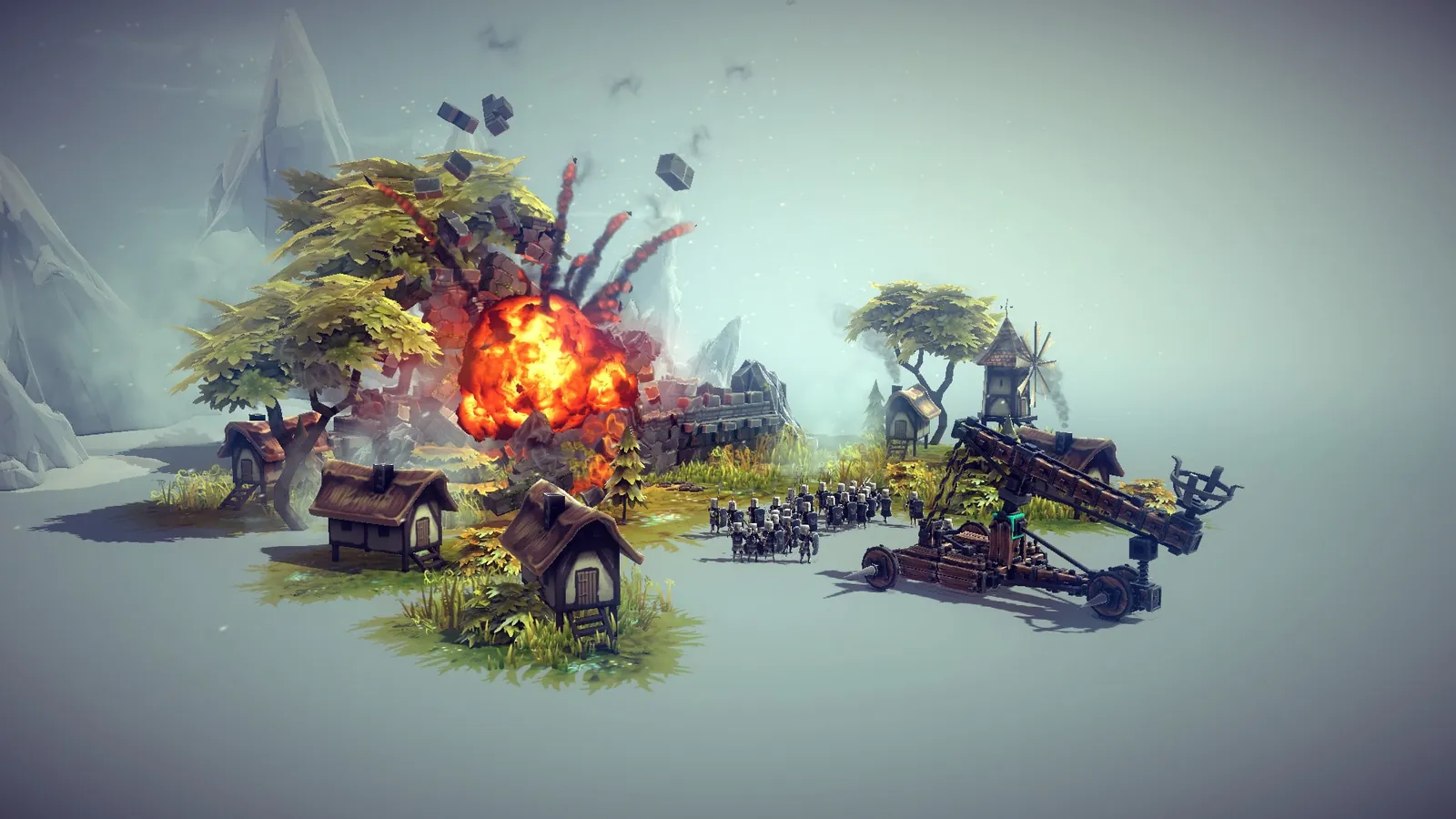
Main Assembly is a robot construction sandbox for Windows PCs, made by Bad Yolk Games and published by Team17. It entered Steam Early Access in June 2020 and reached its 1.0 release in January 2021. There is no story and no lessons. You get a workshop, a large catalog of blocks, wheels, hinges, servos, propellers and thrusters, and a physics simulation that will happily let your machine tip over.
The screen is a bright gridded hangar. On one side sits the parts palette, on the other a control panel where you bind each moving part to a key, a slider or a logic block; players who want more can drop into C# instead. A test button releases the finished machine into a world so you can watch what it actually does.
Around that workshop sit three ways to play: more than a hundred single-player challenges that set a task such as racing, climbing or hauling; a sandbox world builder for making your own obstacle courses and tracks; and Steam Workshop, where thousands of player-made robots and worlds can be downloaded and taken apart. Up to four players can build in the same world or compete in it.
What you actually do
You pick a challenge, look at what it demands, and start snapping parts onto a chassis. Then you decide how the machine is driven: which wheel turns with which key, how far a servo swings, whether a claw closes on a trigger. You press test, and usually it fails. It leans too far forward, the arm has no torque, the legs fight each other. You go back, move the weight, widen the base, slow the motor, and test again.
That build, test, diagnose, rebuild cycle is the whole game. Difficulty rises because later challenges ask for capabilities rather than speed: something that walks up steps, something that grips and lifts, something that stays airborne. Getting better looks like predicting the failure before you press test, and changing one thing at a time so you can tell what fixed it.
What it exercises
- Builds a machine to a stated requirement, then tests whether it actually meets it
- Traces a physical failure, tipping, torque or grip, back to a specific design choice
- Binds controls and simple logic to inputs so a machine responds predictably
- Changes one variable per test so the result of that change stays readable
- Reads another player's shared design and adapts it instead of starting over
Why we rate it Moderate Worksheet score 58 / 100
FitHow much real knowledge or skill does the play itself make you use?60weight 45%
Fit reaches 60. There is no quiz layer, no separate lesson mode and no way to skip the engineering; the sole route through a challenge is to design a machine, watch it fail in a physics simulation and revise it. It settles here rather than higher because the physics is tuned for play, a real domain reduced to a few workable levers.
TransferWill what you practise here work outside the game?50weight 30%
Transfer sits at 50 because what carries out is a habit rather than a body of knowledge. Players come away better at iterating, at expecting first attempts to fail, and at reasoning about balance and leverage by feel, but not with formulas, units or real components, and the physics is tuned for play rather than accuracy.
PracticeDoes the game make you use that skill again and again, as it gets harder?65weight 25%
Practice reaches 65 because the same loop repeats without any hard limit. More than a hundred challenges, a sandbox builder and a steady supply of community creations mean a player returns to designing, testing and revising many times over, with each run demanding something slightly different from the last.
What the evidence says
Editorial onlyNobody outside our desk has checked this. It is our reading of how the game plays.
The evidence level here is editorial only. The Steam store page confirms the developer, the publisher, the release dates, the price, the modes and the four-player cap, and that is all it establishes. No study of Main Assembly, or of physics-sandbox building generally, sits behind this rating. The Steam rating of Very Positive across roughly a thousand English reviews describes how players feel about the game, not whether it helps anyone design better. Our reading is editorial reasoning from the mechanics: a loop that forces prediction, testing and revision plausibly exercises those habits, but nothing here measures it.