You bolt blocks together into a machine: wheels, wooden beams, springs, steering hinges, ballistas, flamethrowers, balloons and wings. Then you drive or fly it at an objective. Everything is simulated, so an unbalanced catapult tips over, a long arm flexes and snaps, and a heavy machine sinks into soft ground.
Why it may be useful
The physics engine is an honest opponent: a taller siege tower runs into center of mass, a faster wheel runs into torque, and none of it is explained, only demonstrated. That intuition is genuine, though nothing marks where the real physics ends and the fantasy begins.
Used in teaching
1 documented case ↓University of Zagreb, Faculty of Electrical Engineering and Computing
Keep in mind
The campaign is about conquest: you destroy villages, burn windmills and crush soldiers who leave red splashes, which is cartoonish but is still killing people as the goal.
Written 2026-09-15 · editorial assessment, not a measured effect · how we rate →
What the game is
Besiege is a physics building game by the British team Spiderling Studios. It spent five years in early access and reached version 1.0 in February 2020 for Windows, macOS and Linux. It has more than fifty thousand Steam reviews and one of the highest ratings on the store.
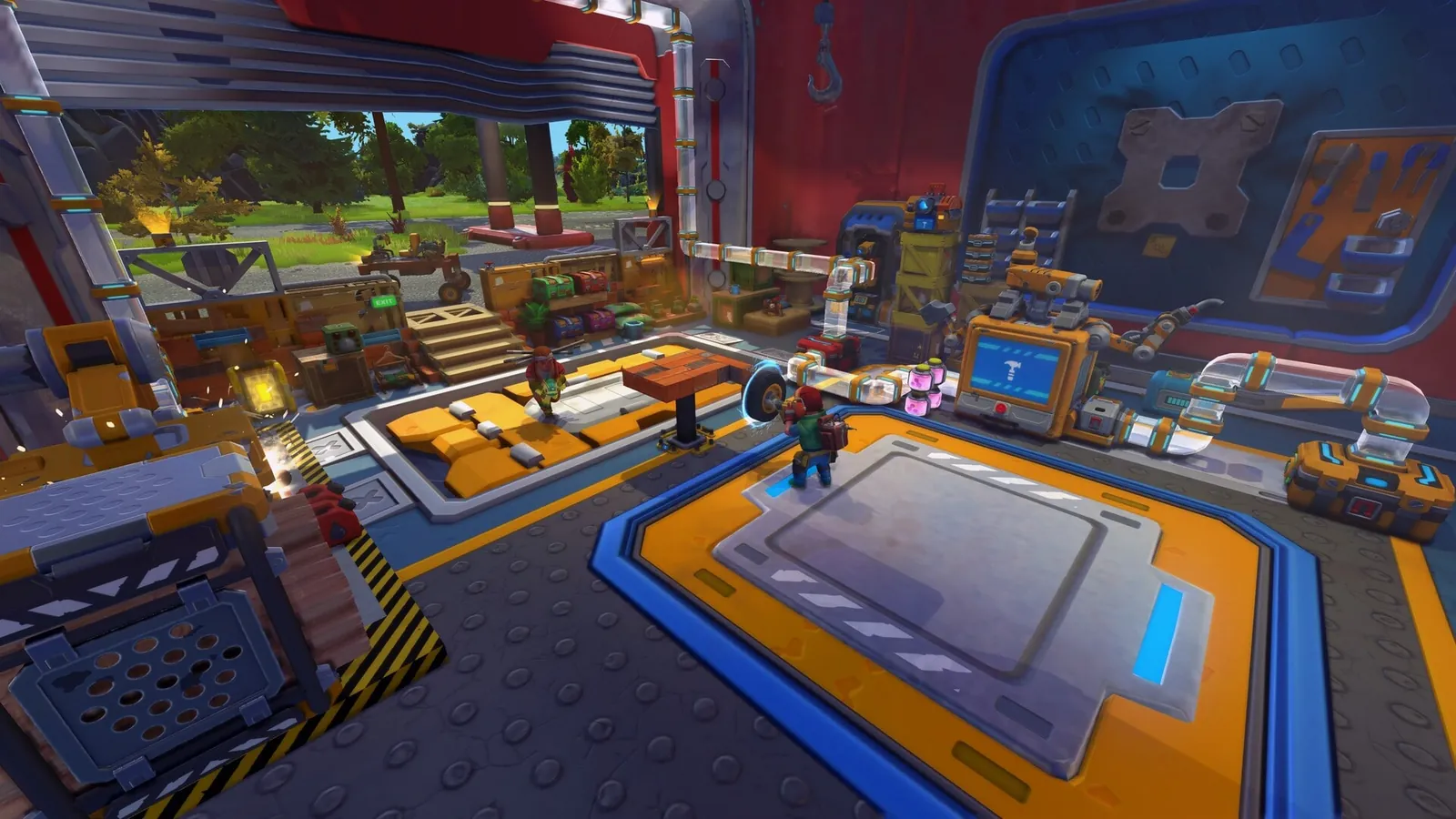
The look is a soft, low-polygon medieval island: pale mountains, thatched cottages, windmills, tiny armored soldiers. You build in a hangar view where a grid of more than seventy block types is laid out beside your machine, then you launch into a level and fly the camera behind your creation. Fifty-five campaign levels span four island nations, and there are large open sandbox maps with nothing to destroy at all. Steam Workshop holds hundreds of thousands of machines other players have shared, which many players treat as the real game.
What you actually do
You drag blocks onto a starting core and connect them: a chassis, wheels, a steering hinge, a spring-loaded arm, a counterweight. Then you press play and find out. A catapult with the pivot too high tips forward on the first shot; a long unbraced arm whips and shears off; a machine with all its weight at the back wheelies and flips. Each failure points at one thing, so you go back to the hangar and change it. Later levels set awkward constraints, a machine that must fly, or fit through a gap, or survive a fall, so a design that worked before has to be rethought rather than scaled up.
What it exercises
Notices how center of mass decides whether a machine tips
Braces a long member to stop it flexing and breaking
Trades weight against speed and stability when choosing parts
Diagnoses a failure by watching which joint gave way first
Redesigns a machine to meet a new constraint rather than enlarging it
Why we rate it Moderate Worksheet score 62 / 100
FitHow much real knowledge or skill does the play itself make you use?62weight 45%
Fit lands at 62 because the simulation genuinely decides every outcome: a machine works or falls apart according to mass, torque, and joint strength, so a working design is real physical reasoning. It scores only moderately because a large share of the challenge is trial and error rather than reasoning through a design before testing it.
TransferWill what you practise here work outside the game?50weight 30%
Transfer sits at 50, the middle of the three. The intuitions about balance and leverage are genuine and do carry over to how you look at real structures, but they stay wordless, and medieval fantasy parts, flamethrowers, balloons that act like magic, sit next to the real physics with no marker distinguishing one from the other.
PracticeDoes the game make you use that skill again and again, as it gets harder?75weight 25%
Practice is the strongest dimension at 75. Fifty-five campaign levels plus open sandboxes and an enormous Workshop library mean the build-test-fix cycle repeats without end, and later levels force a genuine redesign rather than a bigger version of what already worked. The only ceiling is that a player can also settle into copying other people's machines instead of designing.
Where it has been used in teaching
Documented cases of this game being used with learners. Each one links to its source.
StudyUniversity of Zagreb, Faculty of Electrical Engineering and Computing · University · 2024
Researchers at the University of Zagreb compared two student groups learning robotics design, one using physical educational robots and one using Besiege's virtual construction; a mixed-method evaluation with pre/post questionnaires assessed knowledge gains, engagement and problem-solving.
Research-backedPublished research has studied this game, or the exact mechanic it is built on.
The evidence level is Research-backed, resting on one study rather than a broad literature. Researchers at the University of Zagreb's Faculty of Electrical Engineering and Computing compared two student groups learning robotics design, one using physical educational robots and one building inside Besiege, with pre- and post-questionnaires measuring knowledge gains, engagement, and problem-solving. That is university students in one course, not a settled result, and one comparison rather than a body of research. The Steam listing and the developer's own site separately confirm the block count, the fifty-five-level campaign across four nations, the sandbox maps, multiplayer, and the size of the Workshop library the study's virtual condition drew on.
Editorial assessment - not a measured scientific effect.
Fit
62/100
Transfer
50/100
Practice
75/100
Why it makes the cut
The appeal is watching a contraption fall apart spectacularly, and the workshop holds hundreds of thousands of player-made machines built purely for entertainment.
Research-backed
Research-backed: researchers at the University of Zagreb compared students learning robotics design with physical robots against students using Besiege, with pre- and post-questionnaires measuring knowledge gains and problem-solving, which is a direct study of this game with learners.
View on Steam ↗Valve / Spiderling Studios · Checked 2026-09-10
Prices are US store listings in USD, last refreshed 2026-09-25; regional prices and sales differ.
Windows, macOS and Linux. Steam Workshop machines and levels are free and are where much of the building happens.
Age guidance
Ages 11+
Topics
STEM, Creativity
Play styles
Single-player, Multiplayer, Sandbox, Puzzle
Tags
Physics sandbox · Machine building · Cartoon violence · Workshop
Nothing here is scripted, so a working machine is physical reasoning that turned out right, but the intuition stays wordless, and nothing marks where real physics ends and the fantasy parts begin.