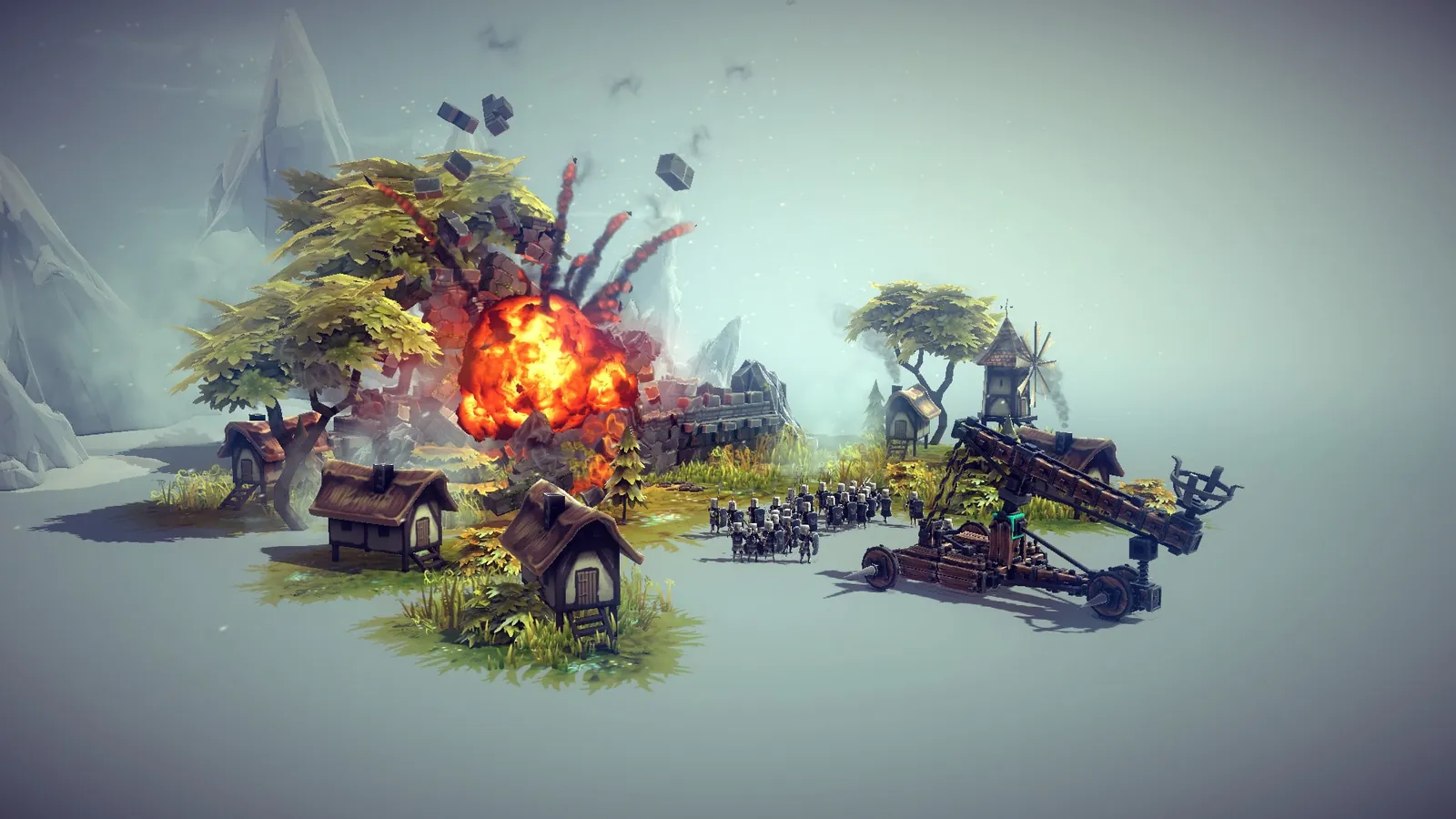
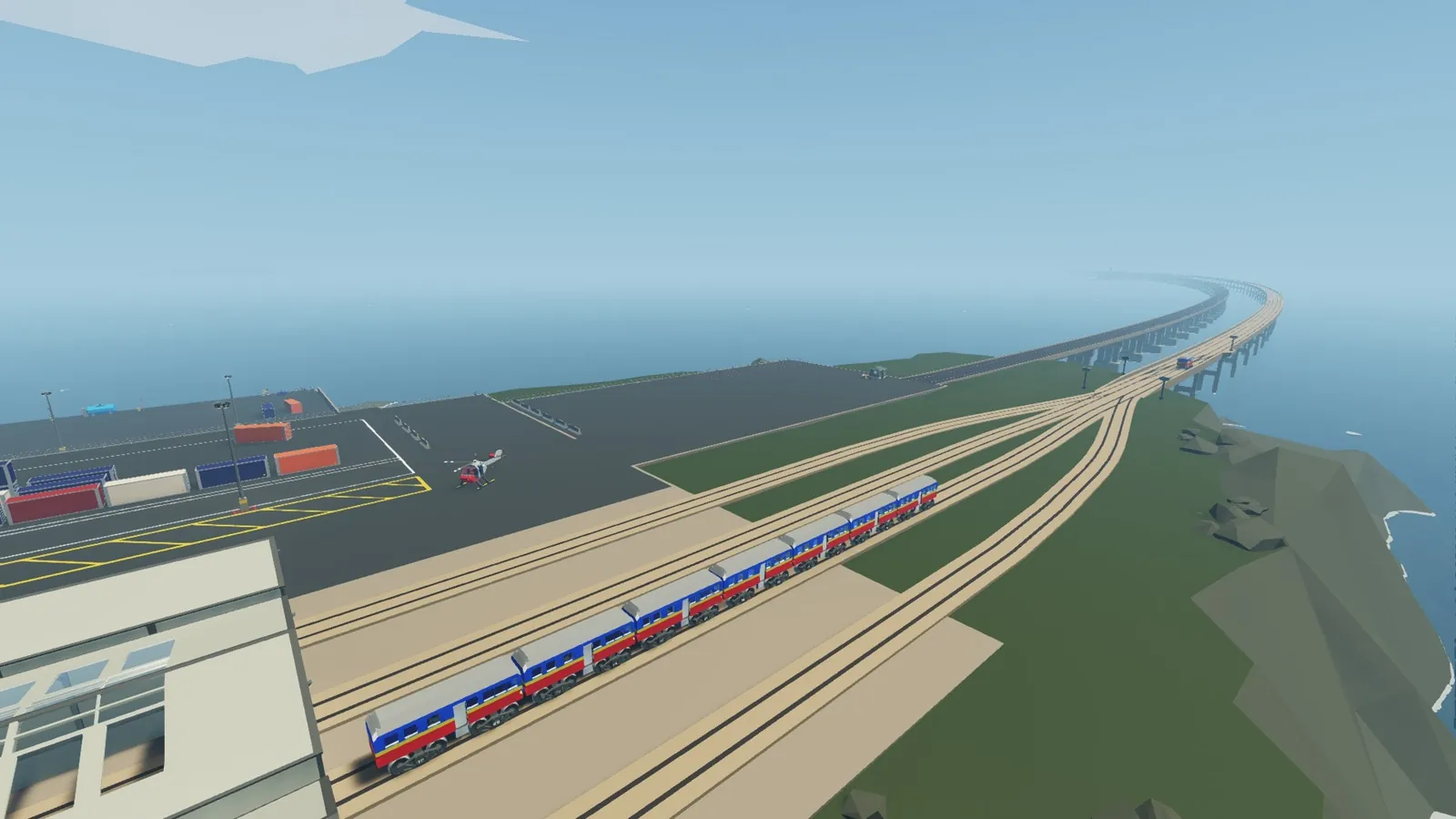
You connect blocks, bearings, pistons, engines, thrusters and controllers into machines, then drive them. A creative mode gives you every part immediately; a survival campaign makes you gather materials, farm and defend a base while hostile robots attack.
Why it may be useful
Bearings, pistons and logic gates are simple enough to wire a working mechanism in an afternoon, and the physics is strict enough that a badly balanced machine visibly fails. It is a short path from an idea to watching it move.
Keep in mind
The survival campaign is a combat game with shooting robots and a real chance of losing progress, and online play puts you in shared worlds with other people.
Written 2026-09-15 · editorial assessment, not a measured effect · how we rate →
What the game is
Scrap Mechanic is a building and survival sandbox by the Swedish studio Axolot Games. It launched into early access in 2016 and reached its full release in July 2026 for Windows. It has well over a hundred thousand Steam reviews and a long-standing following among younger players.
The art is bright and cartoonish: green fields, orange machinery, chunky characters in overalls. You play a mechanic stranded on a farming planet where the harvesting robots have turned hostile. Two modes share the same building system. Creative mode hands you every part and an empty world; survival mode makes you gather scrap, plant crops, fortify a garage and fight off raids. Building itself is done from the shoulder, walking around your machine with a welding tool, which is why players take to it faster than to grid-based builders.
What you actually do
You weld blocks into a frame, put bearings where you want rotation, attach an engine and a seat, and drive. When the vehicle rolls over on the first corner you move the weight lower. When the arm you built cannot lift a crate you swap a bearing for a piston. Controllers let you set speeds and directions, and logic gates let a button do several things at once, so machines gain a control layer without any text. In survival you also farm, mine and defend, which uses none of that reasoning but funds it. Getting better looks like fewer parts doing more work and machines that behave the same way twice.
What it exercises
Builds a mechanism from bearings, pistons and an engine that actually moves
Lowers a center of mass so a vehicle stops tipping
Wires simple logic gates so one input triggers several actions
Tests a machine, identifies the failing joint and replaces it
Works with another person on a shared construction
Why we rate it Moderate Worksheet score 56 / 100
FitHow much real knowledge or skill does the play itself make you use?55weight 45%
Fit scores 55. Creative mode is pure mechanism design and the physics is the judge, which is exactly the kind of direct feedback that makes a fit score high. It is held down because survival mode, where many players spend their time, is a farming and combat game that exercises none of it.
TransferWill what you practise here work outside the game?45weight 30%
Transfer scores 45. Intuition about rotation, leverage and balance is real and shows up in physical building later on. It stays in this band because that intuition remains wordless: the parts are game inventions, and nothing named or measurable, no formula, no vocabulary, carries across to a classroom or a workshop.
PracticeDoes the game make you use that skill again and again, as it gets harder?70weight 25%
Practice scores 70. There is no end to what can be built, the workshop supplies endless examples to copy and modify, and players return to the same balance and rotation problems with every new machine. What keeps it from the very top is that the underlying challenge does not really escalate; a tenth vehicle asks for the same reasoning as the second.
What the evidence says
Editorial onlyNobody outside our desk has checked this. It is our reading of how the game plays.
The single source is the Steam listing, checked on 10 September 2026, which confirms the creative and survival modes, the physics-based building system, online co-op, the level editor, the workshop, and the review figure quoted elsewhere on this page. It makes no educational claim, and we found no study of this game. The rating is our editorial reading. Mechanic fit is high for creative mode and lowered by survival mode, and transfer potential is deliberately modest because the game never names a single mechanical principle it relies on.
Editorial assessment - not a measured scientific effect.
Fit
55/100
Transfer
45/100
Practice
70/100
Why it makes the cut
It is a toy box first: the largest part of its audience builds ridiculous vehicles to share, and the game rewards that with tools rather than with marks.
Editorial only
This is our editorial reading of the mechanics, checked against the Steam listing. It makes no educational claim, and we found no study of this game.
Prices are US store listings in USD, last refreshed 2026-09-25; regional prices and sales differ.
Windows only. Steam Workshop creations and the level editor are free.
The game spent about ten years in early access before its full release in 2026.
Age guidance
Ages 10+
Topics
STEM, Creativity
Play styles
Single-player, Co-op, Sandbox, Creative
Tags
Machine building · Logic gates · Online co-op · Workshop
Creative mode is pure mechanism design, physics as judge, but survival mode, where many players spend their time, is a farming and combat game that exercises none of it.