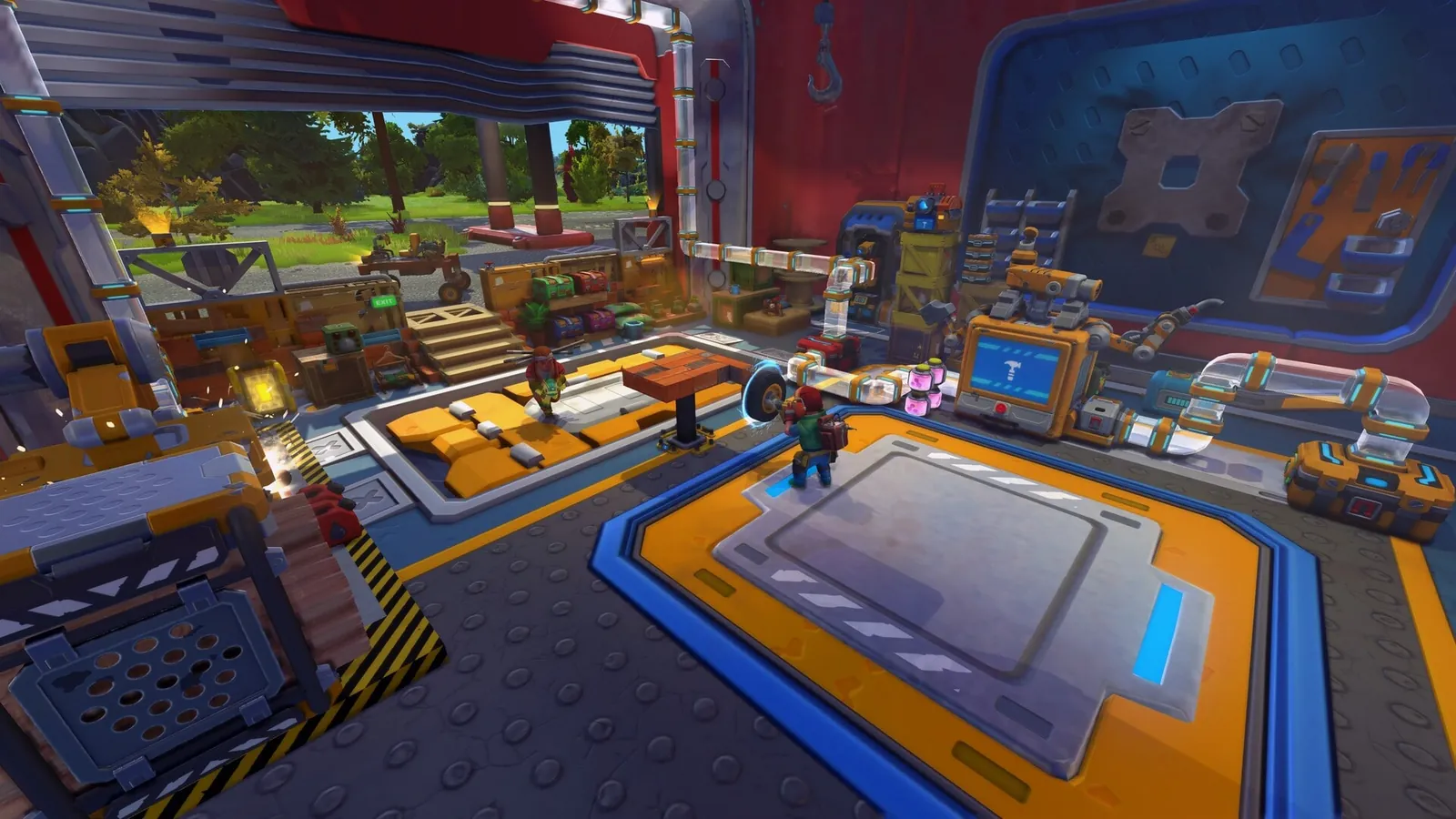
In the workbench you assemble a vehicle from blocks and components: a hull, an engine, a fuel tank, a gearbox, wiring, pumps, radiators, instruments. Then you take it out into an ocean world to answer distress calls, land on a pitching deck in a storm, pull people out of the water and get them to hospital.
Why it may be useful
A vehicle only works if its systems are correctly connected: an engine needs fuel, air, cooling and a drivetrain, and missing any one of them is immediately visible. That habit of tracing dependencies carries into real machines, though the specific parts are game-tuned.
Keep in mind
The learning curve is severe, many players spend their first hours building things that will not start, and rescue scenarios involve injured and drowning people.
Written 2026-09-15 · editorial assessment, not a measured effect · how we rate →
What the game is
Stormworks: Build and Rescue is a vehicle-engineering and rescue simulation by the British studio Geometa, released in September 2020 for Windows and macOS after two years in early access. It has around sixty thousand Steam reviews.
The world is a stylized archipelago of low-polygon islands and a large, genuinely rough ocean. Two modes sit side by side. In the workbench you build in a clean grid view, placing blocks and opening a wiring layer where logic gates, microcontrollers and instruments are connected. Outside, you pilot what you built from a cockpit filled with the dials and switches you placed yourself. Career mode starts with almost no money and a small boat; custom mode gives you every part at once. A Lua-based microcontroller system sits under the harder difficulty settings for players who want to program their vehicles.
What you actually do
You build, then you find out what you forgot. A first boat floats but will not move because the engine has no starter; the second moves but stalls because there is no air intake; the third runs until it overheats because there is no radiator. Each fix is a piece of a real dependency chain. Once something works you take a call, fly or sail out in weather that genuinely pushes the vehicle around, winch a casualty aboard and get them to a hospital before their condition worsens. Getting better means building vehicles that fail gracefully, adding instruments so you can see a problem coming, and eventually writing small control programs.
What it exercises
Traces a chain of dependencies from fuel and air to power and heat
Wires logic gates and sensors to control a machine
Diagnoses a fault by reading the instruments they installed
Balances weight, buoyancy and thrust so a craft handles predictably
Plans a mission under time pressure with limited fuel
Why we rate it Moderate Worksheet score 66 / 100
FitHow much real knowledge or skill does the play itself make you use?68weight 45%
Fit is scored 68. A vehicle only works if its systems are correct, and there is no shortcut or forgiving abstraction: the engine needs fuel, air, a starter, cooling and a drivetrain, and missing any one of them is immediately visible. It stops short of the top because a fair amount of play is placement and cosmetics rather than the dependency reasoning itself.
TransferWill what you practise here work outside the game?55weight 30%
Transfer is scored 55. Systematic fault finding, the habit of asking what a component needs in order to work, is directly useful with real machines, which is a genuine and fairly rare kind of practice for a game. It sits in the middle because the specific part behavior is tuned for the game, so knowledge of the parts themselves does not carry across, only the diagnostic habit.
PracticeDoes the game make you use that skill again and again, as it gets harder?75weight 25%
Practice is scored 75. Every new vehicle repeats the same systems reasoning, and the career progression keeps demanding larger craft, so the skill is exercised across many designs rather than once. It falls short of the very top because a returning player who already understands the dependency chains can coast on known solutions rather than being pushed further.
What the evidence says
Editorial onlyNobody outside our desk has checked this. It is our reading of how the game plays.
The sources are the developer's site and the Steam listing, checked in September 2026. They confirm the block-based vehicle building, the wiring and Lua microcontroller systems, career and custom modes, multiplayer, the survival difficulty options that add engine, fuel and damage detail, and the workshop sharing. Neither claims educational benefit, and no study of the game exists that we could find. The rating is editorial: the dependency chains inside each vehicle are why the game stands out, and the unguided interface is why getting started is hard.
Editorial assessment - not a measured scientific effect.
Fit
68/100
Transfer
55/100
Practice
75/100
Why it makes the cut
The drama of a night rescue in heavy seas is the draw, and the workshop is full of replica ships and aircraft people built purely because they wanted to.
Editorial only
This is editorial: the developer's site and the Steam listing confirm the building, wiring and rescue systems, but no study of this game exists, so the systems-reasoning claim is our reading of what building a working vehicle requires.
A vehicle only works when its systems are correctly connected, which makes real dependency reasoning the core of play, though the interface makes that reasoning hard to reach at first.