Players guide travel, explore ruins, manage light resource and route choices, and follow a long-form story shaped by factional history and personal bonds.
Why it may be useful
This is a slow, literary adventure to read for its atmosphere and its two leads, not for any transferable skill. Piecing together the invented history is satisfying in the moment and carries little beyond the credits.
Keep in mind
Its fictional setting feels culturally textured, but it should not be used to invent real-world cultural claims.
Written 2026-09-15 · editorial assessment, not a measured effect · how we rate →
What the game is
OPUS: Echo of Starsong is a narrative space adventure by the Taiwanese studio SIGONO, released in 2021 and sold on PC as the Full Bloom Edition, which added full voice acting. It follows Eda, who can hear songs coming from certain asteroids, and Jun, a young man exiled from his family, as they travel a war-scarred solar system called the Thousand Peaks.
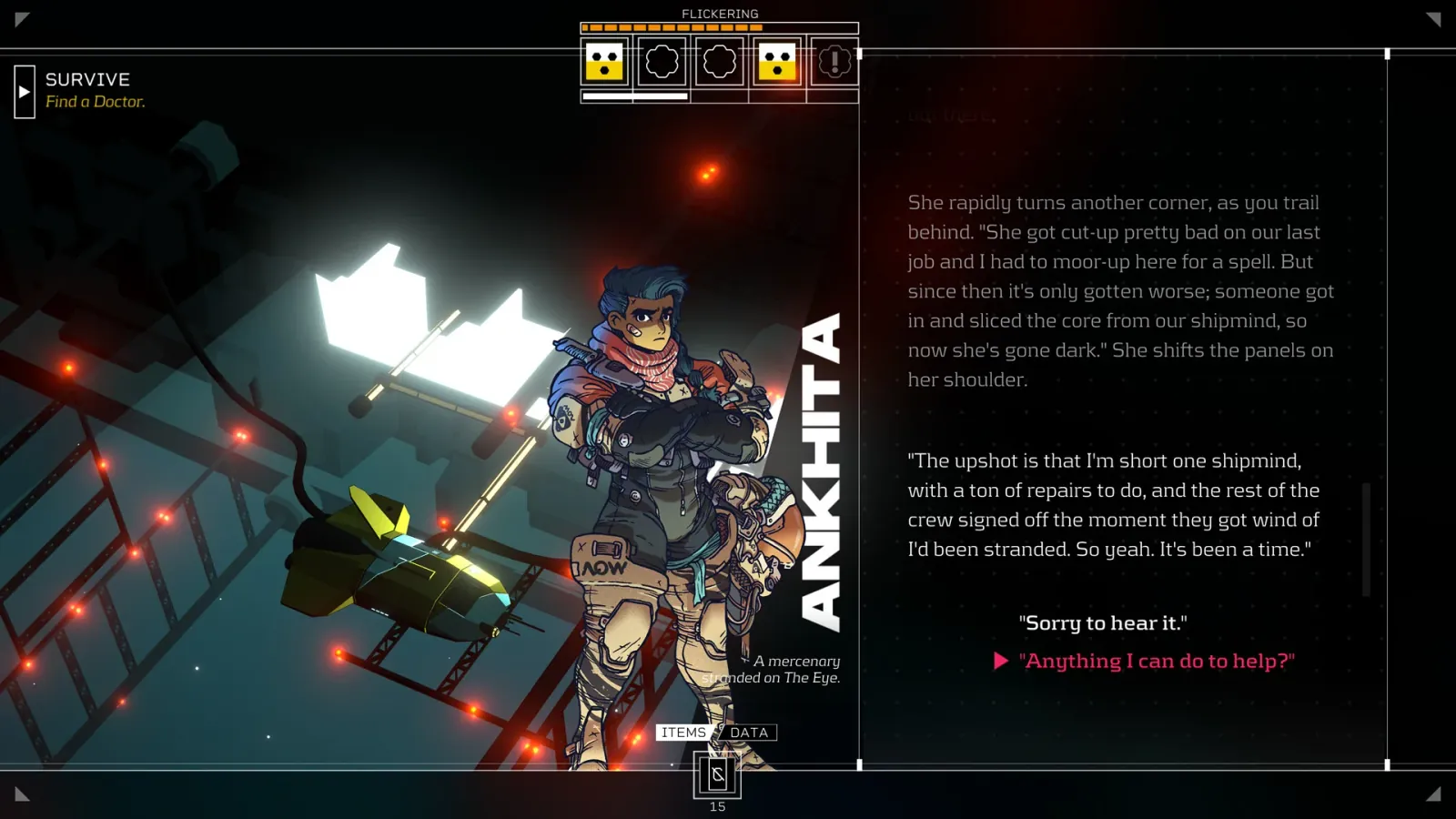
The shape of it is closer to an illustrated novel than to an action game. Long hand-drawn conversation scenes carry most of the running time, broken by star-map navigation, side-on exploration of asteroid caves and temples, and light puzzles. It is one finished story with an ending, not an open world. The text is English while the recorded voices are Mandarin and Japanese, so English-speaking players read throughout. The setting borrows the look and vocabulary of Chinese myth, but its culture, factions and history are invented. It costs around twenty-five euros on Steam.
What you actually do
Most of your time goes on reading and choosing what to ask about. Between story chapters you plot a course across a star map, spending limited fuel to reach the next asteroid, and stop at way stations to gather and sell resources so you can refuel and upgrade the ship. When Eda picks up a starsong you use a tuning tool to home in on its source, narrowing a signal until a hidden asteroid appears. Inside, you explore short side-scrolling caves, find records left by people long dead, and piece together what happened from fragments that do not agree with each other.
What it exercises
Assembles a setting's history from scattered records, songs and place names
Notices where a faction's stated reasons and its actions do not match
Budgets a limited fuel supply across a planned route
Holds the threads of a long story in mind across many sessions
Reads emotional subtext in dialogue that never states it directly
Why we rate it Minimal Worksheet score 20 / 100
FitHow much real knowledge or skill does the play itself make you use?20weight 45%
Fit is low at 20. The interpretive work is genuine: the game withholds a plain account of its history and makes you build one from inscriptions, songs and unreliable witnesses. But that reading sits beside the interactive parts rather than inside them, and the navigation and resource layers are simple enough to add little of their own.
TransferWill what you practise here work outside the game?15weight 30%
Transfer is the weakest dimension at 15. Reading a source for what it leaves out, and holding two accounts of one event side by side, matter well beyond this game, but they are also what a good novel exercises, so nothing here is specific to it. None of the invented history transfers as knowledge.
PracticeDoes the game make you use that skill again and again, as it gets harder?25weight 25%
Practice is 25. The interpretive habit returns often, since every asteroid holds another partial record to reconcile with what you already believe, which is real repetition within one playthrough. But the game finishes in a single pass and gives little reason to return, so the total amount of practice stays small.
What the evidence says
Editorial onlyNobody outside our desk has checked this. It is our reading of how the game plays.
The evidence is editorial only. The Steam store page is the cited source, and it confirms the developer, the 2021 release, the Full Bloom Edition and its added voice acting, the language set, the premise, and the mix of star-map travel, asteroid exploration and light puzzles. It carries no mature content descriptor. No study is cited, and none exists that we could find about whether reading an invented history in this form changes how anyone reads a real one. The figures here are an editorial reading of what the game asks a player to do, kept deliberately modest because the interpretive work sits beside the mechanics rather than inside them.
Editorial assessment - not a measured scientific effect.
Fit
20/100
Transfer
15/100
Practice
25/100
Why it makes the cut
PASS - It is a sought-after narrative adventure on its own merits, not just because of potential cultural insight.
Editorial only
This is editorial only, a reading of the game's structure and pacing. No study exists of what players take from its layered, invented history, and none of the figures here claim otherwise.
Prices are US store listings in USD, last refreshed 2026-09-25; regional prices and sales differ.
No subscription requirement was found on the verified PC route.
Current PC availability is directly verified on Steam. The exact current catalog entity is the Full Bloom Edition, which the Steam page presents as the definitive edition with added voice acting.
Steam lists English text support plus East Asian full-audio options.
Age guidance
Ages 13+ · ESRB T
Topics
Mind & well-being
Play styles
Single-player, Narrative
Tags
Fictional world interpretation · Faction history · Narrative travel
The interpretive reading is real, but it sits beside the interactive parts rather than inside them, and a single playthrough with no strong reason to replay keeps this in the lowest band.