What the game is
My Child Lebensborn is a Norwegian game about being a parent, made by Teknopilot with Sarepta Studio and released in May 2018. It is set in 1951, six years after the German occupation of Norway ended. You adopt a child, Karin or Klaus, from an orphanage, and only later does the child begin to understand what everyone in the town already knows: their father was a German soldier, and their mother was a Norwegian woman who has been punished for it.
The historical background is real. During the occupation, Nazi Germany ran the Lebensborn program, and thousands of children were born to German soldiers and Norwegian women. After the war those children and their mothers faced years of public hostility. The studio says the game could not have been made without the support of Norwegian Lebensborn children.
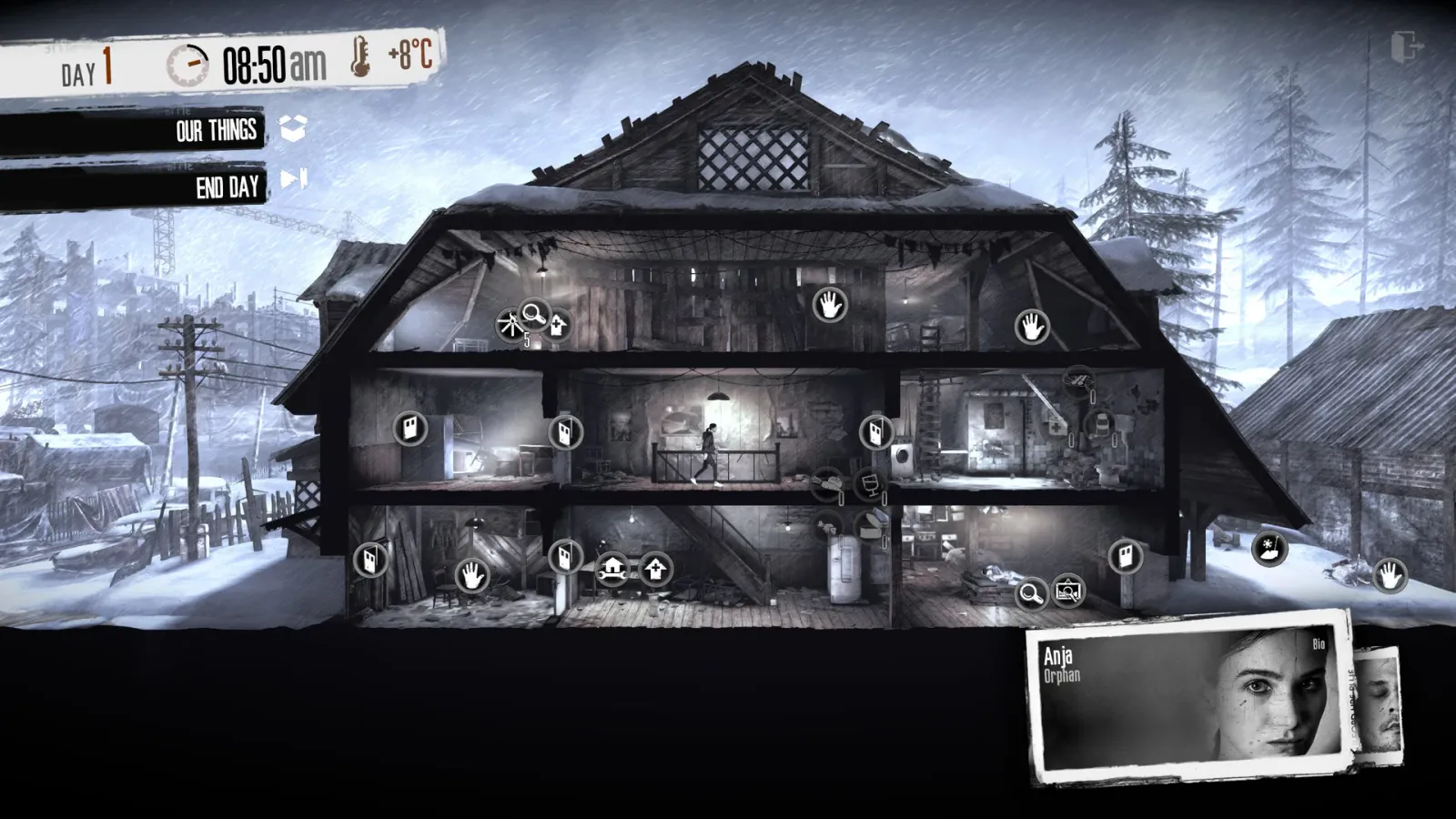
The presentation is deliberately small: a house, a few rooms, a handful of illustrated screens, a child who talks to you. There is no combat, no puzzle and no way to win. It won a BAFTA in 2019 in the Game Beyond Entertainment category, along with Norwegian and international narrative awards, and it is sold on phones, PC and consoles in eighteen languages.
What you actually do
Days pass one at a time and each one has to be paid for. You work for poor wages and come home with a little money and a little time. Food, firewood and clothes all cost. So does affection, in a sense, because the hours you spend on chores are hours you are not spending with the child, and the child notices both the empty plate and the empty chair.
Then the child comes home from school with a torn coat and a question you do not want to answer. You choose: tell the truth about their father, soften it, or change the subject. You choose whether to keep them home, whether to confront a neighbor, whether to spend the last coins on a treat or on coal. The game tracks how the child is doing, and it will not let you fix everything.
What it exercises
- Weighs an immediate need against a longer-term one with genuinely limited resources
- Considers how a child hears an adult's answer, including an evasive one
- Connects a large historical injustice to what it did inside one family
- Sits with a situation that cannot be solved, only handled better or worse
- Recognizes prejudice as something learned and passed on rather than natural
Why we rate it Low Worksheet score 44 / 100
FitHow much real knowledge or skill does the play itself make you use?45weight 45%
Fit is scored 45 because the history is delivered through resource pressure rather than through text: you understand the stigma because it costs you money, time and the child's sleep. It sits in the middle because a scarce-resource loop is a blunt instrument for something this serious, and the mechanic can start to feel like a management puzzle rather than a moral weight.
TransferWill what you practise here work outside the game?42weight 30%
Transfer is scored 42 because the game connects to real history a teenager will meet in school, and thinking about how prejudice reaches a child at home is a habit that travels. It is held down because one dramatized family is a narrow window, and the emotional impression the game leaves is stronger than any structural understanding of the period it teaches.
PracticeDoes the game make you use that skill again and again, as it gets harder?45weight 25%
Practice is scored 45 because the daily loop of earning, feeding, comforting and answering recurs across the whole game, so the same trade-off is faced dozens of times. What does not repeat is the story: once it ends the point has been made, and playing again mostly means watching a different set of choices fail in a similar way.
Where it has been used in teaching
Documented cases of this game being used with learners. Each one links to its source.
CourseUniversity of Agder, Department of Education, Norway · University · 2024
University of Agder researchers observed student teachers in its educator-preparation program using 'My Child Lebensborn' as one gaming station in Future Classroom Lab small-group sessions, studying how the flexible space supported their professional digital competence. Reported as observed collaboration patterns, not measured learning gains.
Flexible learning spaces as an arena for developing professional digital competence through small group collaboration ↗School programSecretaria de Estado de Educação de Minas Gerais, Iniciação Científica na Educação Básica (ICEB) program, Brazil · Secondary school · 2024
A student research team in Minas Gerais's state-run scientific-initiation program for basic education used 'My Child Lebensborn' as a teaching tool with high-school students at a public school, running bullying surveys and thematic classes. The authors describe results as preliminary, reported 'so far,' not a completed study.
Bullying e depressão em jogo? Utilização do jogo digital My Child Lebensborn como ferramenta de ensino ↗
What the evidence says
Practice-backedNo published study, but people who answer for the outcome use it: schools, clinics, museums, research labs.
The level is Practice-backed, grounded in the official project page, the Children Born of War project page and the store listing, which confirm the developers, the May 2018 release, the awards, the platforms and the studio's work with Norwegian Lebensborn children. What lifts the level is documented instructional use: University of Agder researchers observed student teachers using the game as a gaming station in small-group practice sessions, and a Brazilian state science-initiation program used it with high school students in Minas Gerais, running bullying surveys and thematic classes with results described as preliminary. Neither measures what playing changes in a player's understanding of prejudice; the Agder study reports observed collaboration, not learning gains. The score reflects how tightly the mechanics carry the subject, not proof of an outcome.