Written 2026-09-15 · editorial assessment, not a measured effect · how we rate →
What the game is
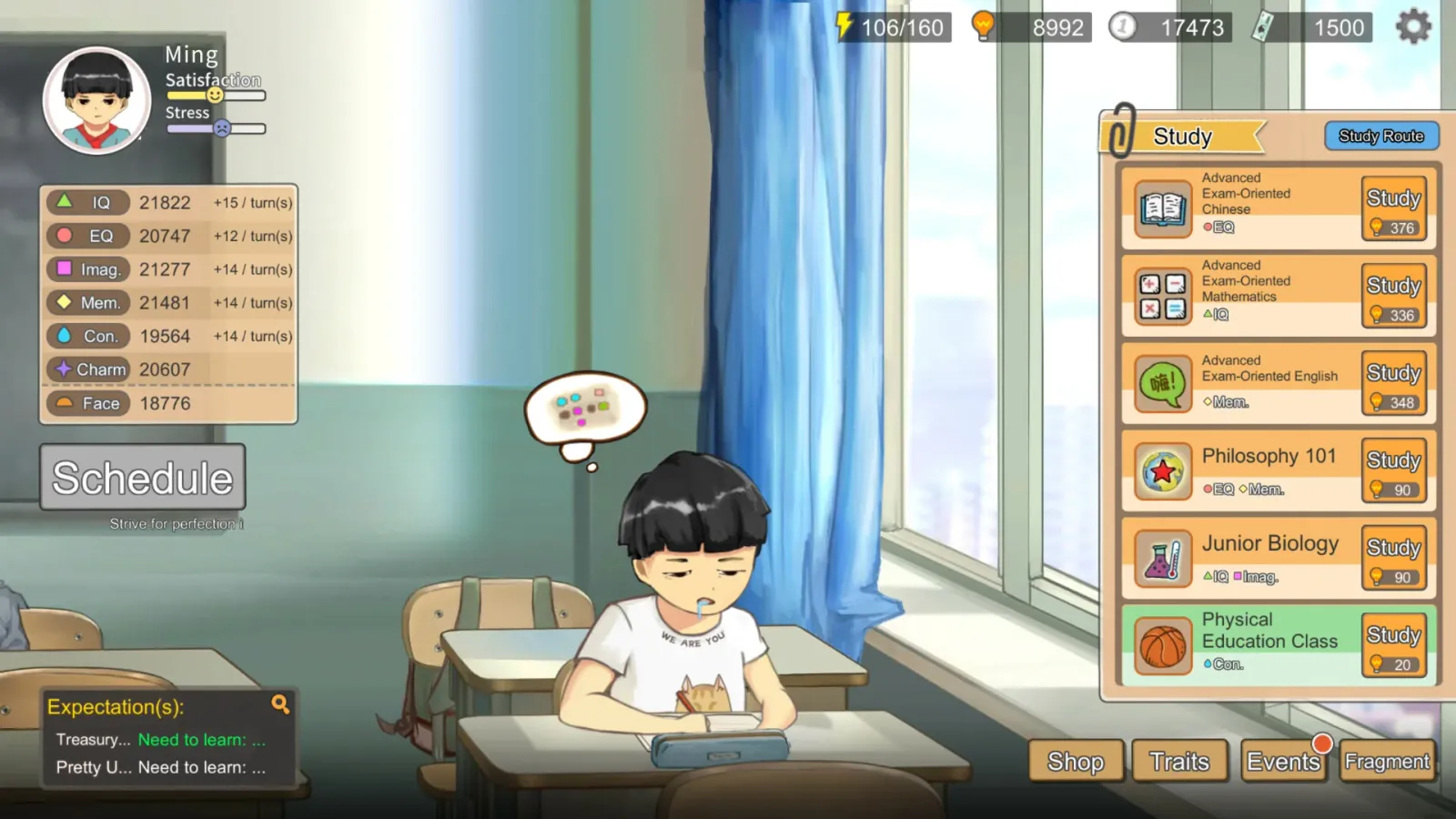
Growing Up is a life simulator that runs one character from toddler to adult. Each in-game week you fill a schedule: hours go to studying a subject, practicing a hobby, spending time with a friend, or resting. Those hours become skill points, and skill points open doors years later, whether a school stream, a scholarship or a job. Vile Monarch made it and released it in October 2021 on PC with Spiral Up Games.
The screen is mostly menus and a stylized city map, in a comic-strip art style with a great deal of dialogue: the store page lists 19 characters whose own stories run alongside yours, more than 200 skills, and 42 careers to end up in. Studying is played out as a small handcrafted mini-game rather than a button press. Relationships develop through timed events and choices, romance included, and a run ends with one of several endings. A finished life can then be handed on, and you play that character's child.
What you actually do
You spend time, and you cannot spend it twice. A week offers a handful of slots, and every one has a cost: an afternoon on mathematics is an afternoon not spent with the friend whose storyline is about to close. Skills are built through the mini-game, so studying is an activity rather than a wait. Events interrupt with choices that change relationships and traits. Consequences arrive slowly and unmistakably, because the entry requirements for a career are visible years before you have to meet them. Getting better means choosing a direction early, accepting what it costs, and noticing which friendships you have quietly let lapse.
What it exercises
Allocates a fixed amount of time across competing goals.
Works backward from a requirement to the skills needed to meet it.
Tracks a long-range plan across many small weekly decisions.
Notices the cost of a choice in terms of what it made impossible.
Weighs keeping a relationship against a measurable reward.
Why we rate it Minimal Worksheet score 37 / 100
FitHow much real knowledge or skill does the play itself make you use?35weight 45%
Fit lands at 35. The weekly schedule is a real constraint, and a player cannot avoid noticing that every hour spent on one goal is an hour taken from another. But the underlying subject, a life, is reduced to a handful of numeric meters and menu choices, so what is actually being exercised is a generic planning skill wrapped around invented content rather than a real domain.
TransferWill what you practise here work outside the game?30weight 30%
Transfer sits at 30, at the edge of what counts as far transfer at all. Planning backward from a goal and accepting that time is finite are real habits a teenager is about to need. The limit is that the game's own economy is a tidy meritocracy where effort reliably pays, and school, luck and money do not behave that way, so the lesson needs correcting rather than simply applying.
PracticeDoes the game make you use that skill again and again, as it gets harder?50weight 25%
Practice is the strongest dimension at 50. The scheduling decision repeats every in-game week across a long run, and playing again with a different goal exercises the same planning from a new angle. What holds it in the middle of the scale is that the decision itself never gets structurally harder, so the repetition is steady rather than rising.
What the evidence says
Editorial onlyNobody outside our desk has checked this. It is our reading of how the game plays.
The evidence level is Editorial only: a reading of the mechanics, checked against the Steam listing. There is no study of Growing Up, and we are not aware of research showing that life simulators change how adolescents plan, so nothing here is a measured outcome. The reasoning is that the game makes opportunity cost visible and unavoidable, week after week, which is unusual and is the whole of the case. The store page supports the October 2021 release, the developer and publishers, the price, the skill and career counts, the study mini-game and the multi-generation structure.
Editorial assessment - not a measured scientific effect.
Fit
35/100
Transfer
30/100
Practice
50/100
Why it makes the cut
Its coming-of-age life-sim structure is appealing beyond any reflective framing.
Editorial only
Editorial: no study has looked at Growing Up or at life simulators changing how teenagers plan, so the reasoning rests on what the weekly scheduling mechanic itself requires rather than on any measured result.
Prices are US store listings in USD, last refreshed 2026-09-25; regional prices and sales differ.
Single-player play is supported.
The game depends on menu reading, event choices, and long-range planning rather than on reflexes.
Age guidance
Ages 13+
Topics
History & society, Mind & well-being
Play styles
Single-player, Strategy, Simulation, Narrative
Tags
Life simulation · Long-term planning · Personal development
It rates minimal because the weekly scheduling puzzle genuinely forces trade-offs, but it models effort as reliably rewarded, which is a tidy fantasy rather than a working picture of how education or careers actually unfold.