Players guide a child from early school years toward adulthood through training, spending, social events, exams, and family choices that shape traits and opportunities.
Why it may be useful
Stress rises when you study and satisfaction falls when you never play, and the exam at the end does not care how the child felt, so you discover the squeeze by living inside it. The model is one country's system, satirized rather than documented.
Keep in mind
Its Chinese social framing is an authored perspective and simulation, not a simple stand-in for all Chinese family life.
Written 2026-09-15 · editorial assessment, not a measured effect · how we rate →
What the game is
Chinese Parents, released in 2018 by the small Chinese studio Moyuwan Games, is a life simulation that runs from a baby's first weeks to the university entrance examination eighteen years later. You are both the parent and, in effect, the child: each round you decide how the child's time is spent, and the results accumulate into who they become.
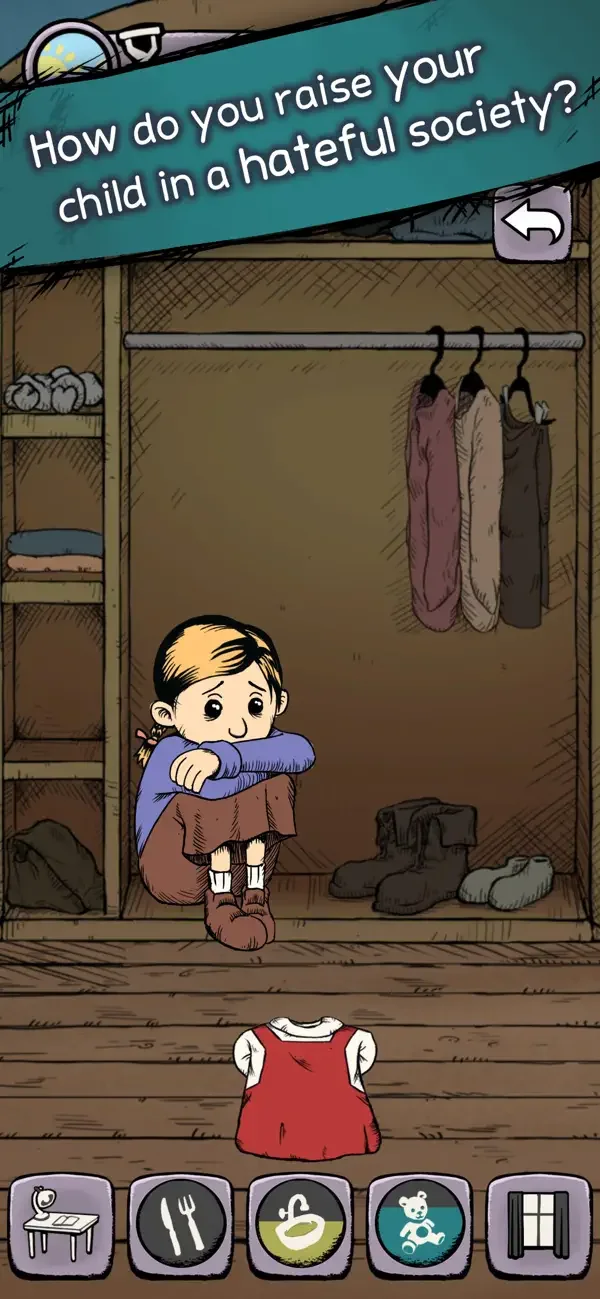
The presentation is cartoon portraits, menus, and pop-up events, with almost no animation. It is a paid single-player PC game, with interface languages in English, Simplified and Traditional Chinese, and Japanese. A full run ends at the gaokao, which the game calls one of the most important examinations of your life, and there are more than a hundred career endings. Finish one life and you can play the next generation, with the child you raised now raising a child of their own.
What you actually do
A round is a handful of time slots. You spend them on studying, on a hobby, on play, or on rest, and each choice moves numbers: intelligence, memory, charm, physique, and, running against them, stress and satisfaction. Push study too hard and the child breaks down. New abilities are unlocked in a small grid puzzle where you clear connected cells with a limited number of moves. Between rounds come set pieces: a bragging contest with a neighbor's parent, played as a card duel, and a red envelope game with relatives at New Year. Your accumulated stats decide which classes, which friendships, which romances, and finally which examination result and which job.
What it exercises
Allocates limited time across competing long-term goals
Balances a resource that rises against one that must be kept down
Traces how a choice made years earlier limits the options now
Reads a social ritual as a system with rules and payoffs
Compares one country's route through school with their own
Why we rate it Low Worksheet score 45 / 100
FitHow much real knowledge or skill does the play itself make you use?45weight 45%
Fit lands at 45. The argument is in the numbers: stress rises when you study, satisfaction falls when you never play, and the examination at the end does not care how the child felt. You discover the squeeze by being caught in it rather than by being told about it. It is not higher because much of the loop is menu clicking, which flattens the feeling.
TransferWill what you practise here work outside the game?40weight 30%
Transfer reaches 40, unusually high for a life simulation, and earned. Teenagers are often living inside a version of this already: limited hours, competing demands, an exam at the end, and the game shows the whole shape of that at once, from outside. It cannot go higher because it models one country's system, and a player who does not know that may read the specific as universal.
PracticeDoes the game make you use that skill again and again, as it gets harder?50weight 25%
Practice sits at 50. A single run is dozens of allocation decisions, and the game is designed for repeat playthroughs, since a second generation starts with advantages inherited from the first, so the same trade-off recurs hundreds of times. What limits it is that a good strategy stabilizes once a player understands the numbers behind the menus.
What the evidence says
Editorial onlyNobody outside our desk has checked this. It is our reading of how the game plays.
Editorial only: our judgment from the mechanics and from the Steam listing, checked in August 2026. That page confirms the developer, the September 2018 release, the PC route, the four interface languages, the eighteen-year structure ending at the gaokao, the fragment and mini-game systems, the face-saving duels and red envelope games, and the second-generation replay. No study looks at this game, and we found none on life simulations as a way of prompting reflection about school pressure. The case for it is structural: a player who has to run the trade-off sees it more clearly than one who is only told about it.
Editorial assessment - not a measured scientific effect.
Fit
45/100
Transfer
40/100
Practice
50/100
Why it makes the cut
Its life-course stat-management structure works as a real game first.
Editorial only
Editorial only: no study looks at life simulations as a way of prompting reflection on school pressure, so the case is structural, a player who runs the trade-off sees it more clearly than one who is told about it.
Prices are US store listings in USD, last refreshed 2026-09-25; regional prices and sales differ.
Single-player play is supported.
The game depends heavily on reading menus, events, and social outcomes.
Steam lists English, Simplified Chinese, Japanese, and Traditional Chinese.
Age guidance
Ages 14+
Topics
History & society, Mind & well-being
Play styles
Single-player, Strategy, Simulation
Tags
Life simulation · Family pressure · Growing up
Stress and satisfaction pull against each other on every choice, and the exam at the end does not care how the child felt, but much of the loop is menu clicking, which flattens that feeling.