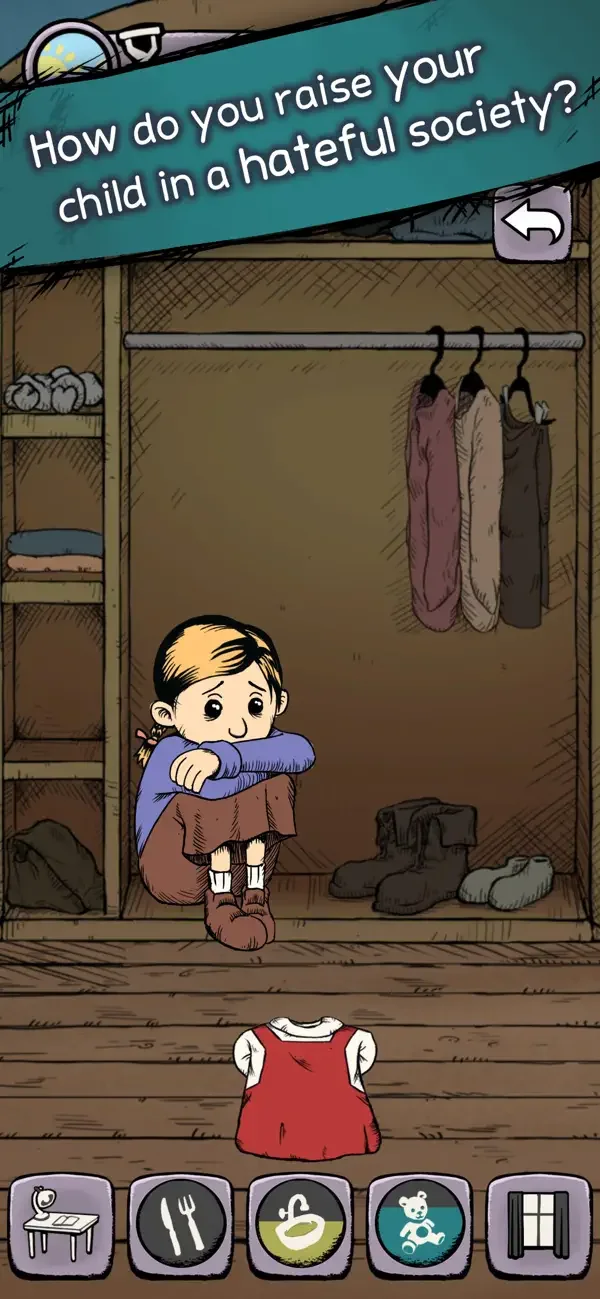
Players ration food and medicine, craft essentials, manage a small shelter, and decide nightly scavenging risks for vulnerable civilians.
Why it may be useful
This War of Mine makes food, medicine and fuel genuinely scarce, so every route to more of them passes through someone else's loss. The concrete skill you practice is rationing a stock across competing needs; anything beyond that is a hopeful, unproven hypothesis.
Written 2026-09-15 · editorial assessment, not a measured effect · how we rate →
What the game is
This War of Mine is a survival management game by the Polish studio 11 bit studios, released in November 2014. It takes the standard war game and turns it around: you are not a soldier but a handful of ordinary civilians hiding in a ruined townhouse in a besieged city, trying to last until a ceasefire that may or may not come.
The screen is a cutaway of the house, several floors of rubble seen from the side, with your survivors moving between them. Play alternates between two phases. By day, snipers make the street lethal, so you stay indoors: clearing debris, building a stove or a rain collector, cooking, patching wounds, trading with a visiting merchant. By night, you send one survivor out to scavenge a location on the city map, leave another on guard, and put the rest to bed.
Survivors are named people with their own skills and histories, and they have a mood as well as hunger and health. A run lasts a few in-game weeks and ends when the ceasefire arrives or the last survivor does not. Runs are randomized, so no two houses fall apart the same way.
What you actually do
Every night you make the same shaped decision under a different pressure. There is a hospital across the city with medicine you need, and there are armed people in it. There is a quiet house with an elderly couple who will not stop you taking their food. Your backpack holds only so much, so you choose between the fuel that keeps the house warm and the medicine that keeps someone alive.
The consequences arrive later, and not always where you expect. A survivor who watched you rob the couple becomes depressed, then stops working, then sometimes stops entirely. Getting better does not mean becoming ruthless. It means planning the week rather than the night: building the workbench early, rationing before you have to, and knowing which trades are worth making.
What it exercises
Rations a limited stock against needs that all matter
Weighs an immediate gain against a delayed cost to someone
Plans a week ahead instead of reacting night by night
Notices how a decision looks from the other person's position
Why we rate it Low Worksheet score 49 / 100
FitHow much real knowledge or skill does the play itself make you use?50weight 45%
Fifty. Food, medicine and fuel are genuinely scarce, and every route to more of them passes through somebody else, which keeps the moral weight inside the mechanics rather than in narration alone. It settles in the middle of the scale because the resource system itself is a fairly narrow rationing loop, one skill applied repeatedly rather than a wide domain a player works within.
TransferWill what you practise here work outside the game?47weight 30%
Forty-seven. Budgeting a scarce stock across needs that all matter is real and portable, and that concrete skill does carry over. The larger claim, that the game changes how a player thinks about civilians in war, is plausible but unproven, and that mix of one solid mechanic and one hopeful hypothesis is exactly what keeps this in the general-skill range rather than higher.
PracticeDoes the game make you use that skill again and again, as it gets harder?50weight 25%
Fifty. A run lasts several in-game weeks of nightly decisions, and randomized locations and survivors mean a second run poses the same problems from a different angle, which most players do take up. It sits at the midpoint because the scarcity math becomes routine once a player learns an efficient opening, so the later repetition rehearses a solved problem more than a harder one.
Where it has been used in teaching
Documented cases of this game being used with learners. Each one links to its source.
School programPolish Ministry of National Education · Secondary school · 2020
In 2020 the Polish government added This War of Mine to the optional part of the official high-school reading list, made the PC version free to download from a government site, and provided lesson topics for teachers; officials called it the first national reading list to include a video game.
Practice-backedNo published study, but people who answer for the outcome use it: schools, clinics, museums, research labs.
Practice-backed rests on a documented case: in 2020 Poland's Ministry of National Education added This War of Mine to the optional part of the official high-school reading list, made the PC version free to download from a government site, and provided lesson topics for teachers, officials calling it the first national reading list to include a video game. That is real classroom adoption, not a study of outcomes, so it says nothing about what students actually took from playing it. The Steam listing confirms the developer, the November 2014 release, and the day-and-night structure. No study measuring attitudes or knowledge is cited, and none is claimed.
Editorial assessment - not a measured scientific effect.
Fit
50/100
Transfer
47/100
Practice
50/100
Why it makes the cut
PASS - Its survival-management loop is respected as a game in its own right, not only for its subject matter.
Practice-backed
Practice-backed: Poland's Ministry of National Education added the game to the official high-school reading list in 2020 and issued lesson topics for teachers, which is documented classroom use, though no study measures what students actually take from playing it.
Prices are US store listings in USD, last refreshed 2026-09-25; regional prices and sales differ.
No subscription requirement was found on the verified PC route.
Steam currently verifies interface support for the listed locales. Full audio and subtitle support are only marked where a current Steam source states them explicitly.
Age guidance
Ages 17+ · ESRB M
Topics
History & society, Mind & well-being
Play styles
Single-player, Strategy, Simulation, Narrative
Tags
Scarcity management · Civilian survival · Moral trade-offs
The resource system makes moral trade-offs unavoidable rather than narrated, which is genuine, but the setting is invented and the deeper claim about changing how a player sees civilians in war stays a hopeful hypothesis.