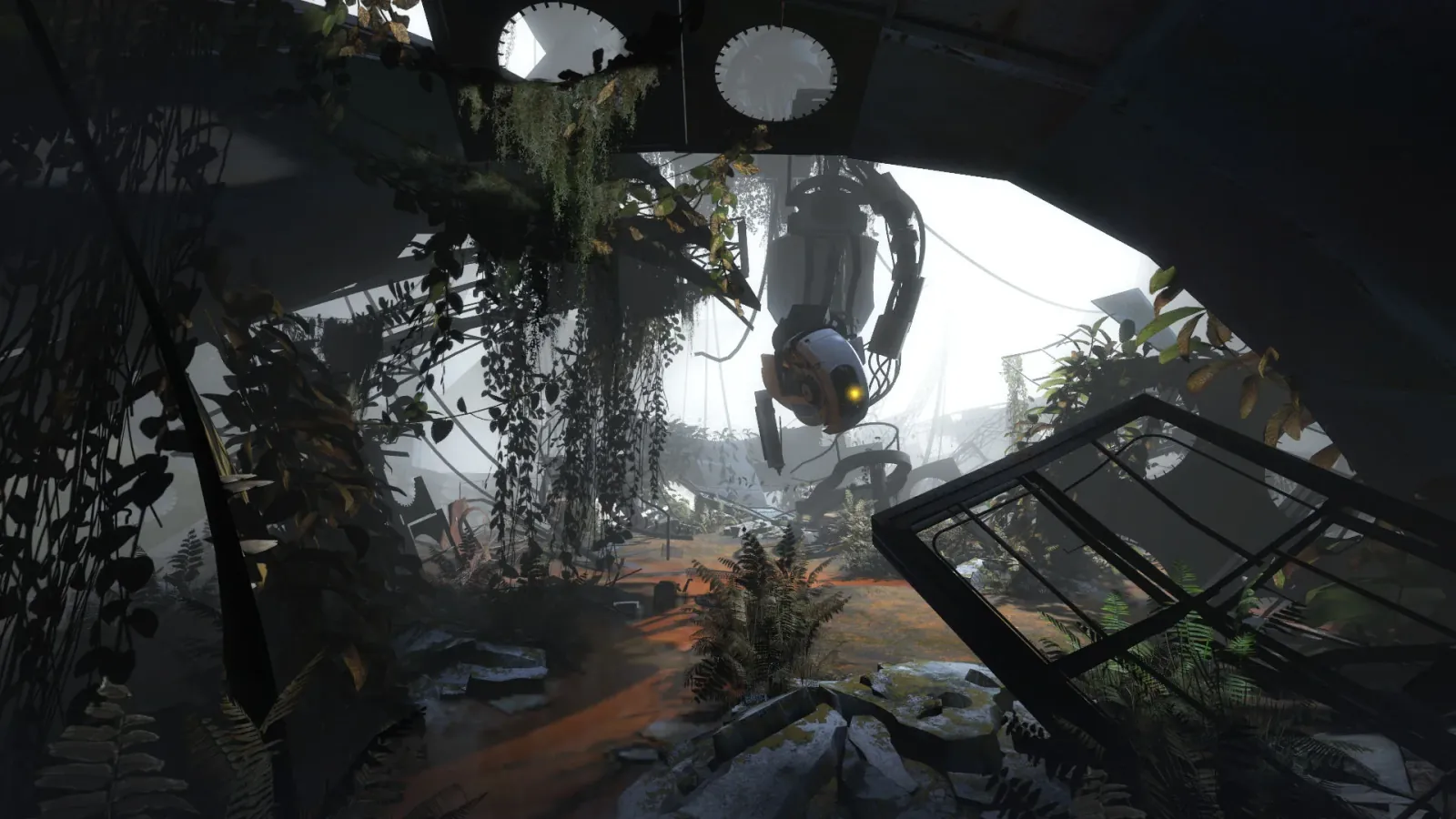
Players pilot a fragile ship, follow clues across planets, experiment inside a repeating time loop, and gradually connect environmental discoveries into a bigger understanding.
Why it may be useful
Progress here comes only from understanding, never from an upgrade or a key, so you get real practice at guessing, testing, and revising an idea using scattered clues. The universe was built to be solvable, which real problems rarely are.
Keep in mind
Its value lies in discovery and reasoning, not in teaching astronomy or physics accurately.
Written 2026-09-15 · editorial assessment, not a measured effect · how we rate →
What the game is
Outer Wilds is a first-person exploration mystery by Mobius Digital, published by Annapurna Interactive and released on Steam in June 2020 at around twenty-three euros. You play a new astronaut in a small hand-built solar system, and you are handed launch codes and no instructions.
The system is caught in a time loop. Every loop ends the same way, with the sun going supernova, and every loop is short, on the order of twenty minutes. You wake at the campfire with your ship intact and nothing carried over except what you now know. There are no upgrades and no keys; the only thing that changes between loops is your understanding.
Two tools do most of the work: a translator for the writing left by a vanished species called the Nomai, and a signalscope for tracking distant sounds. The planets themselves change as the loop runs, so a place can only be entered during part of the cycle. It carries an ESRB E10+ rating, lists thirteen languages, and has one paid expansion, Echoes of the Eye.
What you actually do
You form a guess and go check it. A Nomai note mentions a project on another planet, so you fly there, and the ship's log records what you found and what it still does not explain. You die a great deal, by crashing, suffocating, falling and being crushed, and each death costs nothing but the minutes of a loop. The real work is noticing that one detail contradicts what you assumed, then working out which place you now need to reach and at what point in the cycle it is reachable. Getting better is entirely a matter of knowing more.
What it exercises
Forms a guess about a place and tests it by going there
Finds the detail in scattered notes that contradicts an assumption
Times an approach to a place that is only open during part of the cycle
Keeps track of what is known and what is still unexplained
Treats a failed attempt as information rather than as a loss
Why we rate it Moderate Worksheet score 55 / 100
FitHow much real knowledge or skill does the play itself make you use?62weight 45%
Fit reaches 62. Nothing gates progress except understanding: there is no upgrade to grind, no key to find, no skill check to pass, so every step forward is literally an act of working something out. It is not higher because a fair amount of that progress is still exploration and memorization of where things are, not pure reasoning.
TransferWill what you practise here work outside the game?50weight 30%
Transfer sits at 50. Guess, test, revise, and treat a failure as data rather than as defeat is the shape of investigation in any subject, and this game rehearses it for hours. It is held to the middle because the universe here was designed to be solvable, and real problems come with no such guarantee, so the habit needs recalibrating outside the game.
PracticeDoes the game make you use that skill again and again, as it gets harder?50weight 25%
Practice is 50. The loop guarantees repetition by design: you return to the same handful of worlds many times over, each visit carrying more knowledge than the last, so forming and testing an explanation happens continuously. It is capped by shape, since the whole game is one authored mystery rather than a system you can keep coming back to once it is solved.
What the evidence says
Editorial onlyNobody outside our desk has checked this. It is our reading of how the game plays.
The evidence is editorial only. The cited Steam store page confirms the developer, publisher, the June 2020 release, price, the time-loop premise, the translator and signalscope, the Echoes of the Eye expansion, the ESRB E10+ rating, and the thirteen supported languages. It says nothing about what playing does to anyone. No study of this game is cited and none was found. The reasoning is mechanical: progress is gated only by understanding, which is a defensible basis for saying the game gives sustained practice in inference, though the universe here is designed to be solvable in a way no real problem guarantees.
Editorial assessment - not a measured scientific effect.
Fit
62/100
Transfer
50/100
Practice
50/100
Why it makes the cut
Its exploration mystery is a widely recognized game-first triumph, not a noble exception.
Editorial only
This is our reading of the mechanics: progress is gated only by understanding, which is a defensible basis for saying the game gives sustained practice in inference. No study of this game or its effects on players exists that we can cite.
Prices are US store listings in USD, last refreshed 2026-09-25; regional prices and sales differ.
Single-player play is supported.
The experience depends on player-led exploration and repeated loop-based experimentation.
Age guidance
Ages 10+ · ESRB E10+
Topics
STEM, Logic & strategy
Play styles
Single-player, Narrative, Puzzle
Tags
Curiosity-driven exploration · Inference · Time loop mystery
Nothing gates progress except understanding, which is a rare and strong design, but the universe was built to be solvable in a way no real problem guarantees, which is why this lands in the middle.