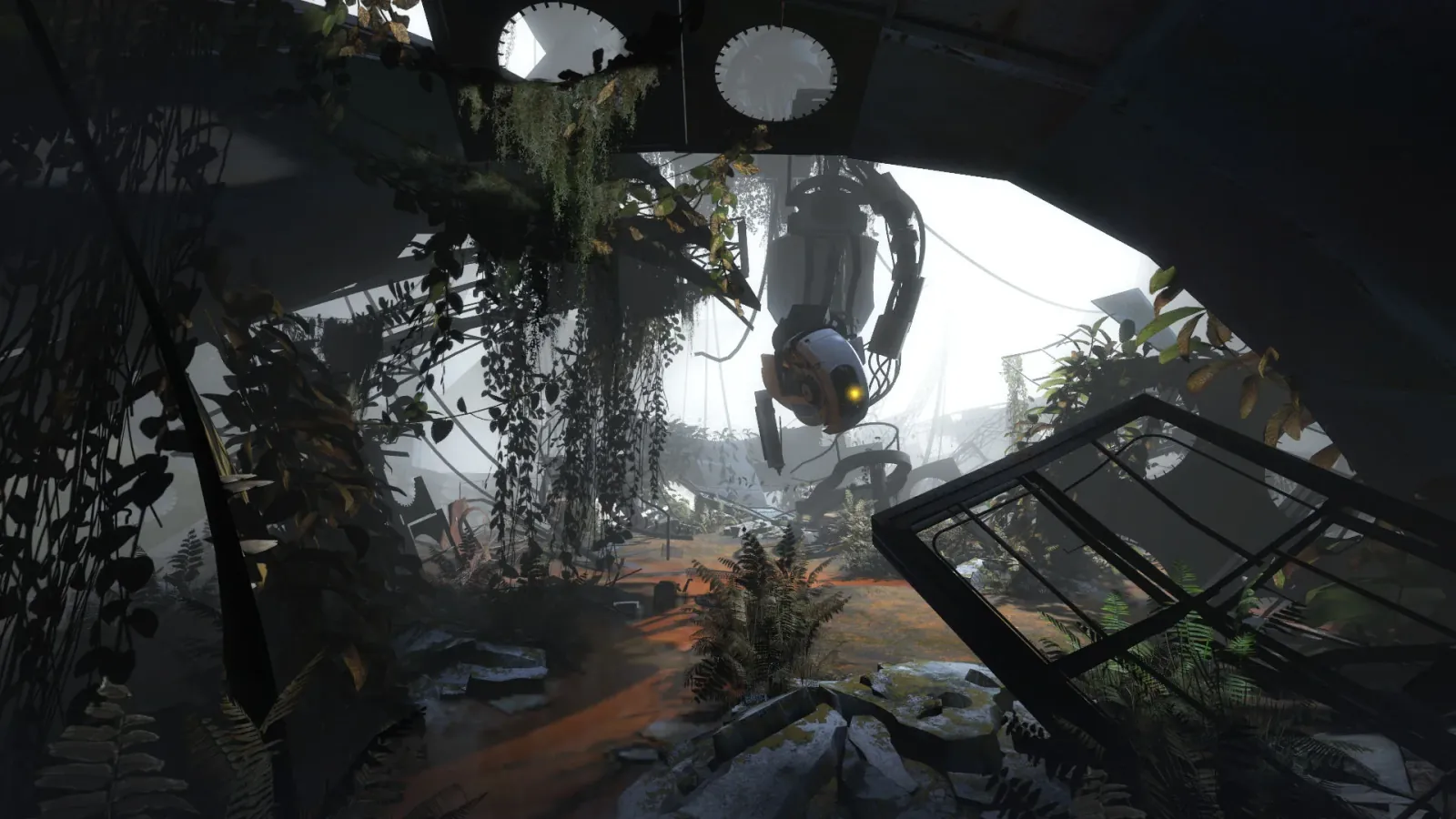
Players use a portal gun to redirect themselves and objects through linked doorways, learning how momentum, line of sight, switches, cubes, and hazards combine inside test chambers.
Why it may be useful
Each chamber teaches exactly one spatial rule, then makes you recombine it with everything before it, which is focused, genuine reasoning practice. The game never names the physics behind it, though, so what you build is fluency at simulating space, not knowledge you could transfer to a classroom.
Keep in mind
Portal should not be treated as proof of physics learning; what it builds is spatial fluency, not knowledge you could name.
Written 2026-09-15 · editorial assessment, not a measured effect · how we rate →
What the game is
Portal is the original first-person puzzle game from Valve, released in October 2007 as part of a bundle called The Orange Box. It is short: most players finish in two to three hours. You wake in a bare test chamber with no explanation, are handed a device that opens two linked doorways, and are walked through a sequence of rooms by a computer voice that is helpful at first and gradually becomes something else.
The whole game is built from one idea, introduced in pieces. Early chambers teach that the two doorways connect. Later ones teach that you keep your speed when you pass through, that only some surfaces accept a portal, and that boxes, buttons, turrets and pools of acid can all be dealt with using the same trick. The last stretch drops the test-chamber structure entirely. On PC it is sold on its own; the current console route is the Portal: Companion Collection on Switch, which bundles it with Portal 2. Steam players rate it Overwhelmingly Positive.
What you actually do
You stand in a room and look for two white surfaces. One goes under you, one goes somewhere you want to reach, and gravity does the rest. The real skill arrives when the game stops giving you a floor to land on and starts asking you to arrive somewhere at speed: fall through a portal in the floor, come out of one high on a wall, and use that momentum to cross a gap. Boxes have to be carried through, turrets have to be flanked, and switches have to be held down by something heavy. Getting better means thinking about where you will be moving rather than where you are standing.
What it exercises
Plans a path through space using two connected openings.
Predicts where momentum will carry you after passing through a portal.
Recognizes which surfaces accept a portal and plans around the ones that do not.
Recombines four or five learned rules into a solution nobody demonstrated.
Reads a room for the one detail that makes the intended solution possible.
Why we rate it Low Worksheet score 49 / 100
FitHow much real knowledge or skill does the play itself make you use?52weight 45%
At 52, fit reflects a tightly focused game: nearly everything on screen is spatial reasoning, with each chamber introducing exactly one new rule and then requiring you to combine it with everything learned before. It sits mid-band rather than higher because that reasoning happens inside an invented physical system with its own rules, not a real domain like architecture or engineering that a player would need to know something about going in.
TransferWill what you practise here work outside the game?42weight 30%
Forty-two is a genuine middle result. Simulating a space in your head, predicting a trajectory and recombining known rules are general mental operations, and Portal drills them constantly and well. It stops short of teaching physics, since none of the underlying vocabulary ever appears on screen, so what a player carries away is fluency in a skill rather than knowledge they could apply in a science class.
PracticeDoes the game make you use that skill again and again, as it gets harder?50weight 25%
Fifty is on the low edge of solid, held down mainly by length: the chambers repeat the same mental act relentlessly, and harder maps return late to demand the same solutions under tighter constraints, but the whole game finishes in two to three hours. There is real repetition inside that short span, just far less of it than a longer game could offer, and once it ends there is little reason to return.
What the evidence says
Editorial onlyNobody outside our desk has checked this. It is our reading of how the game plays.
The record stays at Editorial only even though three research-adjacent items are cited, because none of them measures a learning outcome from playing. One paper, presented at CHI PLAY, examines how puzzle games teach their own rules and uses Portal as a case study. A Spanish-language education paper argues Portal has potential for building intuitive physics ideas, without testing that claim on players. An American Journal of Play article discusses the game as an object worth studying. Together they show researchers find the design worth analyzing. None of them shows that a player reasons better about space after finishing it.
Editorial assessment - not a measured scientific effect.
Fit
52/100
Transfer
42/100
Practice
50/100
Why it makes the cut
Portal is one of the clearest examples in the whole batch of a game players would obviously still want purely for the challenge and wit.
Editorial only
This stays Editorial only on purpose: three academic papers analyze Portal's design and its potential for teaching intuitive physics, but none of them measures whether a player who finishes the game reasons better about space afterward.
Prices are US store listings in USD, last refreshed 2026-09-25; regional prices and sales differ.
The current console route is bundled with Portal 2 on Switch.
Do not write the public review as if Portal were currently sold as a standalone console title everywhere.
The current console route is the Switch bundle.
Steam verifies the standalone PC release. Nintendo currently verifies Portal as part of Portal: Companion Collection on Switch, which is a bundle route rather than a standalone console sale.
Steam explicitly verifies English, French, German, Spanish, and Brazilian Portuguese among many others.
Premium purchase on Steam; current Switch console access is inside a premium collection bundle.
Age guidance
Ages 13+ · ESRB T
Topics
Logic & strategy, STEM
Play styles
Single-player, Puzzle, Narrative
Tags
Spatial reasoning · Physics puzzles · Dark humor
Every chamber demands genuine spatial reasoning with no filler, but the game never supplies the underlying physics vocabulary, so what a player takes away is fluency at simulating space rather than transferable knowledge.