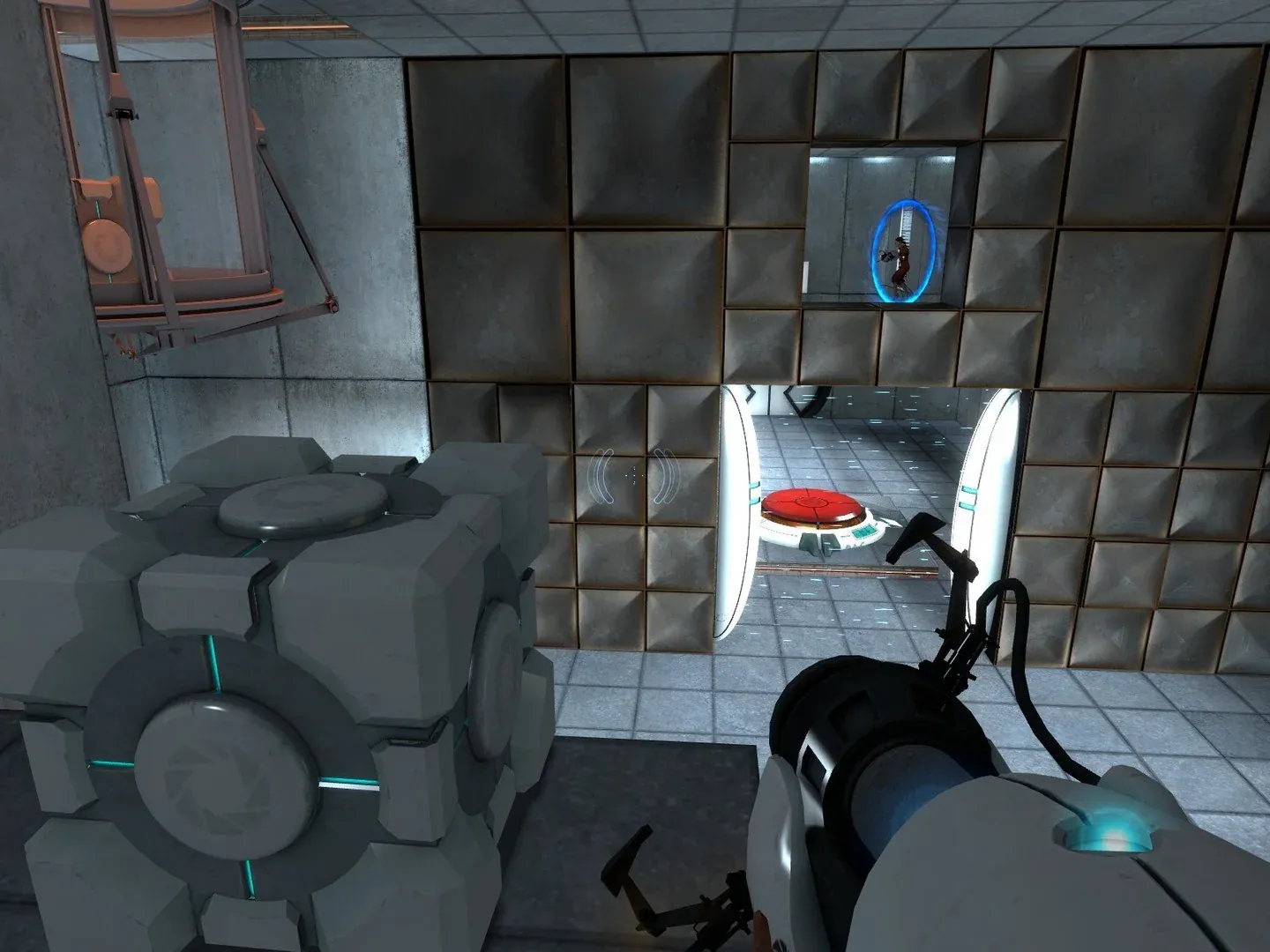
Players place paired portals, redirect momentum and lasers, and in co-op coordinate two bodies across separate but linked puzzle spaces.
Why it may be useful
The puzzles are spatial reasoning and nothing else: predicting where a portal leads and how speed carries through it. That mental skill genuinely echoes geometry and map-reading, though the game never gives you the vocabulary, so what sticks is fluency, not knowledge you could name in a classroom.
Used in teaching
4 documented cases ↓University of Cadiz, Faculty of Education Sciences · Michigan Technological University
Keep in mind
Mentally rotating a portal path is real spatial practice, but nothing here amounts to physics or geometry instruction you could name.
Written 2026-09-15 · editorial assessment, not a measured effect · how we rate →
What the game is
Portal 2 is a first-person puzzle game made and published by Valve, released in April 2011. You are shown a series of rooms and told to reach the exit. The tool you are given is a gun that shoots two linked doorways, one blue and one orange, onto white surfaces. Step into one and you come out of the other, keeping whatever speed you had. The setting is a decaying underground testing facility run by an artificial intelligence with an unpleasant sense of humor.
There are two separate campaigns. The single-player story is longer and stranger than the first game's, moving out of the clean test chambers into the ruins beneath them. The co-op campaign is a wholly different set of chambers with two robot characters and its own story, and it requires two people, because almost every puzzle needs four portals rather than two. A level editor and Steam Workshop supply an unlimited stream of player-made chambers. Steam players rate it Overwhelmingly Positive across more than 170,000 English reviews.
What you actually do
You look at a room and work out a path. Then you put a doorway on the floor at the bottom of a drop and another on a distant wall, fall through one, and arrive at the other carrying the speed you built up. Later chambers add gels that make surfaces bouncy or slippery, beams of solid light you can walk along, funnels that carry objects through the air, and lasers to be redirected into receivers. In co-op, the two players see different halves of the problem, so one describes what they see while the other acts.
What it exercises
Plans a route through three-dimensional space before acting on it.
Predicts how speed carries through a portal from one surface to another.
Combines a small set of rules into a solution the game never demonstrated.
Describes a spatial arrangement clearly enough for a partner to act on it.
Tests a partial idea, watches what fails, and adjusts one step of the plan.
Why we rate it Low Worksheet score 53 / 100
FitHow much real knowledge or skill does the play itself make you use?55weight 45%
At 55, fit is about as tight as a puzzle game gets: the challenge is spatial reasoning and nothing else, no combat, no dexterity test, no resources to manage, and co-op adds explicit communication as a requirement. It stops short of the top band because a stuck player can sometimes brute-force a chamber by firing portals at random until something works, which is not quite the same as reasoning it through.
TransferWill what you practise here work outside the game?45weight 30%
Forty-five reflects real but bounded transfer. Mentally rotating a space and predicting where a moving object ends up are the same operations used in geometry and in reading a map, and that is a genuine overlap. What holds the number down is that the game never supplies the vocabulary or connects a chamber to an actual subject, so a player builds fluency at simulating space without necessarily being able to use that fluency anywhere it needs to be named.
PracticeDoes the game make you use that skill again and again, as it gets harder?60weight 25%
Sixty is a decent result for a single-player puzzle game: every chamber is the same exercise with different pieces, dozens across two campaigns, and the Workshop adds thousands more once those run out. It does not reach a higher band because the core mental act, predicting where a portal leads, does not itself get harder in kind as the campaign progresses, only more elaborately staged.
Where it has been used in teaching
Documented cases of this game being used with learners. Each one links to its source.
StudyUniversity of Cadiz, Faculty of Education Sciences · University · 2022
170 early-childhood-education students at the University of Cadiz used Portal 2 as part of a Mathematical Knowledge course; the study reports the game increased students' motivation toward math and measured gains in their visuospatial perception skills.
StudyMichigan Technological University · Mixed ages · 2014
A Michigan Tech thesis studied a two-week afterschool program at an unnamed science museum where students played Portal 2 to explore Newton's Laws; pre/post testing found a statistically significant gain in physics understanding, with no measured shift in attitudes toward science.
StudyInstituto Politecnico da Guarda · University · 2018
Researchers at the Instituto Politecnico da Guarda (Portugal) describe using Portal 2's Puzzle Maker as a physics lab tool with higher-education engineering students who had learning difficulties, building and analyzing virtual experiments tied to the course's physics content; the paper reports the method, not test scores.
Teacher's accountCameron Pittman (physics teacher; school not named in the article) · Secondary school · 2013
A high school physics teacher, Cameron Pittman, recounts building a semester of labs around the Portal 2 Puzzle Maker, having students construct and analyze virtual experiments that follow real-world physics; the article is his own account of the course, not an independent evaluation.
Research-backedPublished research has studied this game, or the exact mechanic it is built on.
This entry is Research-backed. University researchers have used Portal 2 directly with students: 170 early-childhood-education students at the University of Cadiz used it in a mathematics course and showed a measured gain in visuospatial perception, and a Michigan Tech afterschool program at a science museum found a significant gain in physics understanding after using the game to explore Newton's Laws. Other sources document a Portuguese engineering-physics lab built around the Puzzle Maker and a high school teacher's own account of a semester of physics labs using it. None of this measures Portal 2 played casually at home, and the gains are tied to structured coursework, not the base game alone.
Editorial assessment - not a measured scientific effect.
Fit
55/100
Transfer
45/100
Practice
60/100
Why it makes the cut
PASS - It materially broadens the original with co-op and larger puzzle spaces, justifying a second entry.
Research-backed
Research-backed: several university studies and classroom accounts have used Portal 2 directly with students, including a measured gain in visuospatial perception and a physics-understanding study, though none establishes a lasting real-world skill from casual play.
Prices are US store listings in USD, last refreshed 2026-09-25; regional prices and sales differ.
No subscription requirement was found on the verified PC route.
Steam currently verifies interface support for the listed locales. Full audio and subtitle support are only marked where a current Steam source states them explicitly.
Predicting how momentum carries through a portal is genuine spatial reasoning practiced hundreds of times, but the game never names the underlying physics or geometry, so the fluency it builds rarely connects to anything you could call knowledge.