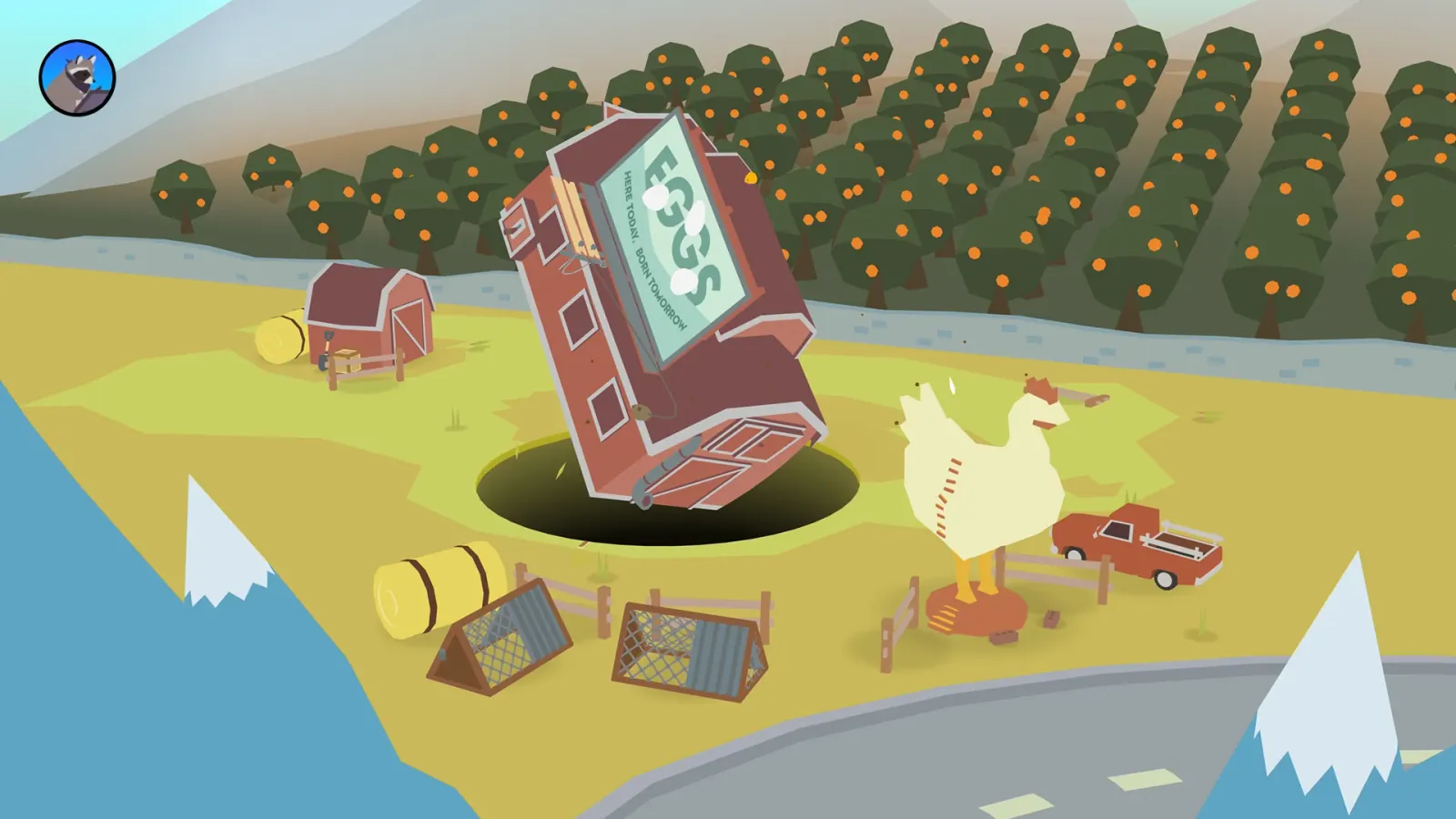
Players wobble through a whimsical world, solve environmental puzzles, help odd residents, uncover a comic conspiracy, and optionally tackle local co-op challenge rooms.
Why it may be useful
This is mostly pure play: absurd physical puzzles, gentle jokes and a light satirical thread about a too-generous benefactor. Any habit of noticing hidden costs behind free gifts is real but thin, and the game never asks you to apply it.
Keep in mind
The satirical point is easy to miss entirely, so do not expect the game to teach anything about power or fairness on its own.
Written 2026-09-15 · editorial assessment, not a measured effect · how we rate →
What the game is
Pikuniku is a short side-scrolling puzzle adventure by the small team at Sectordub, published by Devolver Digital in January 2019 for PC and Switch. You control Piku, a red oval with two long legs, who drops into a pastel valley whose residents are convinced a beast is loose. The art is flat shapes and cheerful color, the music bounces, and nothing in the world can seriously hurt you.
The campaign runs roughly four to five hours, so most players finish it across a few evenings. Structurally it is a chain of small errands: walk to the next screen, talk to someone, solve the thing blocking them, move on. Beneath the jokes sits a light satire about a generous benefactor whose free gifts turn out to have a cost. A separate local co-op mode adds short challenge rooms for two players sharing one screen and one couch. Steam players rate it Overwhelmingly Positive, ninety-six percent of nearly ten thousand English reviews.
What you actually do
You walk, jump, kick and curl into a ball. That is the whole verb list, and the game keeps finding new uses for it: kick a rock into a switch, roll down a slope to build speed, wedge your legs into a machine until it coughs up what you need. A villager asks for something specific, and you look at the screen to work out which of your few moves solves it. Difficulty rises by adding moving parts and timing rather than harder controls. Getting better looks like reading a room quickly and being willing to try the silly option, because the silly option is usually the correct one.
What it exercises
Scans a screen for the one object that reacts, then tests a guess quickly.
Connects a stated request to a physical action somewhere else in the level.
Coordinates timing and position with a second player in the shared challenge rooms.
Notices when a friendly character's offer costs somebody else something.
Recovers from a failed attempt without penalty and tries a different approach.
Why we rate it Minimal Worksheet score 13 / 100
FitHow much real knowledge or skill does the play itself make you use?12weight 45%
At 12, fit is low because cooperation and noticing are optional garnish rather than the mechanism: the co-op rooms do require two people to work together, but the single-player campaign is solvable alone from start to finish, and the satire is carried by sight gags rather than by anything you must reason through to progress.
TransferWill what you practise here work outside the game?10weight 30%
Ten is close to the floor. Spotting that a friendly offer carries a hidden cost is a real habit, but the game plays it entirely for laughs and never asks you to name the pattern or apply it anywhere else, so almost nothing here is built to travel beyond the credits.
PracticeDoes the game make you use that skill again and again, as it gets harder?20weight 25%
Twenty reflects a short game rather than a repeated discipline: every screen repeats the same look, guess, test cycle, which adds up across four or five hours, but once the campaign ends only a handful of co-op challenge rooms remain, so there is little room for the skill to keep sharpening.
What the evidence says
Editorial onlyNobody outside our desk has checked this. It is our reading of how the game plays.
This is Editorial only: our own reading of the mechanics, not a measured result. The sources are the official Pikuniku site and the Steam store page, which confirm the developer, publisher, release date, length, co-op mode, purchase model and languages, and nothing about outcomes. No research has examined whether playing Pikuniku changes how anyone reads social situations, and no proxy study was borrowed to stand in for one. What can be said is narrow: the co-op rooms require two players to divide a task and talk about it, and the story places a friendly-looking arrangement in front of the player without commenting on it. Whether anyone notices depends more on conversation afterward than on the game itself.
Editorial assessment - not a measured scientific effect.
Fit
12/100
Transfer
10/100
Practice
20/100
Why it makes the cut
The absurd movement, jokes, puzzles, and side rooms would still make this an appealing adventure even without the light social reading.
Editorial only
This reading rests on the official site and the Steam listing, which confirm the game's length, modes and mechanics but nothing about outcomes; no independent study of Pikuniku or its co-op puzzles was found.
Prices are US store listings in USD, last refreshed 2026-09-25; regional prices and sales differ.
Local co-op exists but is not required for the main campaign.
No mobile version was verified in this pass.
The official site currently links Steam, itch.io, GOG, and Nintendo eShop as the live purchase routes verified in this pass.
Steam verifies interface and subtitle support for English, French, German, Spanish, and Brazilian Portuguese.
Premium purchase on verified storefronts; no IAP or subscription dependency was found on the verified routes.
Age guidance
Ages 8+ · ESRB E
Topics
History & society
Play styles
Single-player, Co-op, Puzzle, Narrative
Tags
Absurd adventure · Co-op puzzles · Light satire
The cooperation and social noticing are genuine while they last, but the campaign is short, solvable alone, and the satire is played so lightly that most players will finish without registering it.