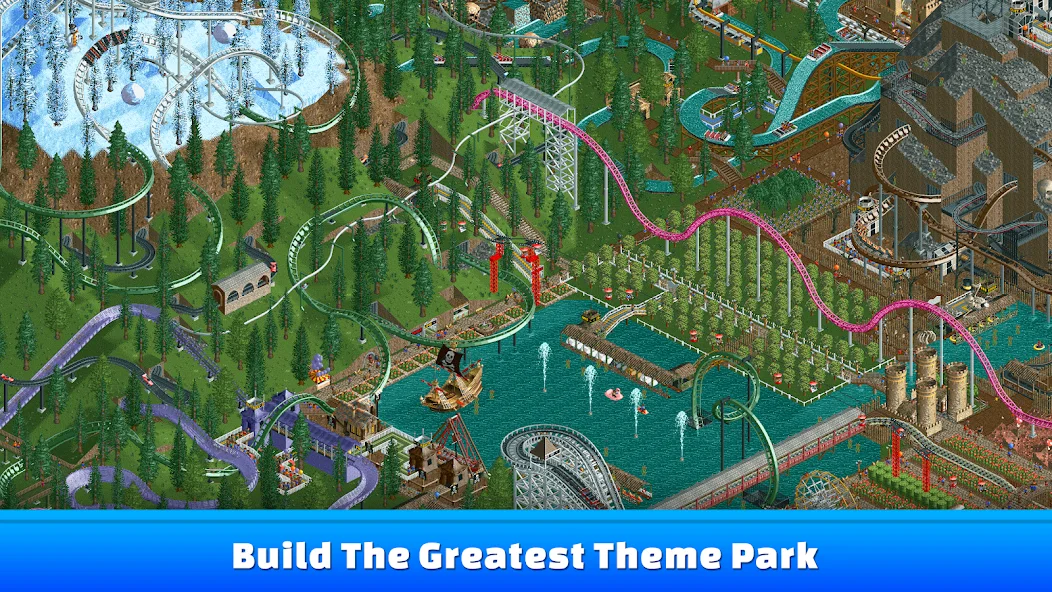
Players sculpt terrain, build rides piece by piece, place amenities, and respond to crowd behavior, finances, and reputation pressures.
Why it may be useful
You get real, repeated practice noticing how paths, queues and incentives shape where people go, but that design thinking is a soft general skill wrapped in theme-park scenery, and little of it carries to real engineering, business or urban planning.
Keep in mind
Its design-thinking payoff is real but general, and sandbox mode lets players skip the crowd-flow pressure entirely.
Written 2026-09-15 · editorial assessment, not a measured effect · how we rate →
What the game is
Planet Coaster is a theme-park builder from Frontier Developments, released in November 2016 for PC. The camera floats over an empty green plot that you fill in yourself: paths, a ticket booth, food stalls, toilets, staff rooms, and rides assembled track piece by track piece. There are more than a thousand scenery parts and terrain tools that raise hills, dig caverns and flood lakes underneath the whole thing.
It runs in three shapes. Career mode hands over an existing park with a specific problem to fix. Challenge mode starts you with money and a clock. Sandbox removes the constraints and is where many players spend their time. Every guest is simulated as an individual with a mood, a wallet and a destination, and the park's finances follow from how those individuals are treated. Steam players rate it Very Positive across more than thirty thousand English reviews.
What you actually do
You draw a path, decide where it forks, and put a ride at the end of it. Then you watch where the little people actually walk, which is rarely where you expected. A queue backs up because the entrance faces the wrong way. A corner of the park empties because there is no toilet within two minutes. Building a coaster is its own craft: you lay track segment by segment, set the height of each hill and the angle of each bank, run a test, and read the ride's excitement, fear and nausea ratings. Getting better means designing for the crowd rather than for the photograph.
What it exercises
Predicts where a crowd will walk from the shape of the paths already drawn.
Diagnoses a failing area by reading guest complaints instead of guessing.
Sets a ticket price against what guests are actually willing to pay.
Builds curved track to a target height and angle, adjusting piece by piece.
Balances a budget where every new attraction carries an ongoing running cost.
Why we rate it Low Worksheet score 40 / 100
FitHow much real knowledge or skill does the play itself make you use?35weight 45%
At 35, fit is modest: reading where a crowd will walk and diagnosing a failing area from complaints is a real, useful habit, but it stays a general design-thinking skill wearing theme-park scenery rather than a domain worked within, like real architecture or transportation engineering. Sandbox mode also lets a player switch that pressure off entirely, which holds the score down further.
TransferWill what you practise here work outside the game?25weight 30%
Twenty-five is low because almost nothing here travels. The habit of asking where people will walk and what they will want on arrival is genuine design thinking, and it can show up in unrelated layout problems, but nothing about real ride engineering, structural safety or business economics survives contact with an actual park. What a player takes away is a way of looking, not usable knowledge.
PracticeDoes the game make you use that skill again and again, as it gets harder?65weight 25%
At 65, practice is solid: the same question, where will the crowd go and what do they need, comes up hundreds of times across a single park, and the Steam Workshop supplies endless other builds to study and pull apart. The ceiling is that a stable, finished park stops generating new problems, and sandbox play can drift into pure decoration with nothing left to solve.
What the evidence says
Editorial onlyNobody outside our desk has checked this. It is our reading of how the game plays.
This is an Editorial only entry: editorial judgment about the mechanics, with no research behind it. The single source is the Steam store page, which confirms the developer, release date, modes, the individual guest simulation and Workshop support, and nothing else. Nobody has studied whether building theme parks changes how anyone thinks about layout or crowds, and no study on this game or this mechanic was found. What can be said is narrow and observable: the game rewards reasoning about where people will go and penalizes ignoring it, over and over, while sandbox mode lets that pressure be switched off entirely. Calling that practice is fair; calling it design education is not.
Editorial assessment - not a measured scientific effect.
Fit
35/100
Transfer
25/100
Practice
65/100
Why it makes the cut
PASS - Its build-and-tune coaster sandbox is a genuine creativity game first.
Editorial only
This is an editorial reading based on a single Steam store page confirming the game's modes, tools and reception; no study has tested whether building theme parks changes how anyone thinks about layout or design.
Prices are US store listings in USD, last refreshed 2026-09-25; regional prices and sales differ.
No subscription requirement was found on the verified PC route.
Steam currently verifies interface support for the listed locales. Full audio and subtitle support are only marked where a current Steam source states them explicitly.
Age guidance
Ages 10+ · ESRB E
Topics
Creativity
Play styles
Single-player, Simulation, Creative, Sandbox
Tags
Crowd flow · Park design · Guest incentives
Guest-flow pressure is real when you engage it, but sandbox mode lets that pressure be switched off entirely, and nothing about real ride engineering or park economics carries beyond the screen.