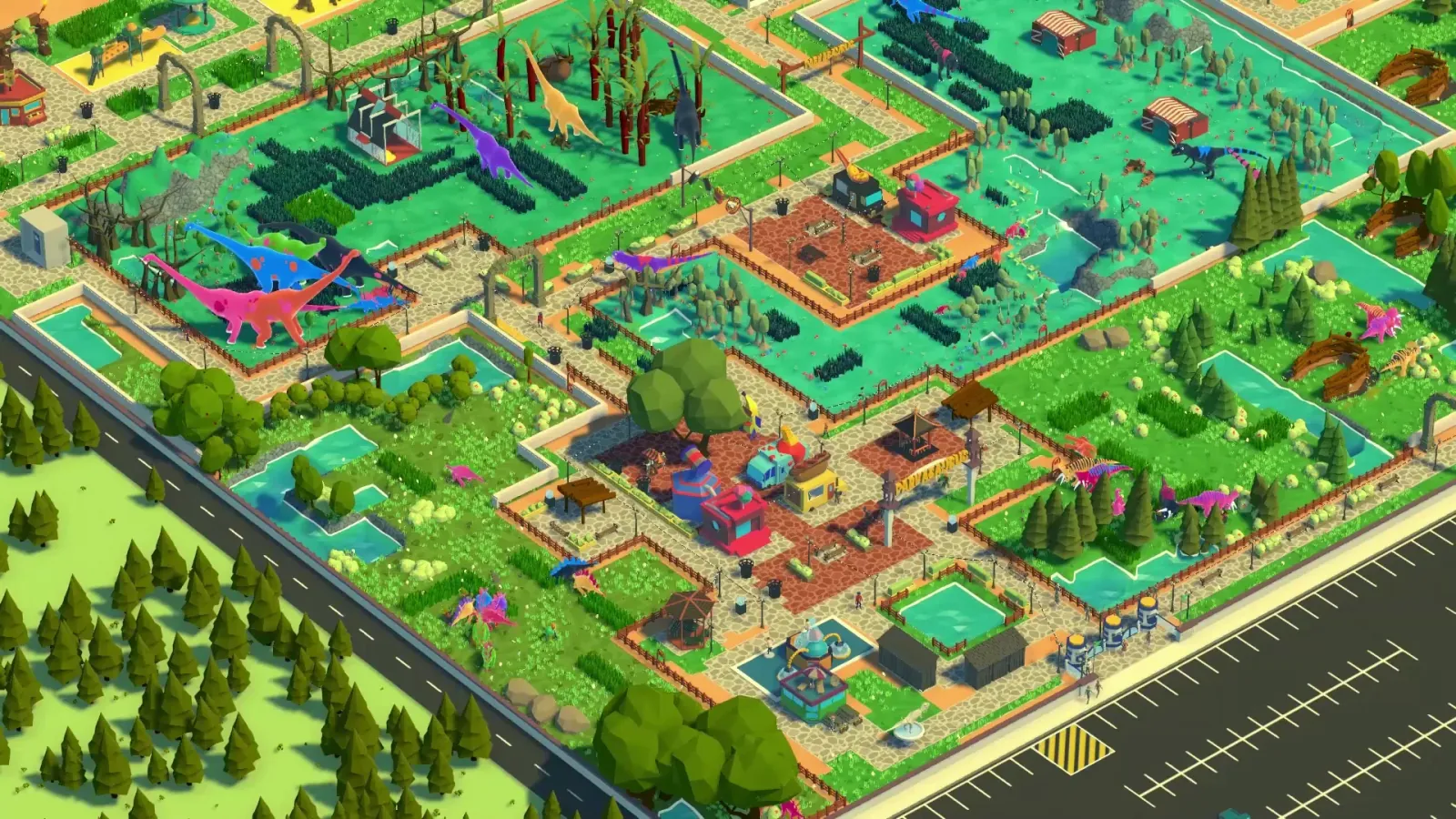
Players build coasters and amenities, shape walkways and scenery, monitor guest satisfaction, and tune finances across many fixed scenarios or custom builds.
Why it may be useful
You read guest complaints as data, then adjust prices, paths and ride intensity to fix them. The economics are a caricature, but the habit of watching a system respond to your changes is real and repeats constantly.
Keep in mind
The park economics are a caricature, not a model of a real business, and a single scenario can run for hours with no natural stopping point.
Written 2026-09-15 · editorial assessment, not a measured effect · how we rate →
What the game is
RollerCoaster Tycoon Classic is a theme-park management game released in 2017 by Origin8 Technologies and published by Atari. It combines features of the first two RollerCoaster Tycoon games into one package, and it looks the part: a small isometric park seen from above, drawn in sprite art, with a grid you lay paths and rides onto.
Each scenario hands you a park and a target to hit by a deadline. You build coasters piece by piece, price the tickets and the burgers, hire mechanics and handymen, and watch small pixel guests walk your paths and either queue or leave. Ninety-five scenarios come from the original two games, and the bundled Wacky Worlds and Time Twister packs add seventeen and fourteen more.
The Toolkit, included on PC, adds a scenario editor and a ride designer with import and export. Steam lists seven supported languages. The Android version is a paid app in which Wacky Worlds, Time Twister and the Toolkit are separate in-app purchases.
What you actually do
Building a coaster is the part players come for. You lay track segment by segment, choosing slope and banking, then run a test and read the ratings it produces for excitement, intensity and nausea. Too gentle and nobody queues; too intense and guests are sick on the path outside. The rest is quieter. You watch where crowds bunch up, widen a path, move a food stall beside a long queue, raise a price until sales dip and lower it again. Clicking a guest tells you whether it is bored, thirsty or lost.
What it exercises
Reads a crowd as data: where guests bunch, what they complain about
Changes one price at a time and watches what the change does
Plans a layout under space and money constraints before committing
Connects a design choice to a consequence that arrives minutes later
Why we rate it Low Worksheet score 43 / 100
FitHow much real knowledge or skill does the play itself make you use?38weight 45%
Fit scores 38. Reading a system, guest satisfaction, queue length, price and cash all pushing on each other, is the actual mechanism for hitting a scenario target, and that part is real. The number stays in the thirties because a large share of playtime goes to decorating and laying track piece by piece, which exercises patience and taste more than the system-reading the score is measuring.
TransferWill what you practise here work outside the game?28weight 30%
Transfer scores 28. Watching a change ripple through a system after a delay is a habit worth having, and this drills it hard. But the simulation is a caricature: guests are simple, demand is crude, and none of the numbers correspond to anything real, so what actually travels is a way of looking rather than any fact about running a business.
PracticeDoes the game make you use that skill again and again, as it gets harder?70weight 25%
Practice scores 70. A hundred and twenty-six scenarios mean the same balancing act set up differently over and over, and each park runs long enough that the practice is steady rather than a quick burst. The scenario editor extends that indefinitely. What caps it below the very top is attention: plenty of players build coasters for hours and never touch the finances at all.
What the evidence says
Editorial onlyNobody outside our desk has checked this. It is our reading of how the game plays.
The evidence level is Editorial only. Two store pages support the facts above, Steam and Google Play, and they confirm Origin8 Technologies and Atari, the 2017 release, the price, the seven supported languages, the ninety-five classic scenarios, the bundled Wacky Worlds and Time Twister packs with the Toolkit, and that the Android edition sells those additions separately. Neither source, and no study we are aware of, measures what building a park does for a player. Management sims are often described as teaching economics; we found no research testing this one.
Editorial assessment - not a measured scientific effect.
Fit
38/100
Transfer
28/100
Practice
70/100
Why it makes the cut
PASS - Its enduring sandbox appeal is unmistakably game-first.
Editorial only
This is our editorial reading of the Steam and Google Play listings. Management sims are often said to teach economics, but no research tests this one, so nothing external supports the claim.
Prices are US store listings in USD, last refreshed 2026-09-25; regional prices and sales differ.
The PC release includes Toolkit plus Wacky Worlds and Time Twister in the base purchase.
The current Android release is paid up front and keeps Wacky Worlds, Time Twister, and Toolkit as optional in-app purchases.
Current PC availability is directly verified on Steam. Current Android mobile availability is directly verified on Google Play, where the base app is paid and the Wacky Worlds, Time Twister, and Toolkit additions remain optional in-app purchases.
Steam currently verifies interface support for the listed locales. Full audio and subtitle support are only marked where a current Steam source states them explicitly.
Age guidance
Ages 8+ · ESRB E
Topics
Creativity, Logic & strategy
Play styles
Single-player, Simulation, Creative, Sandbox
Tags
Guest flow · Scenario management · Classic park design
Reading guest complaints and adjusting price or layout is the actual play, but much of the time goes to decorating and track-laying instead, which is not the same exercise as the system-reading that earns the score.