Players travel between communities, use dialogue cards to sustain conversations, adapt to unfamiliar communication patterns, and decide which relationships and obligations to prioritize.
Why it may be useful
Every conversation makes mismatch and the cost of adapting mechanically visible, which is a genuinely useful idea to sit with. The claim stays modest: the game offers a metaphor to think with, not a technique you can practice.
Keep in mind
It works best as a reflective communication game, not as a simple social-skills trainer.
Written 2026-09-15 · editorial assessment, not a measured effect · how we rate →
What the game is
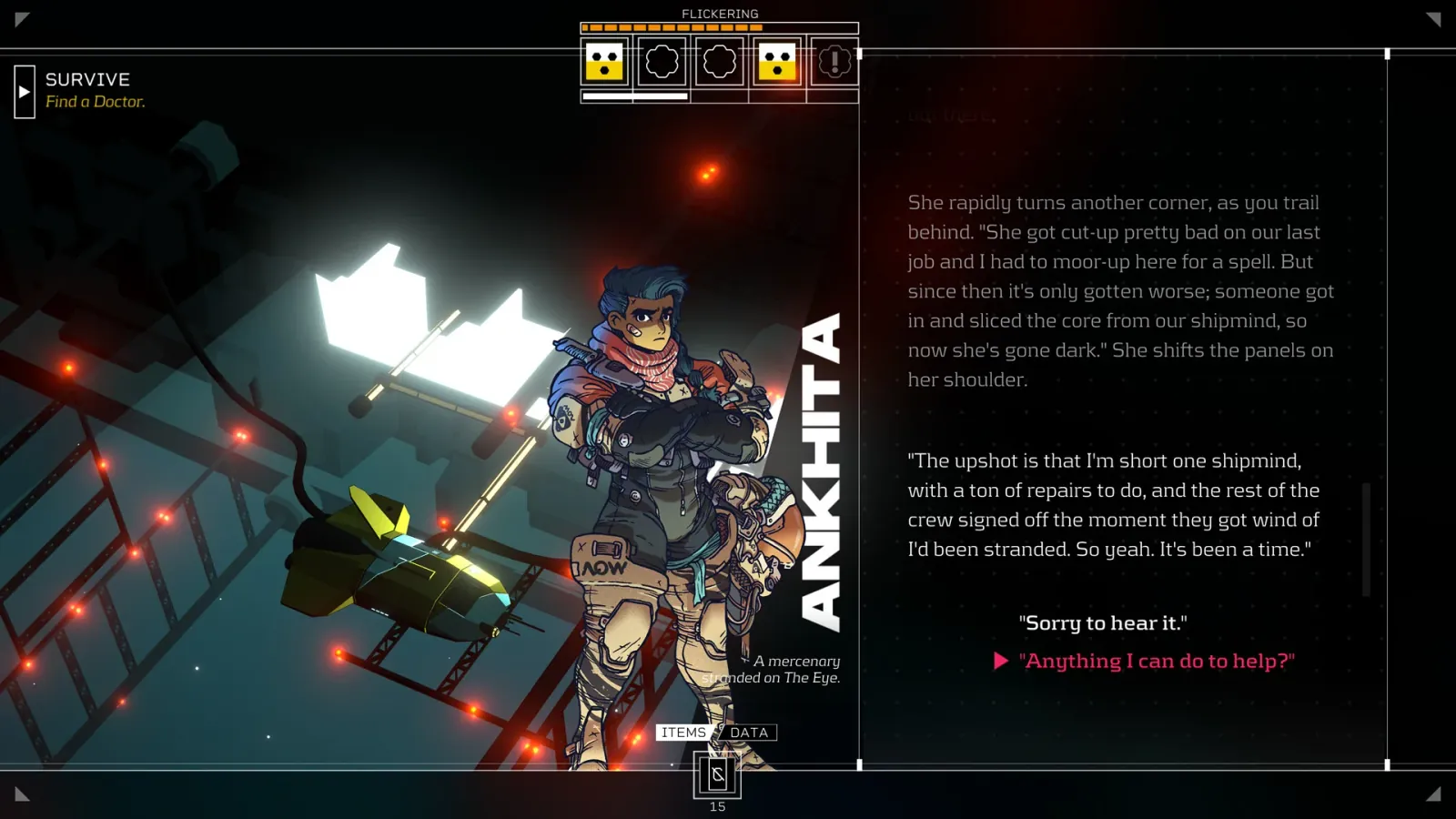
Signs of the Sojourner is a card game in which the cards are conversations. Echodog Games released it in May 2020 for Windows and macOS. Your mother has died and left you her shop in a small town, in a world where the climate has turned and travel is difficult, so you join the trading caravan and go looking for things to stock the shelves with.
Every meeting with a person is played out as a hand of cards. You and they take turns laying cards down, and a card connects only if it fits what was just played; connections build understanding and misfits build friction. The result is not a score but an outcome in the story: they open up, or they do not, and the game continues either way.
Your deck is the point. Cards come from the places you visit and the people you spend time with, and taking new ones on changes what kinds of conversation you are good at. Get better at talking to people out on the road and you may find you have grown worse at talking to the people back home. Steam lists English only, and there are several endings.
What you actually do
A trip is a sequence of stops, each with a person to talk to and a limited number of days before the caravan leaves, so you choose who to spend that time on. In a conversation you look at your hand, see what has just been played, and decide whether to answer in kind or push your own way of speaking and accept the friction. Between stops you adjust the deck, which means deciding what to give up. Getting better is not about winning conversations, because you cannot win them all. It is about choosing whose language you want to be able to speak.
What it exercises
Reads what another person has offered and answers in the same terms
Accepts that adapting to one group costs fluency with another
Chooses where to spend limited time among competing relationships
Plans a deck around the conversations that matter most
Why we rate it Minimal Worksheet score 32 / 100
FitHow much real knowledge or skill does the play itself make you use?30weight 45%
Fit is scored 30. The theme is not decoration on top of a card game; the card game is the theme. Mismatch, effort and the drift between two people are all mechanical, so a player feels them turn rather than being told about them. It stays modest because the whole system runs on a small set of symbols invented for this game, not on anything transferable.
TransferWill what you practise here work outside the game?25weight 30%
Transfer is scored 25. Recognizing that communication can fail without anyone being at fault, and that fitting in somewhere new carries a price, is a useful idea and a hard one to convey in words. What keeps this low is that the model stays a metaphor: real conversations are not decks of cards, and nothing here is a technique a player can carry into an actual exchange.
PracticeDoes the game make you use that skill again and again, as it gets harder?45weight 25%
Practice is scored 45. Conversations are constant and every one runs the same decision, so the core act repeats dozens of times across a single run, and runs are short enough to replay with a different approach. It lands in the middle because the whole story is a handful of hours, not a system a player returns to for months.
What the evidence says
Editorial onlyNobody outside our desk has checked this. It is our reading of how the game plays.
The evidence level is Editorial only. Two official sources are listed, the Echodog Games press kit and the studio site, alongside the Steam page read while writing this. Together they confirm Echodog Games as developer and publisher, the May 2020 release for Windows and macOS, the price, English as the only supported language, the deck-building conversation system, the inherited shop and the trading trips, and multiple endings. None of them measures anything about a player, and no study of this game exists. Every claim here about what it may exercise is our reading of the mechanic, offered as editorial judgment rather than a demonstrated result.
Editorial assessment - not a measured scientific effect.
Fit
30/100
Transfer
25/100
Practice
45/100
Why it makes the cut
Its conversational card-play system is interesting as a standalone design, not merely as a message carrier.
Editorial only
The evidence here is editorial: two official sources confirm the release, platforms and mechanics, but no study has tested what players take from a conversation, so the reflective value described is our reading of the design.
Prices are US store listings in USD, last refreshed 2026-09-25; regional prices and sales differ.
Single-player play is supported.
Dialogue-card matching and reading are central to the actual play experience.
Age guidance
Ages 13+
Topics
Mind & well-being, History & society
Play styles
Single-player, Strategy, Narrative
Tags
Communication · Narrative cards · Social adaptation
The card system makes communication mismatch feel real in the moment, but the model is a metaphor, and a short, single playthrough limits how much practice it actually gives.