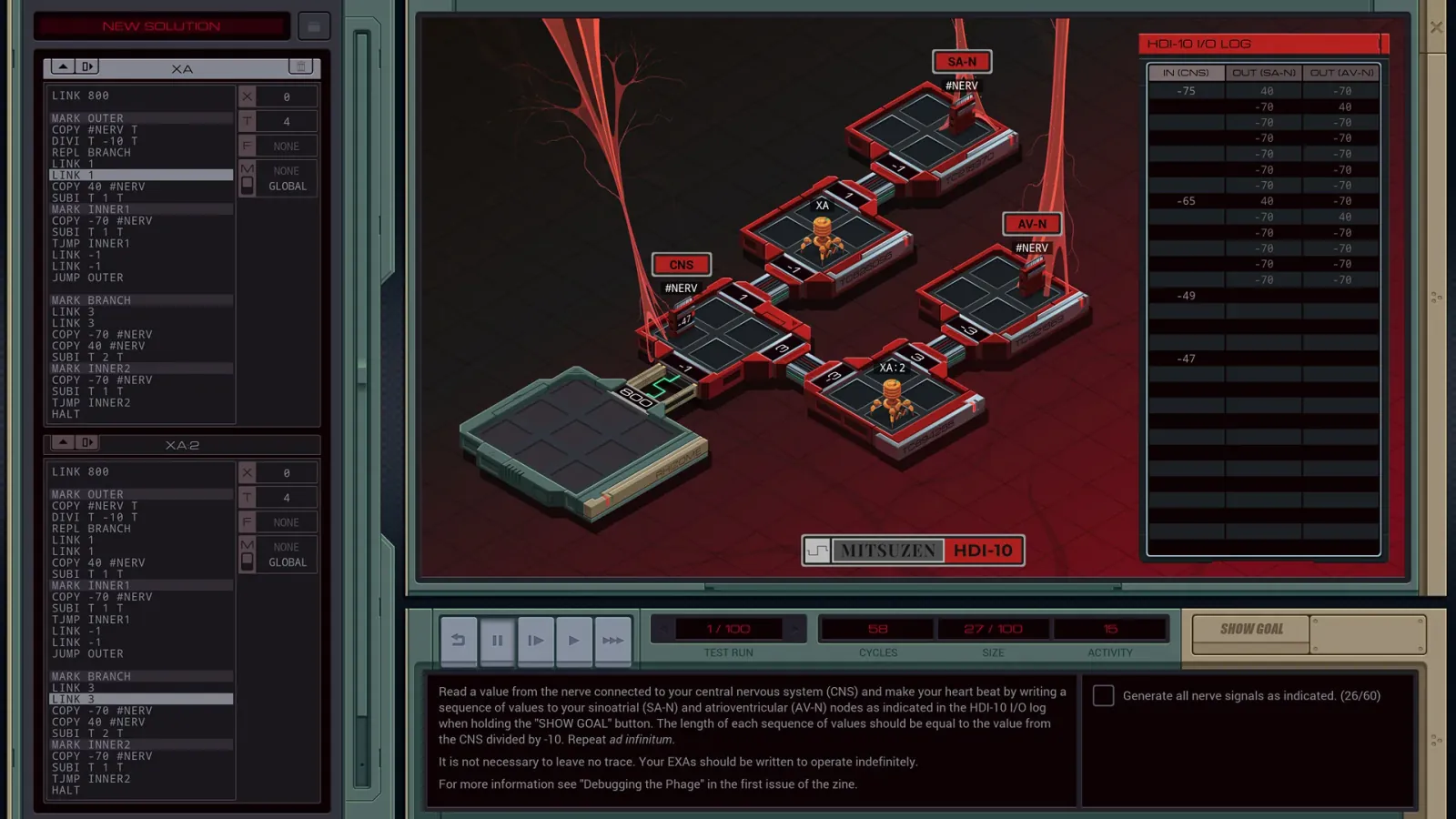
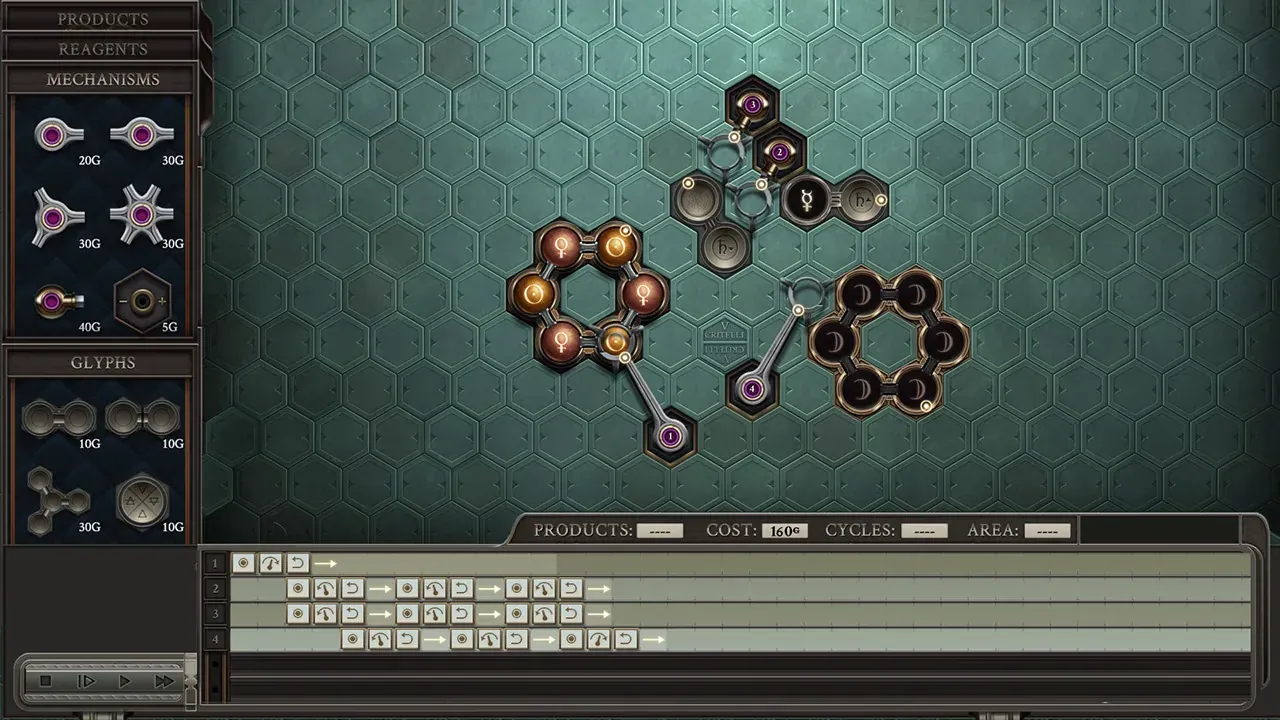
Inside each reactor you draw two colored tracks and drop commands onto them. Two mechanical arms follow their track, picking up input atoms, rotating them, bonding or splitting them and dropping finished molecules into the output. You have to keep the arms from colliding and keep the reactor running forever without jamming.
Why it may be useful
Every level requires you to design a small concurrent program, even though it never looks like code, and that habit of sequencing, branching and synchronizing two processes is genuinely rare practice at this depth, though the chemistry framing is decorative.
The chemistry is a costume: real bonding rules, energetics and reaction conditions are absent, so this practices programming and systems thinking rather than chemistry.
Written 2026-09-15 · editorial assessment, not a measured effect · how we rate →
What the game is
SpaceChem, released in March 2011, is the game that made Zachtronics known. You are a reactor engineer for a chemical company supplying frontier colonies, sent from one planet to the next as each one asks for a harder product.
The interface is a flat grid seen from above, drawn in muted greens and greys with a faint 1970s technical-manual look. On each grid you lay two loops of track, one red and one blue, and place instruction tiles on them. Above the grid sits the molecule you must produce; below sit the counters for cycles, symbols and reactors. Levels are short to start and become enormous, with later assignments needing several reactors piped together across a whole factory map. Between assignments a short comic strip carries the story, which turns quietly grim as the frontier expands.
What you actually do
You place commands on two tracks and press run. The red arm grabs an atom from the input, carries it, rotates it, bonds it to another; the blue arm does something else at the same time; both keep circling. Almost every failure is a collision, a jam or a molecule assembled in the wrong shape, and all three are visible as they happen. Difficulty rises by widening the gap between what you have and what is asked: first one reactor, then several linked in series, then a whole planet's production chain where each reactor's output is the next one's input. Getting better looks like fewer cycles, fewer instruction symbols and fewer reactors for the same result.
What it exercises
Coordinates two processes sharing one workspace without collisions
Designs a component with a fixed input and output for reuse
Predicts a repeating cycle and finds where it will jam
Breaks a large production requirement into linked stages
Reduces a working solution against a measured cost
Why we rate it High Worksheet score 72 / 100
FitHow much real knowledge or skill does the play itself make you use?75weight 45%
Fit is scored 75. The player writes a program every level, even though it never looks like text: sequencing, branching, synchronization and reuse are the only tools available, and no level yields to reflexes or persistence alone. It stops short of the very top because the puzzle space, while deep, stays confined to one invented notation rather than a real programming language.
TransferWill what you practise here work outside the game?58weight 30%
Transfer is scored 58. The concurrency intuition built here, shared resources, waiting, deadlock, is unusually valuable and hard to get elsewhere at this age, which keeps the number respectable. Against that, the notation is unique to the game, so nothing carries across as vocabulary a teacher or a real programming course would recognize, and that gap holds it in the middle of the scale.
PracticeDoes the game make you use that skill again and again, as it gets harder?85weight 25%
Practice is scored 85, the strongest of the three. Fifty-plus assignments plus optional defense levels reuse the same reasoning, and the leaderboards give a real reason to rebuild solved puzzles for a better score, so the skill gets worked repeatedly rather than once. Few puzzle games in the catalog return a player to the same demanding reasoning this often.
Where it has been used in teaching
Documented cases of this game being used with learners. Each one links to its source.
School programZachtronics · Secondary school · 2019
Zachtronics runs Zachademics, a free institutional license program for public schools and school-like nonprofits; SpaceChem is currently listed among the eligible games. The company says its games need adult scaffolding and are not designed as teaching tools; no specific school's use is reported.
Practice-backedNo published study, but people who answer for the outcome use it: schools, clinics, museums, research labs.
The evidence level is Practice-backed because of the documented Zachademics program below; the underlying sources are the Zachtronics game page and the Steam listing, both checked in September 2026. They confirm the reactor design mechanics, the fifty-plus puzzles and the optimization scoring. Neither claims an educational outcome on its own, and we found no independent study of this specific game. The rating beyond the licensing program is editorial: designing a correct concurrent program is required to pass any level, while the chemistry framing does not correspond to real chemical behavior.
Editorial assessment - not a measured scientific effect.
Fit
75/100
Transfer
58/100
Practice
85/100
Why it makes the cut
It is a puzzle game with per-level leaderboards for cycles, symbols and reactors, and players return for years to shave a solution down, which nobody does with a lesson.
Practice-backed
This is practice-backed: Zachtronics runs a free licensing program that lists this game for schools, though the company itself says its games need adult scaffolding and are not built as teaching tools, and no specific classroom use is documented.
Prices are US store listings in USD, last refreshed 2026-09-28; regional prices and sales differ.
Windows, macOS and Linux. Older mobile and tablet versions are no longer sold.
Age guidance
Ages 12+
Topics
STEM, Logic & strategy
Play styles
Single-player, Puzzle
Tags
Programming puzzle · Chemistry theme · Optimization · Very challenging
Every level is solved by designing a working concurrent program, which is demanding, genuine practice, though the chemistry dressing it wears has little to do with how real bonding works.