You are handed a grid of tiny processors, each with room for about fifteen lines of assembly and one register, and each able to pass values only to its neighbors. A puzzle names an input stream and the output it should become, and you write the code in every node that makes it happen.
Why it may be useful
It drills two core low-level programming habits: splitting a problem across units that cannot see each other's state, and reading a reference manual instead of guessing. The cycle, instruction and node counters turn a working answer into something worth optimizing.
This is genuinely difficult, deliberately austere, and easy to bounce off; the story is fragmentary and there is nothing here for a player who wants warmth or spectacle.
Written 2026-09-15 · editorial assessment, not a measured effect · how we rate →
What the game is
TIS-100 is a programming puzzle game by Zachtronics, the studio behind SpaceChem, Infinifactory, Opus Magnum and Shenzhen I/O. It came out in July 2015 for Windows, macOS and Linux and is one of the cheapest games in this catalog.
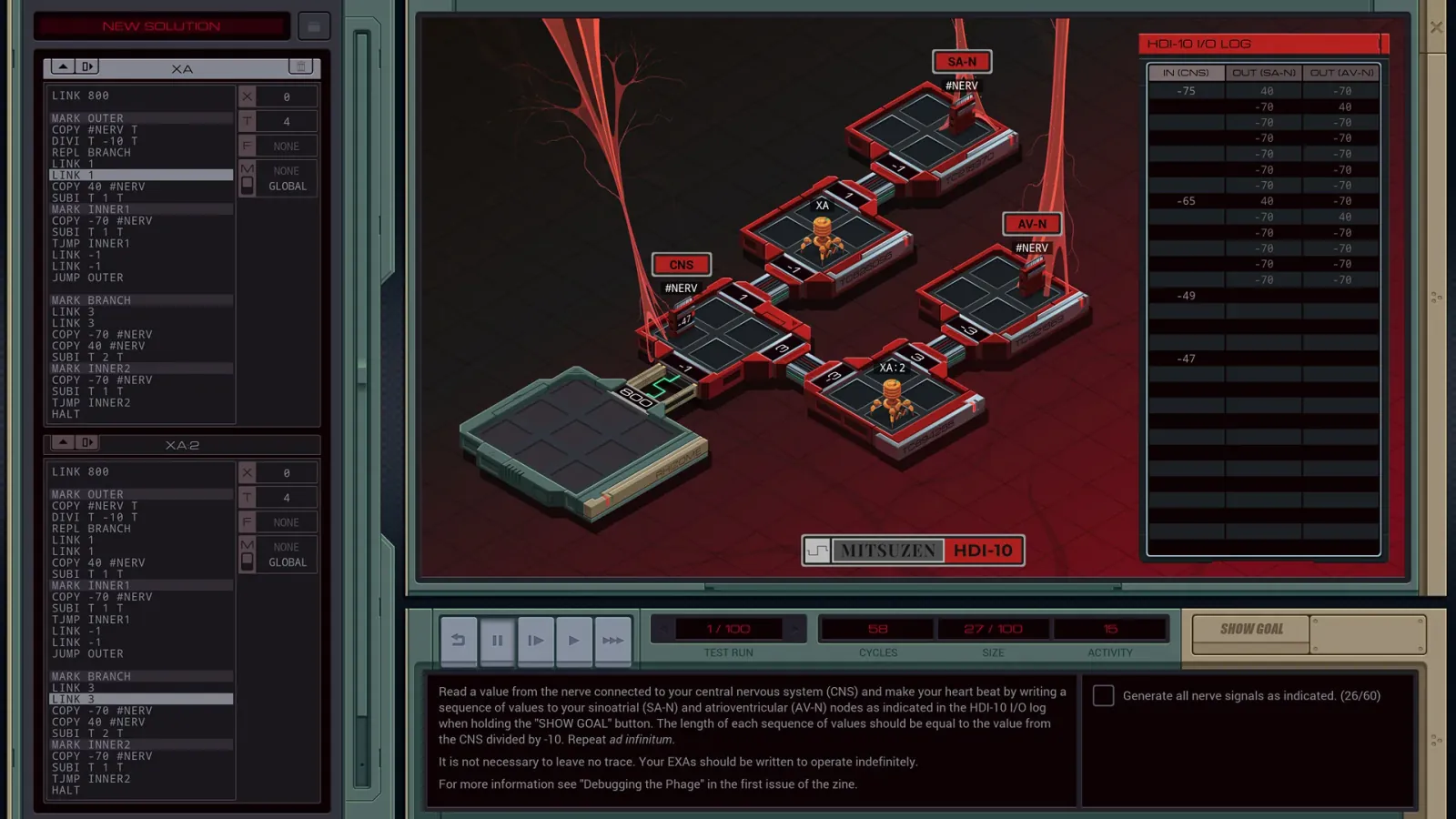
It looks like a monochrome terminal from 1985. A grid of twelve small nodes fills the screen; each node holds about fifteen lines of code and a single accumulator, and can only pass a value up, down, left or right to the node beside it. Down the left edge sit the input stream and the output the puzzle wants. There is no art, no music beyond a hum, and no character on screen. The fiction arrives as scraps of a printed manual left by the machine's previous owner, and the manual is also the reference you actually need, because the game explains almost nothing on screen.
What you actually do
You read what the puzzle wants, then decide how to spread the work over the grid. One node might read the stream and test the sign of each number; two more might handle the negative and positive branches; another might merge the results and send them out. Because nodes block while waiting for a neighbor, timing matters, and a design that works can deadlock when you change one line. When it finally runs, the game shows how many cycles, instructions and nodes you used against a histogram of everyone else's solutions, and most players immediately go back to make theirs smaller.
What it exercises
Writes short assembly routines with jumps, conditions and a single register
Splits one problem across units that cannot see each other's state
Reads a technical reference manual to find an instruction
Diagnoses a deadlock by tracing which node is waiting for which
Rewrites a working solution to hit a stated efficiency target
Why we rate it High Worksheet score 79 / 100
FitHow much real knowledge or skill does the play itself make you use?84weight 45%
At 84 the play is squarely inside a real discipline: writing and debugging small assembly routines under real constraints of registers and message passing. It is not higher because the twelve-node grid and the invented instruction set are a simplified model of real hardware, not the work of building one directly.
TransferWill what you practise here work outside the game?72weight 30%
At 72 the instruction set is fictional, so nobody leaves able to program an actual chip. What does carry over is heavier: reasoning about state, blocking and message passing between independent units, and optimizing a working answer against a stated metric instead of stopping at merely correct.
PracticeDoes the game make you use that skill again and again, as it gets harder?80weight 25%
At 80 more than forty-five puzzles use the same skills at rising difficulty, the cycle-and-instruction histograms invite return visits to solved levels, and three sandboxes let a player set new problems once the campaign ends, which is unusually deep repetition for a puzzle game of this size.
Where it has been used in teaching
Documented cases of this game being used with learners. Each one links to its source.
School programZachtronics · Secondary school · 2019
Zachtronics runs Zachademics, a free institutional license program for public schools and school-like nonprofits; TIS-100 is currently listed among the eligible games. The company says its games need adult scaffolding and are not designed as teaching tools; no specific school's use is reported.
Practice-backedNo published study, but people who answer for the outcome use it: schools, clinics, museums, research labs.
The evidence here is Practice-backed, resting mainly on Zachtronics running Zachademics, a free institutional licensing program that currently lists TIS-100 among the games eligible for public schools and school-like nonprofits. The company is explicit that its games need adult scaffolding and were not designed as teaching tools, and no specific school's use of this title is documented beyond that eligibility. The Zachtronics game page and the Steam listing, both checked on 10 September 2026, confirm the node grid, the assembly language, the reference manual, the puzzle count and the sandboxes. No study measures what a player learns from it.
Editorial assessment - not a measured scientific effect.
Fit
84/100
Transfer
72/100
Practice
80/100
Why it makes the cut
Players compete on histograms of cycles, instructions and nodes, build their own puzzles in the sandboxes, and keep going long after the story ends, which is the behavior of a puzzle game rather than a course.
Practice-backed
Zachtronics offers this game free to schools through its own Zachademics program, which is documented institutional use, though the company states its games need adult scaffolding and are not built as teaching tools; beyond that, this is our reading of the published mechanics.
Prices are US store listings in USD, last refreshed 2026-09-28; regional prices and sales differ.
Windows, macOS and Linux. The printable reference manual that comes with the game is the actual tutorial.
Age guidance
Ages 14+
Topics
STEM, Logic & strategy
Play styles
Single-player, Puzzle
Tags
Assembly language · Parallel processing · Very challenging · Cheap
Writing and debugging real assembly logic is the entire activity, but the instruction set is invented and the difficulty wall keeps out most players who might otherwise benefit from it.