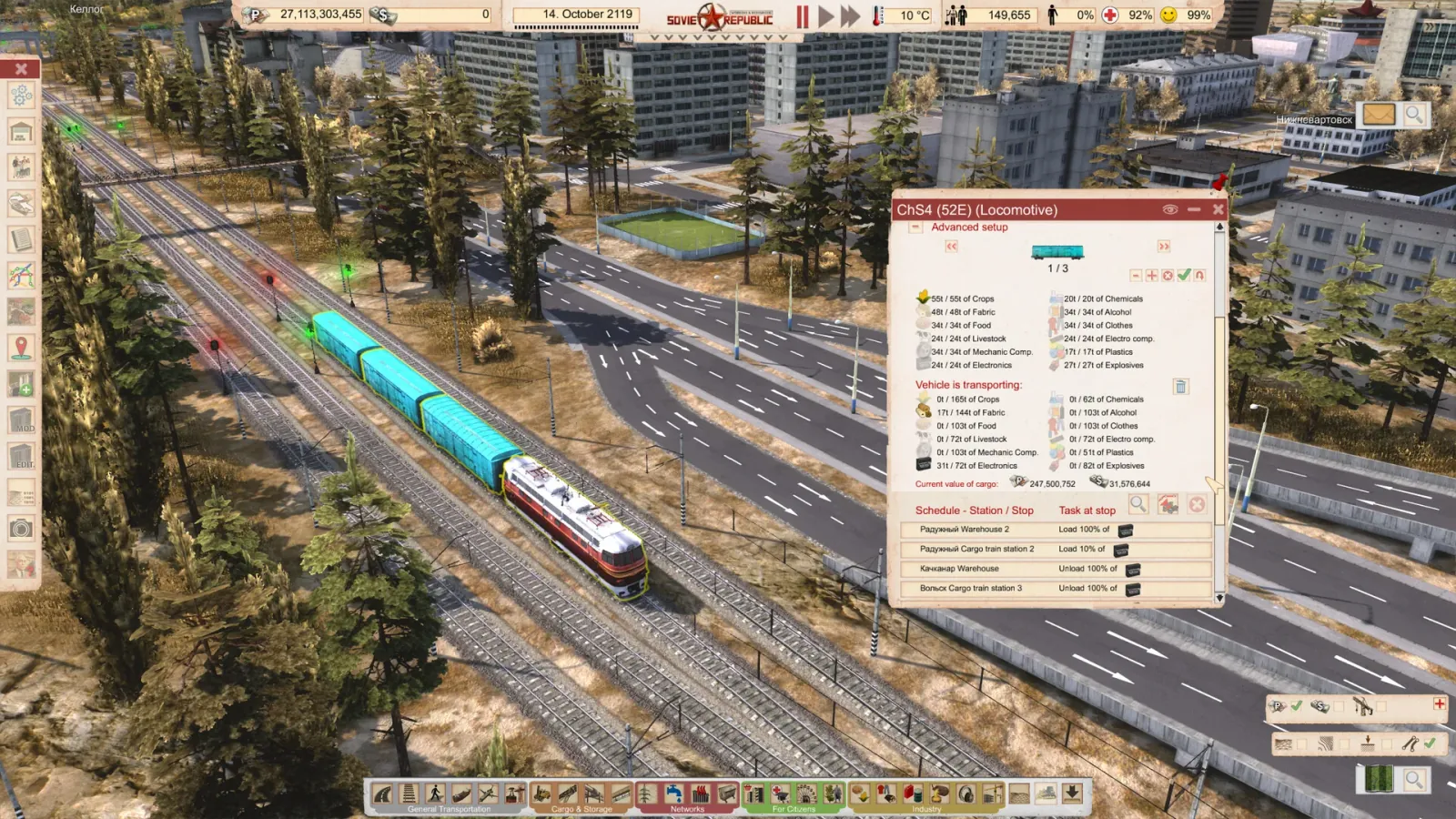
Players expand cities, link factories and shipping lines, satisfy layered population tiers, and manage the knock-on effects of industrial growth across multiple regions.
Why it may be useful
Nothing can be built without inputs, and those inputs come from other buildings on other islands, so tracing a shortage back through a production chain is the constant activity. The reasoning is real and rehearsed for hours, but it stays unnamed and tied to one invented economy.
Keep in mind
Anno 1800's colonial and industrial model is not neutral history; it is a designed economic simulation with clear assumptions.
Written 2026-09-15 · editorial assessment, not a measured effect · how we rate →
What the game is
Anno 1800 is a city-building strategy game from Ubisoft's Mainz studio, released in 2019 for PC. You settle a group of islands during the industrial revolution and grow a population that keeps wanting more: first farmers who need fish and schnapps, then workers who need sausage and beer, then artisans, engineers and investors, each tier with its own list of goods and services.
Everything you build is part of a chain. Bread needs flour, which needs a mill, which needs grain, which needs the right soil, which may only exist on another island, which means ships, which means shipyards and trade routes. Islands specialize by necessity, and the map slowly becomes a logistics network rather than a set of towns.
There is a campaign, a sandbox and a great deal of paid downloadable content covering other regions and industries. The verified route is Steam, which requires a Ubisoft account and includes Denuvo anti-tamper software. Sessions are long: a mature city is many hours of play, and the game is designed to be returned to.
What you actually do
You read a shortage and trace it back. Beer is missing, so the brewery has stopped, so the hops farm is short of fertility, so you need an island that grows hops, so you need a trade route and a ship to run it, so you need money, so you need something worth selling. Every fix creates the next constraint. Meanwhile population tiers keep upgrading and demanding goods you do not yet make. Getting better means seeing the bottleneck two steps before it stops production.
What it exercises
Traces a shortage backwards through a multi-stage production chain
Plans transport between locations that each produce different things
Balances competing demands from several groups with different needs
Reads a set of dashboards and works out which number is the real constraint
Invests now for a payoff several production steps later
Why we rate it Moderate Worksheet score 60 / 100
FitHow much real knowledge or skill does the play itself make you use?55weight 45%
Interdependence is the whole game: nothing can be built without inputs, and the inputs come from other buildings on other islands, so you are forced to hold a supply network in mind at all times. The score settles at 55 because, for all its scale, the underlying decision is a familiar chain-tracing move repeated across many goods rather than a wider range of reasoning.
TransferWill what you practise here work outside the game?45weight 30%
Reasoning about dependencies, throughput and bottlenecks is genuinely general, and this game gives an unusually large and legible example of it. What holds this to 45 is that the reasoning is never named or abstracted: you practice it fluently inside Anno without necessarily recognizing the same shape of problem anywhere else.
PracticeDoes the game make you use that skill again and again, as it gets harder?85weight 25%
The trace-the-bottleneck move recurs constantly across sessions that run for many hours, and each new island repeats it with different constraints, which is why practice is the strongest score here at 85. Very few games in this catalog ask for that reasoning so continuously over so much play time.
What the evidence says
Editorial onlyNobody outside our desk has checked this. It is our reading of how the game plays.
The evidence level is Editorial only: our judgment grounded in the mechanics, checked against the game's Steam page, which confirms the developer, the 2019 release, the PC route, the Ubisoft account requirement, the anti-tamper software and current player reception. There is no study of this game in our sources and none is claimed. The meaningfulness case rests on something visible in the interface rather than on any research: production is literally a chain of dependencies, and a player who cannot trace one backwards cannot keep a city growing.
Editorial assessment - not a measured scientific effect.
Fit
55/100
Transfer
45/100
Practice
85/100
Why it makes the cut
PASS - Its logistics-and-production loop is a high-quality strategy attraction on its own.
Editorial only
Our reading of the mechanics, checked against the game's Steam page, which confirms the release, the Ubisoft account requirement and current player reception. No independent study of this game exists.
Prices are US store listings in USD, last refreshed 2026-09-25; regional prices and sales differ.
The current Steam route requires a Ubisoft account and includes Denuvo anti-tamper.
Current PC availability is directly verified on Steam. The verified route requires a Ubisoft account and current DLC is extensive but optional.
Steam currently verifies interface support for the listed locales. Full audio and subtitle support are only marked where a current Steam source states them explicitly.
Age guidance
Ages 13+ · ESRB T
Topics
History & society, Logic & strategy
Play styles
Single-player, Strategy, Simulation
Tags
Production chains · Industrial logistics · Population tiers
Interdependence is the whole game, since nothing can be built without inputs from elsewhere, and long sessions rehearse that reasoning constantly, but the chain is never named or abstracted into something you could apply outside it.