Players paint, zoom, arrange objects, and solve small scene-based puzzles while piecing together fragments of the protagonist's story.
Why it may be useful
Progress depends on looking closely and matching color to light, so Behind the Frame gives real if modest practice at visual attention. At roughly ninety minutes and never naming what it is teaching, that practice stays a light nudge rather than a lasting habit.
Keep in mind
This is a quiet observation puzzle, not proof of any lasting benefit to attention or wellbeing, and several puzzles reduce to finding one small hotspot.
Written 2026-09-15 · editorial assessment, not a measured effect · how we rate →
What the game is
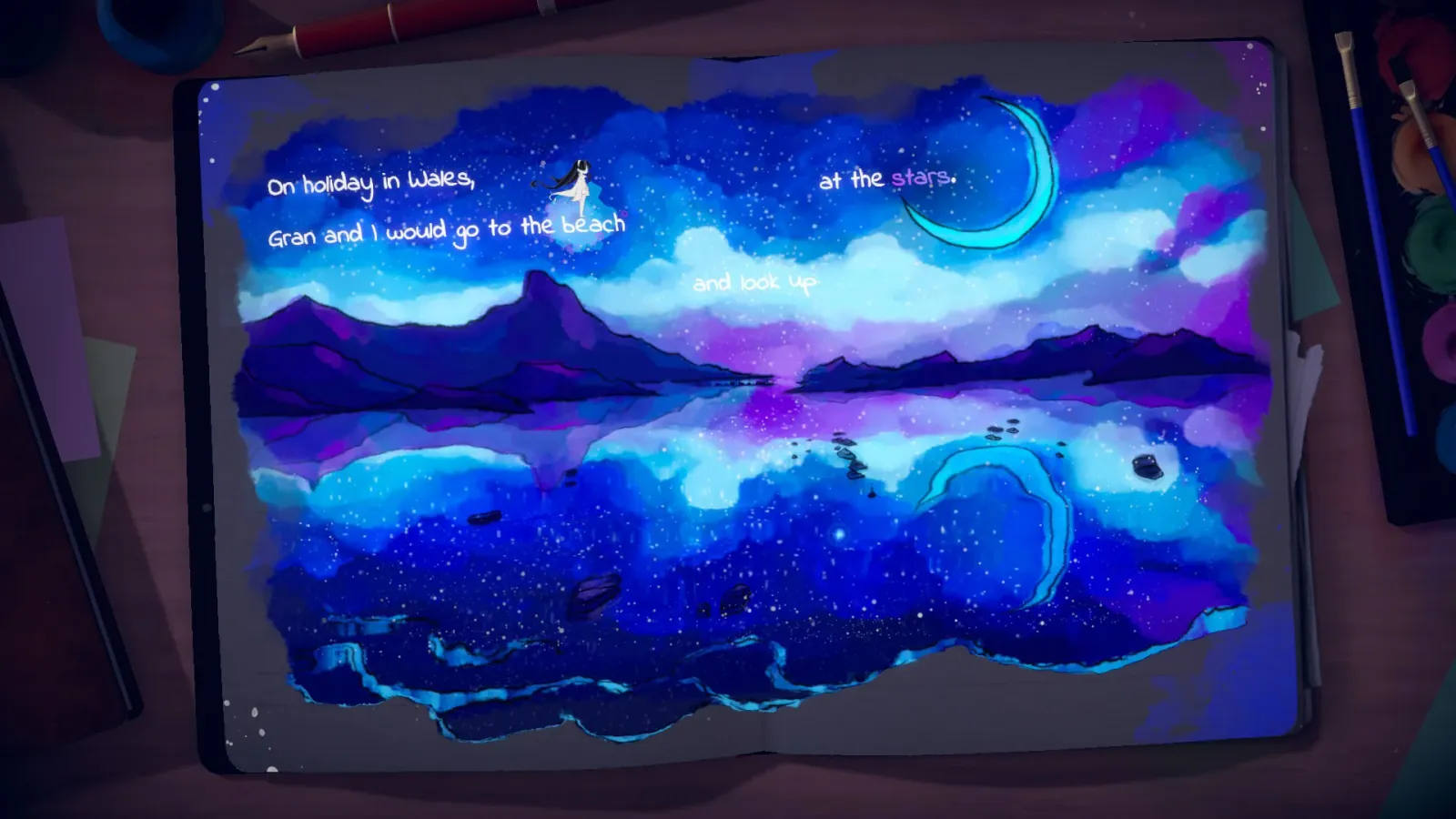
Behind the Frame is a short point-and-click adventure about a young painter finishing one canvas. Silver Lining Studio, a small team in Taiwan, released it in August 2021, with Akupara Games and Akatsuki Taiwan publishing. Everything is hand-drawn and animated in the flat, warm style of a watercolor picture book. You spend the game inside one apartment and inside the paintings it produces, moving through a handful of short chapters that each cover part of a day.
The whole story runs about one to two hours, roughly the length of a film, and there is no fail state, no timer, and no combat. Steam lists it as a single-player adventure with ten interface languages, including English. Most of the screen is the room or the canvas. You click things, and the game answers with animation and music rather than with text.
What you actually do
Each chapter gives you a small set of things to touch. You look around the apartment, find the objects the painter needs, and then work on the canvas: pick a color, drag it where it belongs, fill in the part of the picture that is missing. Some puzzles are matching, where the shade on the palette has to agree with the light outside the window. Others are ordering, where a memory only makes sense once its pieces are arranged correctly. Progress is not about a steady hand. The game accepts your stroke as soon as you have chosen the right idea. Getting better here means noticing sooner: seeing which detail in the room has changed, or which color a scene is short of.
What it exercises
Scans a detailed scene for the one object or color that changed
Matches a color on the palette to the light in a scene
Reads a wordless story from images, gesture, and music
Holds a sequence of remembered scenes in the right order
Stays with a slow, quiet task that offers no score
Why we rate it Minimal Worksheet score 17 / 100
FitHow much real knowledge or skill does the play itself make you use?20weight 45%
The useful part sits inside the click: you cannot advance without looking closely and choosing a color deliberately. But the fit tops out at 20 because a fair number of puzzles resolve to finding the single hotspot the designer left, which is searching more than seeing, and the game rarely asks you to reason about what you found.
TransferWill what you practise here work outside the game?15weight 30%
Careful looking is a habit that can travel to a museum or a picture book, but the game never names what it is asking for, and roughly ninety minutes is not enough repetition to fix a habit on its own. Transfer sits at 15 because any carryover depends entirely on what a player does with it afterward, not on the game itself.
PracticeDoes the game make you use that skill again and again, as it gets harder?15weight 25%
The same act, look, notice, choose a color, apply it, repeats in every chapter, which is why practice is not at the very bottom. But the game is short, the puzzles do not regenerate, and once the story ends there is no reason to return, so the repetition stops well before it could build into anything durable.
What the evidence says
Editorial onlyNobody outside our desk has checked this. It is our reading of how the game plays.
The evidence level is Editorial only: our reading of the mechanics, the Steam listing, and the developer's own page, both checked in August 2026. No study looks at this game, and we found none on short observational adventures as a group. What the sources support is factual: who made it, when it came out, that it runs roughly one to two hours, that it is single-player, and that the confirmed route is a paid PC download. Everything here about attention and looking follows from what the puzzles require a player to do, not from any measured result.
Editorial assessment - not a measured scientific effect.
Fit
20/100
Transfer
15/100
Practice
15/100
Why it makes the cut
PASS - Its painterly object-interaction loop is appealing as an artistic game experience in itself.
Editorial only
Editorial only: no study looks at this short adventure, and our case rests on what the puzzles require rather than on any measured outcome for a player who completes them.
Prices are US store listings in USD, last refreshed 2026-09-25; regional prices and sales differ.
No subscription requirement was found on the verified PC route.
Steam currently verifies interface support for the listed locales. Full audio is captured only where Steam explicitly marks it; subtitle coverage remains unknown unless a platform source states it separately.
Age guidance
Ages 10+ · ESRB E
Topics
Creativity, Mind & well-being
Play styles
Single-player, Narrative, Puzzle
Tags
Visual observation · Short narrative · Scene puzzles
The puzzles ask you to look and match color rather than think through a system, and at ninety minutes with no scaling difficulty, that light observation practice barely counts as sustained skill-building.