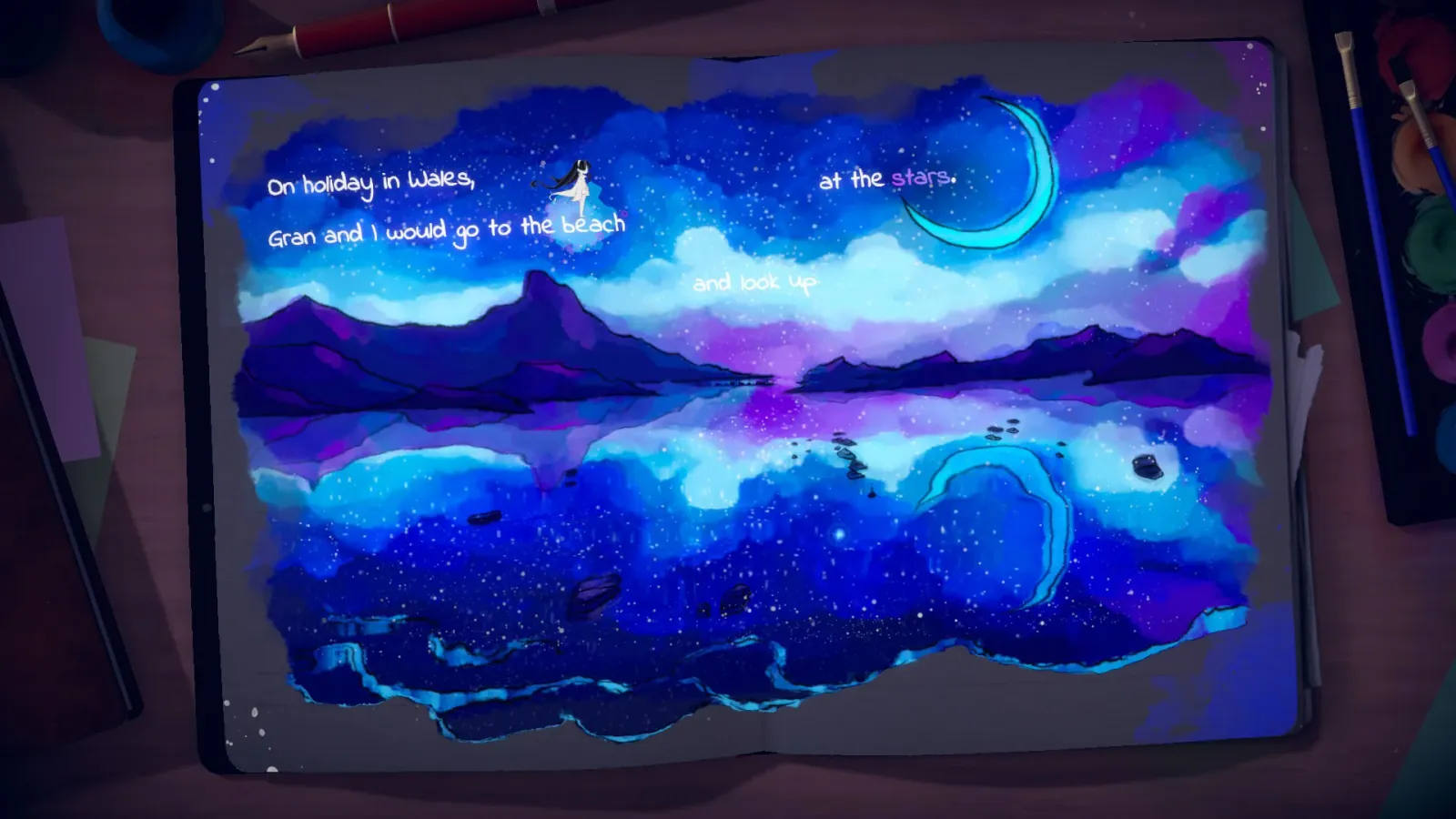
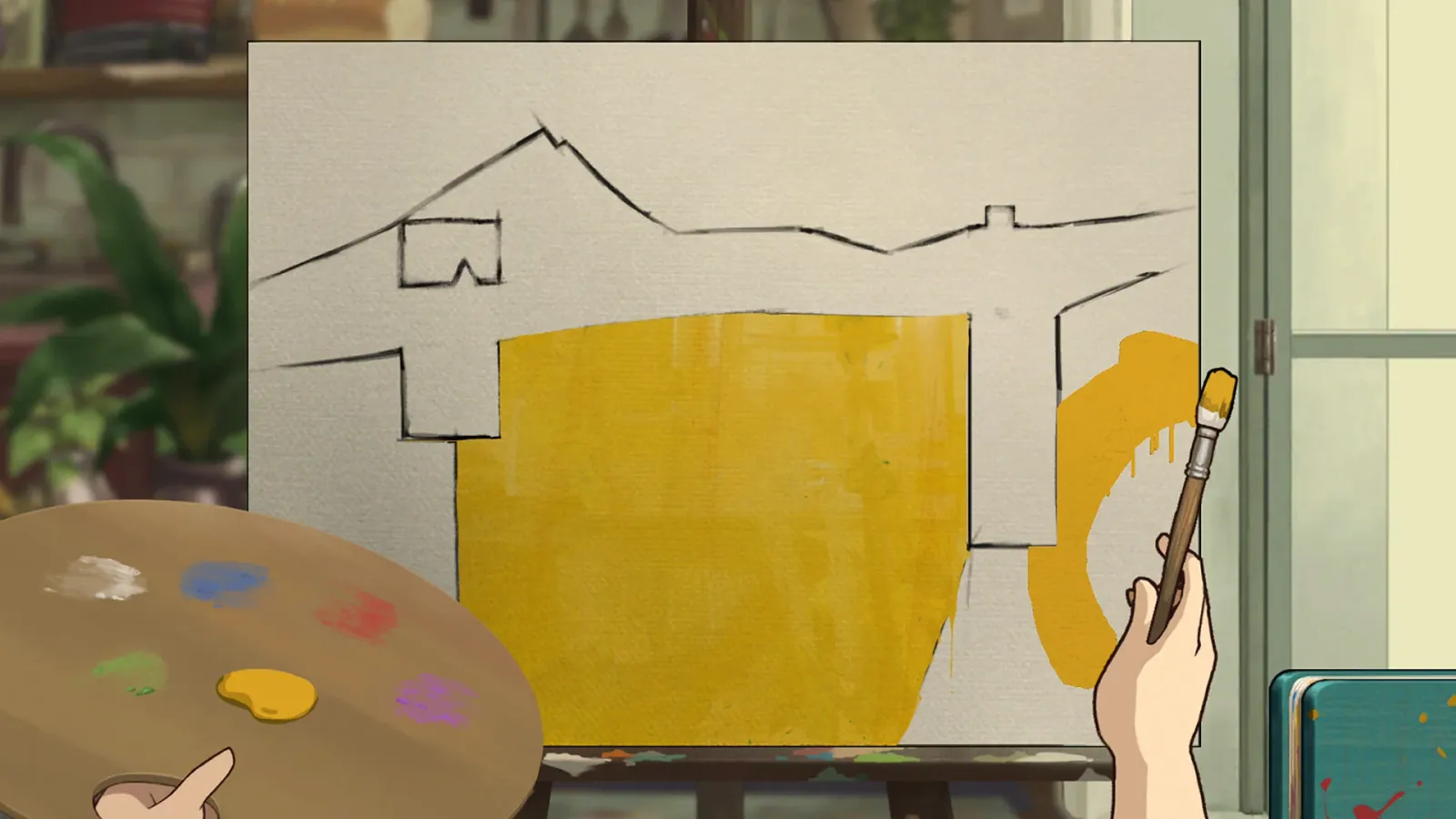
Players paint walls, bring magical creatures to life, solve light environmental problems with color and motion, and gradually change both the town and its emotional atmosphere.
Why it may be useful
Every genie request is a small design brief you answer with a picture, so composing scenes is wired into progress rather than bolted on. The stamps do most of the actual drawing, so what you practice is choice-making, not drawing technique.
Keep in mind
Its bullying and emotional distress are central to the experience and materially affect age fit.
Written 2026-09-15 · editorial assessment, not a measured effect · how we rate →
What the game is
Concrete Genie is a single-player painting adventure made by PixelOpus, a small studio inside Sony, and released for PlayStation 4 in October 2019. You play Ash, a teenager in Denska, a seaside town closed down by pollution and mostly emptied out. Ash's sketchbook is torn up by a group of local boys and the pages scatter across the streets.
Recovering them turns Ash's brush into something that paints light onto walls. The town is a chain of small, dim districts you climb through, and the walls are the canvas: painting fills them with moving trees, waterfalls and stars. Creatures you draw, the genies, step out of the mural and follow you along the wall. Play alternates between quiet painting and keeping out of the way of the boys who are looking for you.
The official PlayStation page rates it Everyone 10+ with a fantasy violence descriptor. Optional PlayStation VR modes exist, including a free-paint mode using two Move controllers, but the main game does not need VR.
What you actually do
You aim the brush by tilting the controller and paint with a sweep of the stick: pick a stamp such as a tree, a butterfly or a rainbow, swipe it onto the wall, and it animates. Filling the walls of a district lights its streetlights and opens the way onward. The genies then ask for things. One wants apples painted so it can eat, another wants wind so it can turn a fan, and satisfying the request gets you past an obstacle. So the loop is read what a mural is missing, paint it, and watch the genie solve the problem. In between, the boys patrol; being caught sets you back rather than killing you. The last stretch of the game turns toward light action, which is what the fantasy violence descriptor refers to.
What it exercises
Chooses which painted element a scene needs to produce the effect you want
Steers a brush by tilting a controller, which asks for fine motion control
Plans a route through a district by deciding which walls to light first
Composes a picture from a limited set of stamps and colors
Reads emotional states in characters, including the boys doing the chasing
Why we rate it Minimal Worksheet score 27 / 100
FitHow much real knowledge or skill does the play itself make you use?28weight 45%
Scored 28. Painting genuinely drives progress: you clear obstacles and move the story forward by answering a genie's request with a picture, rather than painting as decoration. It stays low because there is little for that choice to work with, a handful of preset stamps rather than any real compositional or technical subject matter.
TransferWill what you practise here work outside the game?22weight 30%
Scored 22, near the floor. Deciding what a scene needs and adjusting a picture is a real habit from drawing, but the stamps do the actual drawing for you, so what you practice is selection rather than technique. Almost nothing here builds toward making a picture with your own hand.
PracticeDoes the game make you use that skill again and again, as it gets harder?30weight 25%
Scored 30. Each district repeats the same cycle of exploring, finding walls, painting and answering a genie, so the composing decision comes up many times across a playthrough, and the set of stamps grows to keep choices from going stale. But the game is not long, and once finished there is little reason to replay it, which keeps repeated practice modest.
What the evidence says
Editorial onlyNobody outside our desk has checked this. It is our reading of how the game plays.
This is Editorial only. The only source is Sony's own product page for the game, checked in August 2026 and re-read here. It confirms the developer, the October 2019 release, the E10+ rating and its fantasy violence descriptor, the paintbrush and genie premise, and the optional VR modes. It says nothing about effects on players. The meaningfulness rating is our own reading of the mechanics: painting drives real progress, but it works with only a handful of preset stamps rather than any deeper subject matter, and what carries over stays modest because those stamps do the actual drawing. We found no study of this game, and we make no claim that it helps anyone cope with bullying.
Editorial assessment - not a measured scientific effect.
Fit
28/100
Transfer
22/100
Practice
30/100
Why it makes the cut
Its art-and-exploration loop is attractive as play beyond any message layer.
Editorial only
This is our own reading of the mechanics, checked against Sony's official product page, which confirms the release date, the rating and the paintbrush-and-genie premise. It says nothing about effects on players, and no study of this game exists.
Painting is how you travel and solve problems here, which ties creative choice directly to progress, but the stamps do the actual drawing and the game is short, so the practice stays real but modest.