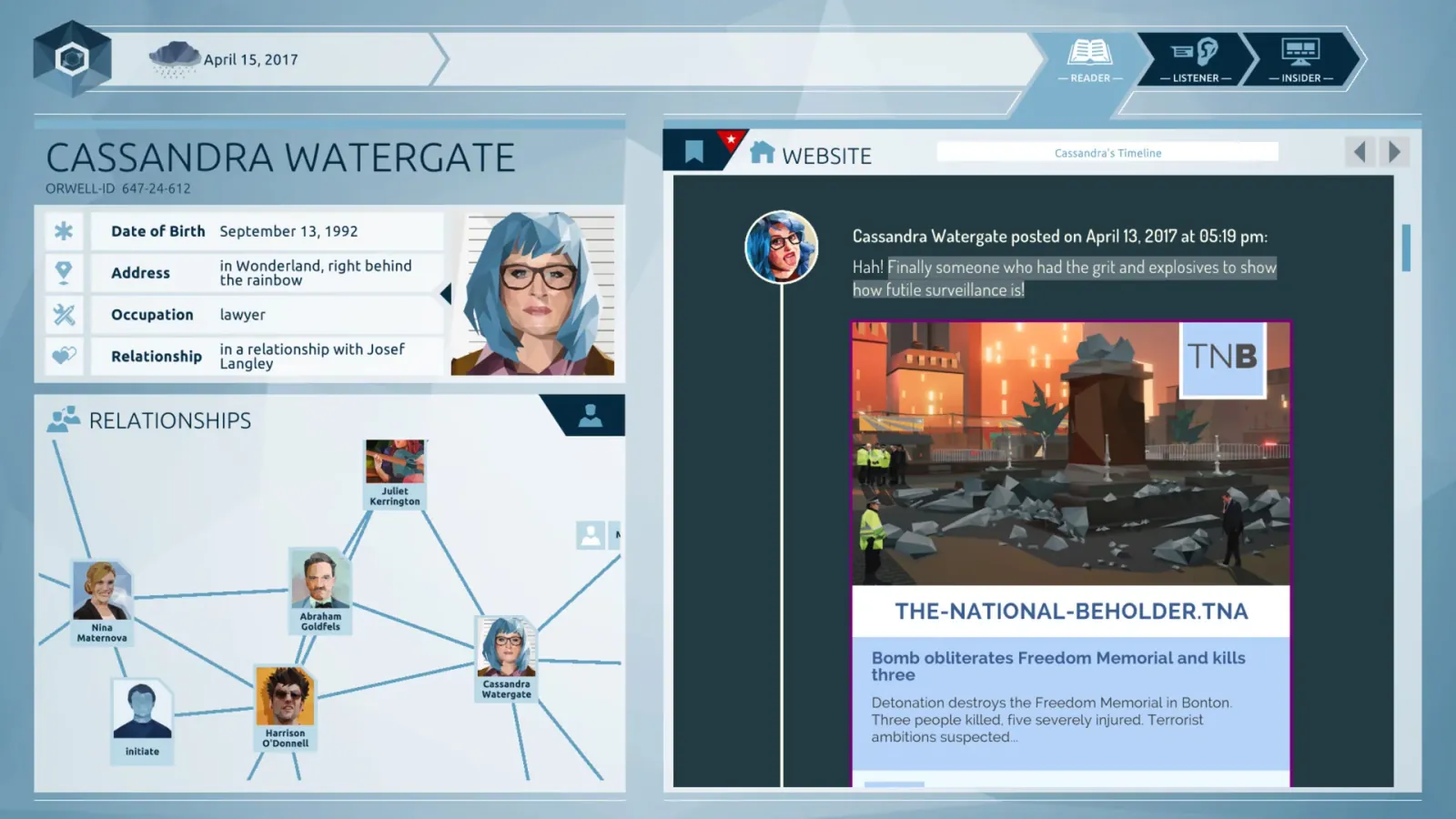
Players spy on tenants, search rooms, file reports, and decide which harms they will enable, resist, or exploit.
Why it may be useful
Beholder turns state surveillance into a budget line: you cannot pay rent without informing on someone, so you feel how an informer system works rather than reading about it. The country is invented, so what travels is a way of thinking, not facts.
Used in teaching
1 documented case ↓Spanish Official School of Languages (Escuela Oficial de Idiomas)
Keep in mind
Beholder should be framed as fictionalized authoritarian interpretation, not as a factual lesson about institutions.
Written 2026-09-15 · editorial assessment, not a measured effect · how we rate →
What the game is
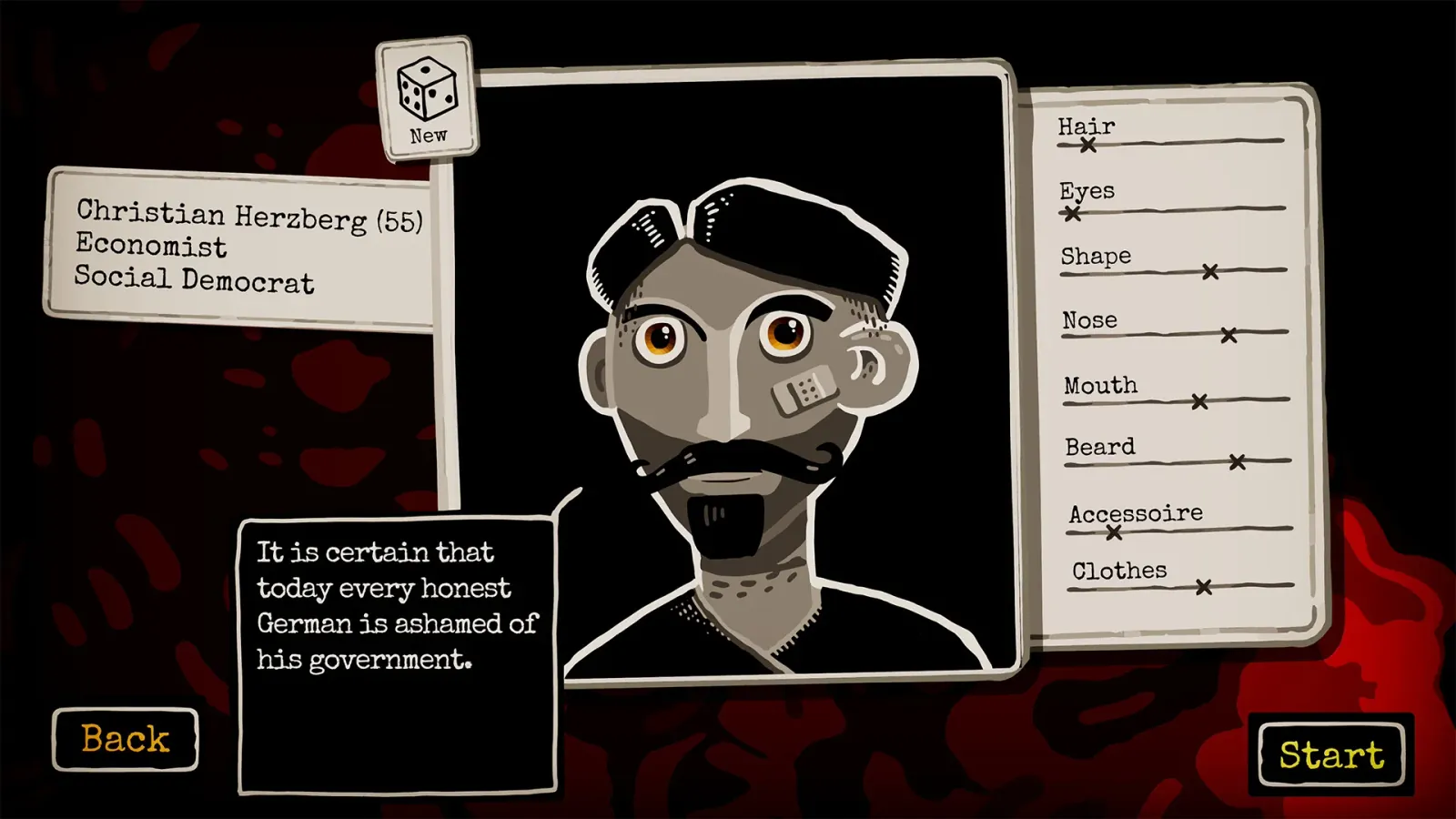
Beholder is a management game with a stopwatch and a conscience. Alawar Stargaze released it in November 2016 for PC. You play a state-appointed manager of an apartment building in an unnamed totalitarian country. The building is drawn as a cutaway, like a doll's house with the front wall removed, so you watch every floor at once. Tenants move in, live their lives in view, and leave for work.
The state sends orders with deadlines, and rent, food, and your own family's needs all cost money you do not have. Play runs in days. The art is stark black and white with one accent color, and the tenants are silhouettes with pale eyes. Steam applies an age gate and a violence tag to the store page, and the game is single-player only, in several interface languages.
What you actually do
You wait for a tenant to leave, unlock their door, and go through the place: drawers, wardrobes, mattresses, the bin. Anything you find goes into a profile. This one owns a banned book; that one is hiding someone. Cameras can be installed to catch what you missed. Then a request arrives. The ministry wants a name by a deadline, or a tenant asks you to look the other way, or you can quietly take money to stay silent. Every choice pays in a different currency, and the bills at home keep coming. Later days squeeze harder, with more tenants, shorter deadlines, and orders that cannot all be obeyed.
What it exercises
Reads a system of incentives and sees who benefits from each rule
Tracks several deadlines and a thin budget at the same time
Builds a case from scattered physical evidence, then weighs how solid it is
Names the cost of a choice when every option harms someone
Notices how ordinary work becomes complicity one small step at a time
Why we rate it Low Worksheet score 42 / 100
FitHow much real knowledge or skill does the play itself make you use?45weight 45%
The pressure is inside the play: you cannot pay the rent without informing on someone, so the game turns complicity into a budget line rather than a speech, and nothing arrives as a lesson. Fit lands at 45, held down by several missions that resolve into ordinary fetch tasks with no moral weight attached to them at all.
TransferWill what you practise here work outside the game?40weight 30%
Seeing how an institution buys cooperation with small rewards is a habit that can carry into a history lesson or a news report, and the game gives a concrete image to hang it on, which is why transfer reaches 40. It stays fiction about an invented country, so what actually travels is a frame for thinking rather than any fact you could cite.
PracticeDoes the game make you use that skill again and again, as it gets harder?40weight 25%
The same judgment repeats dozens of times across a playthrough, and the different endings mean a second run asks the same questions with different information, which is genuine density of practice for one kind of decision. Practice sits at 40 rather than higher because the decisions start to rhyme once you learn how the ministry behaves, and the challenge flattens from there.
Where it has been used in teaching
Documented cases of this game being used with learners. Each one links to its source.
StudySpanish Official School of Languages (Escuela Oficial de Idiomas) · Adults · 2024
A researcher affiliated with the University of Warsaw ran a didactic intervention in a B2.1 Russian classroom at a Spanish Official School of Languages, using the game Beholder to teach bureaucratic vocabulary; pre/post vocabulary tests and interviews showed increased motivation and confidence.
Research-backedPublished research has studied this game, or the exact mechanic it is built on.
The evidence level is Research-backed, resting on one peer-reviewed study rather than a body of research. A researcher affiliated with the University of Warsaw ran a classroom intervention in a B2.1 Russian course at a Spanish Official School of Languages, using Beholder to teach bureaucratic vocabulary; pre- and post-tests showed vocabulary gains alongside reported motivation and confidence. That is one course, one language pairing, and a small group of adult learners, not proof about how a player learns alone at home. The Steam and Alawar pages separately confirm the developer, the 2016 release, the PC route, and the core surveillance, search, and reporting mechanics the study built its lesson around.
Editorial assessment - not a measured scientific effect.
Fit
45/100
Transfer
40/100
Practice
40/100
Why it makes the cut
PASS - Its landlord-surveillance premise is tense and game-driven, not simply message-forward.
Research-backed
Research-backed: a peer-reviewed study describes a classroom intervention that used Beholder to teach bureaucratic vocabulary to Russian-language learners, with pre- and post-tests showing gains in vocabulary and reported motivation, which is direct evidence tied to this exact game.
Prices are US store listings in USD, last refreshed 2026-09-25; regional prices and sales differ.
No subscription requirement was found on the verified PC route.
Steam currently verifies interface support for the listed locales. Full audio is captured only where Steam explicitly marks it; subtitle coverage remains unknown unless a platform source states it separately.
Age guidance
Ages 13+ · ESRB T
Topics
History & society
Play styles
Single-player, Strategy, Narrative
Tags
Surveillance · Moral compromise · Authoritarian systems
The pressure works because the numbers are real, but the setting is a composite of no actual country, and several missions resolve into ordinary fetch tasks, which keeps the band at low rather than higher.