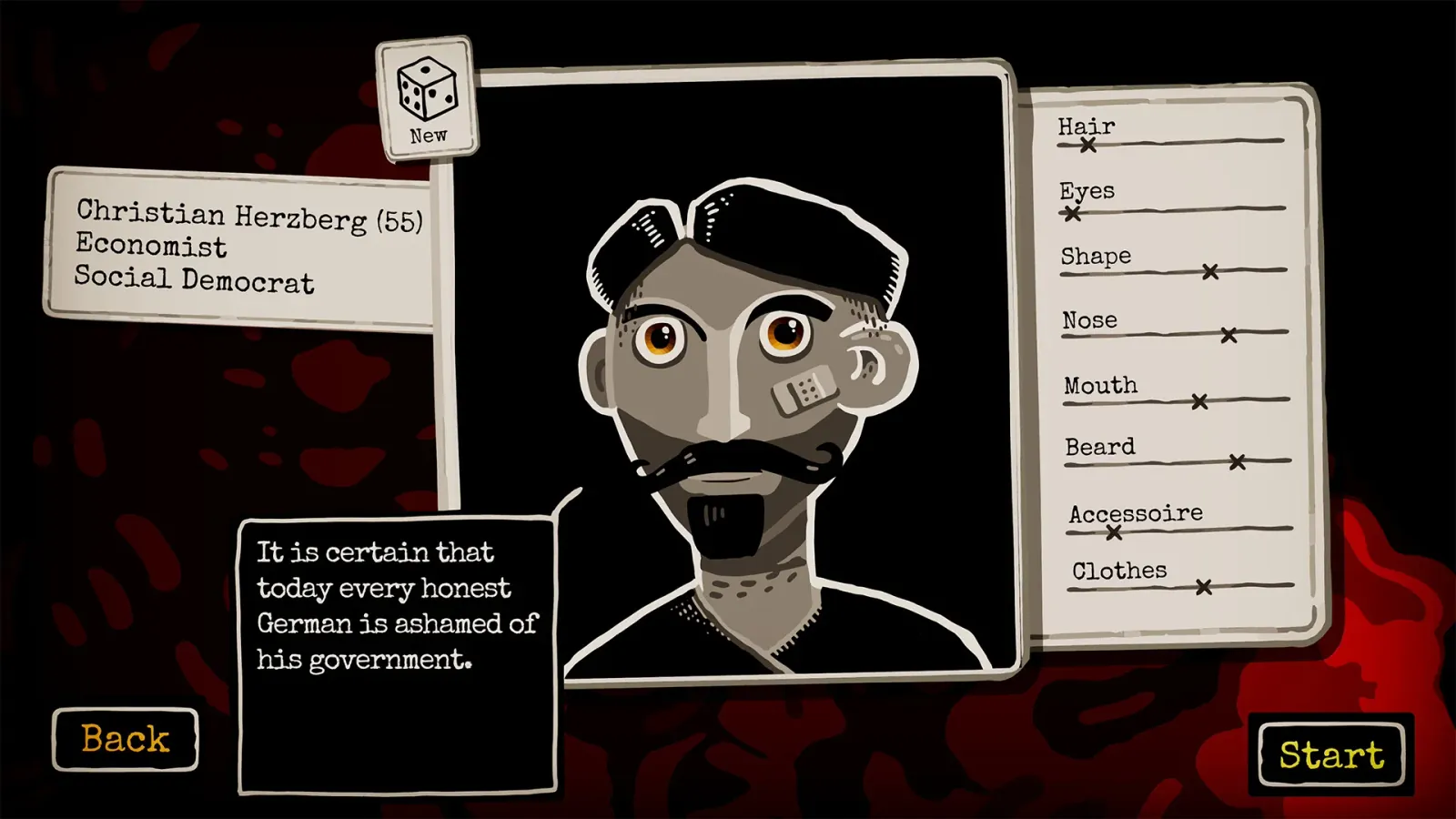
Players inspect messages, posts, files, and reports, then choose which facts to submit into a government surveillance system while the consequences reshape the investigation.
Why it may be useful
You practice reading a source in context and noticing what a profile leaves out, since the whole game is built from fragments you choose to submit. That habit of skeptical reading is the real payoff, more than any specific claim about surveillance policy.
Keep in mind
Its political and ethical value comes from reflective fiction, not from neutral civics instruction.
Written 2026-09-15 · editorial assessment, not a measured effect · how we rate →
What the game is
Orwell: Keeping an Eye On You is a surveillance thriller by the German studio Osmotic Studios, published by Daedalic Entertainment in October 2016 for PC at around ten euros. You never leave a desk. The whole game takes place inside a fictional government monitoring tool, and you are the first human researcher allowed to operate it.
The setting is an invented country called the Nation, whose capital Bonton has just been hit by a bomb. Your screen is a plain interface with a browser on one side and a suspect's profile on the other. You read blogs, news articles, social feeds, emails, medical files and chat logs, and you drag the highlighted fragments you consider relevant into the profile. A handler talks to you through the panel. The story is told in episodes, and the security service acts only on what you send: the store page states it directly, saying only the information you provide will be seen by the security forces.
What you actually do
You read, and then you decide what counts. A blog post says a suspect once owned a firearm; a later message says he sold it. Both are true and you can submit either, but the profile only shows what you upload, and the officers acting on it never see the rest. Investigations widen as you go, from public posts into private messages and eventually live conversations, and every widening is something you chose. The tension is not difficulty. It is that the useful move and the intrusive move are the same move, and that a person is arrested or cleared on the strength of fragments you selected out of a much larger life.
What it exercises
Separates what a source states from what it merely implies
Notices when two sources about the same person contradict each other
Considers how a true fact reads once it is stripped of context
Tracks who gains when a particular fragment is submitted
Weighs acting on an incomplete picture against waiting for more
Why we rate it Low Worksheet score 43 / 100
FitHow much real knowledge or skill does the play itself make you use?45weight 45%
Fit is held to 45. The only verb in the game is submit this fragment, and the whole argument is built from what you chose to send, which is about as tight a link between mechanic and theme as a game can manage. It stays in the middle because the underlying task, sorting text into a form, is mechanically thin on its own.
TransferWill what you practise here work outside the game?42weight 30%
Transfer reaches 42. Reading a quote in context, noticing that a profile was assembled by someone with a purpose, and asking what was left out are habits you will use on social media the same week, which is why this dimension scores highest of the three. It is not higher because the game never makes you act on the habit outside its own fiction.
PracticeDoes the game make you use that skill again and again, as it gets harder?40weight 25%
Practice is lowest at 40. Each episode runs the same read, judge, submit cycle dozens of times, and the cases grow more ambiguous as they go, which is real repetition within one playthrough. But the whole story is short, and once it ends there is little reason to keep rehearsing the same judgment.
What the evidence says
Editorial onlyNobody outside our desk has checked this. It is our reading of how the game plays.
The evidence is editorial only. The cited Steam store page confirms the developer, publisher, the October 2016 release, the price, the fictional Nation setting, the episodic structure, the content descriptors and the central rule that only submitted information reaches the security forces. It says nothing about what a player takes away. No research on this game is cited and none was found, so the claim that it exercises careful reading of evidence is an argument from the mechanics, not a measured outcome, and it is limited accordingly across all three figures.
Editorial assessment - not a measured scientific effect.
Fit
45/100
Transfer
42/100
Practice
40/100
Why it makes the cut
Its surveillance-database play loop is gamey enough to attract players beyond its message.
Editorial only
This is our reading of the mechanics, since no study of this game or of what players take from it exists that we can cite. The claim rests on how tightly the design ties action to theme, not on any measured effect.
Prices are US store listings in USD, last refreshed 2026-09-25; regional prices and sales differ.
Single-player play is available on the verified route.
The game depends on reading, evidence sorting, and on-screen desktop-style interaction.
Steam lists English, French, German, Spanish, and Brazilian Portuguese among its supported languages.
Age guidance
Ages 15+
Topics
History & society
Play styles
Single-player, Narrative, Strategy
Tags
Surveillance · Privacy and power · Evidence framing
The only real action is choosing what to submit, and that choice carries real everyday reading habits, but the loop is short and a designed mystery with an authored answer underneath.