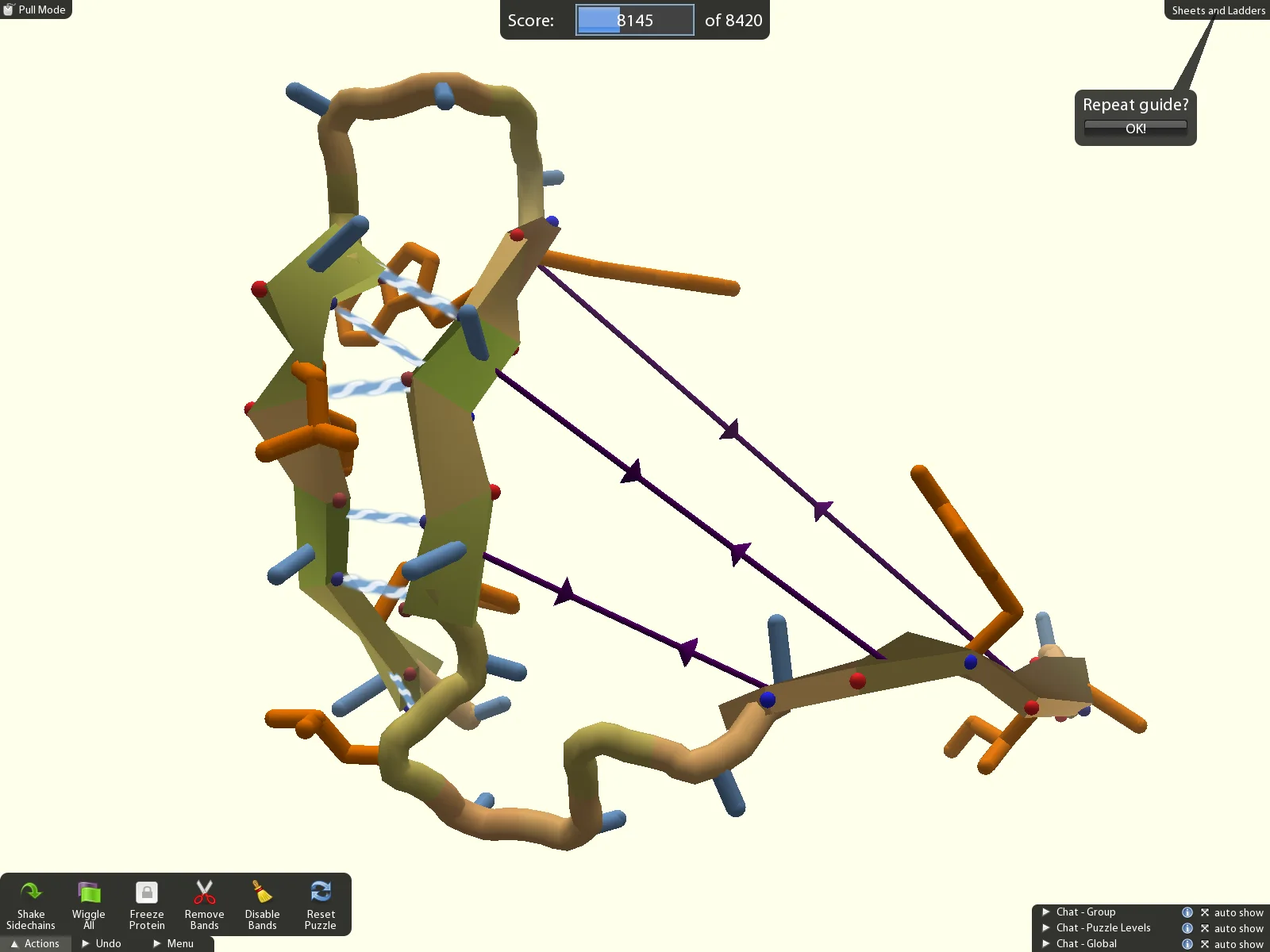
Players solve nucleotide puzzles and may participate in laboratory testing of proposed designs.
Why it may be useful
Designing RNA structures here uses the same folding-prediction model researchers rely on, and well-designed solutions can be synthesized and tested in a real laboratory. It covers one narrow corner of molecular biology, not the subject as a whole.
Written 2026-09-15 · editorial assessment, not a measured effect · how we rate →
What the game is
Eterna is a browser puzzle game about RNA, built by academic scientists and open to the public since 2010. It is free, runs in a browser, and has an Android version. You need an account to play. What each puzzle gives you is a target shape and a molecule, and the job is to make the molecule fold into that shape.
The screen is a diagram rather than a world: a loop of colored beads, each one a nucleotide, joined into stems and hairpins. Click a bead to change which of the four bases it is, and the diagram re-folds in front of you as the energy of the structure changes. Green marks a pair that has landed where the target wants it, red marks one that has not.
Above the puzzles sits the part that makes Eterna unusual. Player designs are voted on, and winning ones are synthesized and tested in a university laboratory, with the results fed back to the community and into published research. The tutorial and player-made puzzles are the game; the laboratory challenges are optional and come later.
What you actually do
A puzzle shows a target secondary structure, the branching shape the finished molecule should take, alongside a starting sequence that does not produce it. You click through the sequence swapping bases, and the folding prediction updates immediately, so the loop is change one base, watch the shape move, keep it or undo it. Because a pair only holds if both partners agree, editing one position often breaks something elsewhere, and the puzzle becomes a question of which constraints conflict. Later puzzles add switches that have to fold two different ways depending on what binds to them. Getting better means recognizing structural motifs on sight and knowing which substitutions are safe.
What it exercises
Reads a diagram of a structure and identifies which parts conflict
Changes one variable at a time and observes the effect
Works inside a hard constraint where fixing one part breaks another
Recognizes recurring structural patterns and reuses a known solution
Follows technical vocabulary well enough to use it in a community
Why we rate it Exceptional Worksheet score 85 / 100
FitHow much real knowledge or skill does the play itself make you use?92weight 45%
Fit is 92, as high as the scale goes, and it is earned. This is not a metaphor for RNA folding, it is a genuine folding-prediction model, the same kind researchers use, with a player's edits as the direct input. There is essentially no gap between playing well and reasoning about the molecule itself.
TransferWill what you practise here work outside the game?76weight 30%
Transfer is 76. A player leaves knowing what a base pair is, what a hairpin loop looks like, and why a sequence determines a shape, which is real molecular biology vocabulary attached to something they have actually handled. It stops short of the very top because secondary structure is one narrow corner of the subject, and nothing here covers the rest of molecular biology.
PracticeDoes the game make you use that skill again and again, as it gets harder?85weight 25%
Practice is 85. Thousands of player-made puzzles sit alongside the official ones, and the same reasoning about conflicting constraints repeats in every one of them, with laboratory rounds giving returning players a reason to come back for years. It stops short of the very top only because the difficulty curve loses many players early, before that rising challenge fully takes hold.
Where it has been used in teaching
Documented cases of this game being used with learners. Each one links to its source.
CourseTexas Wesleyan University · University
Eterna's own educational-resources page states that activity guidelines for the RNA-design game were written specifically for undergraduate biology majors at Texas Wesleyan University, introducing them to RNA secondary structure through the game's tutorial puzzle series; no year is stated.
Stanford University used Eterna puzzle examples covering statistical mechanics, allostery, and RNA design in its 2013 graduate molecular-biophysics course, Biochemistry/Structural Biology 241; course materials note that students' own RNA designs made in the game were synthesized afterward.
CourseStanford University (Stanford Online) / Center for Genetically Encoded Materials (C-GEM) · Adults · 2023
In 2023 the NSF-funded Center for Genetically Encoded Materials partnered with Stanford Online to build two modules of the course 'RNA Biology with Eterna Academy,' combining explainer videos and knowledge checks with Eterna puzzles as coursework, per an RCSB PDB newsletter.
Research-backedPublished research has studied this game, or the exact mechanic it is built on.
The evidence level is Research-backed, and it rests on the project itself rather than on a study of its players. Eterna is run by academic laboratories, credited on the official site to groups including the University of Washington, Northeastern and Stanford, with support from DARPA, the NSF and the NIH. Player designs are voted on, then synthesized and tested at the bench, and findings from those rounds have appeared in peer-reviewed journals. The game is also used directly in teaching: Texas Wesleyan built undergraduate biology activities around its tutorial puzzles, and Stanford has used it twice, in a 2013 graduate biophysics course and a 2023 online module built with a materials-science research center. None of this shows that playing changes a student's grasp of biology; no such outcome study exists.
Editorial assessment - not a measured scientific effect.
Fit
92/100
Transfer
76/100
Practice
85/100
Why it makes the cut
RNA design is presented as a sustained puzzle game with progression and community challenges.
Research-backed
Research-backed: Eterna is run by academic laboratories that synthesize and test winning player designs at the bench, with findings in peer-reviewed journals, and the game is also used directly in university biology courses at Texas Wesleyan and Stanford.
Prices are US store listings in USD, last refreshed 2026-09-28; regional prices and sales differ.
Age guidance
Ages 13+
Topics
STEM
Play styles
Single-player, Puzzle
Tags
RNA · Free · Research contribution
It sits at the top because the puzzle is not a metaphor for RNA folding, it is a working folding-prediction model, and solving it well produces genuinely useful scientific output.