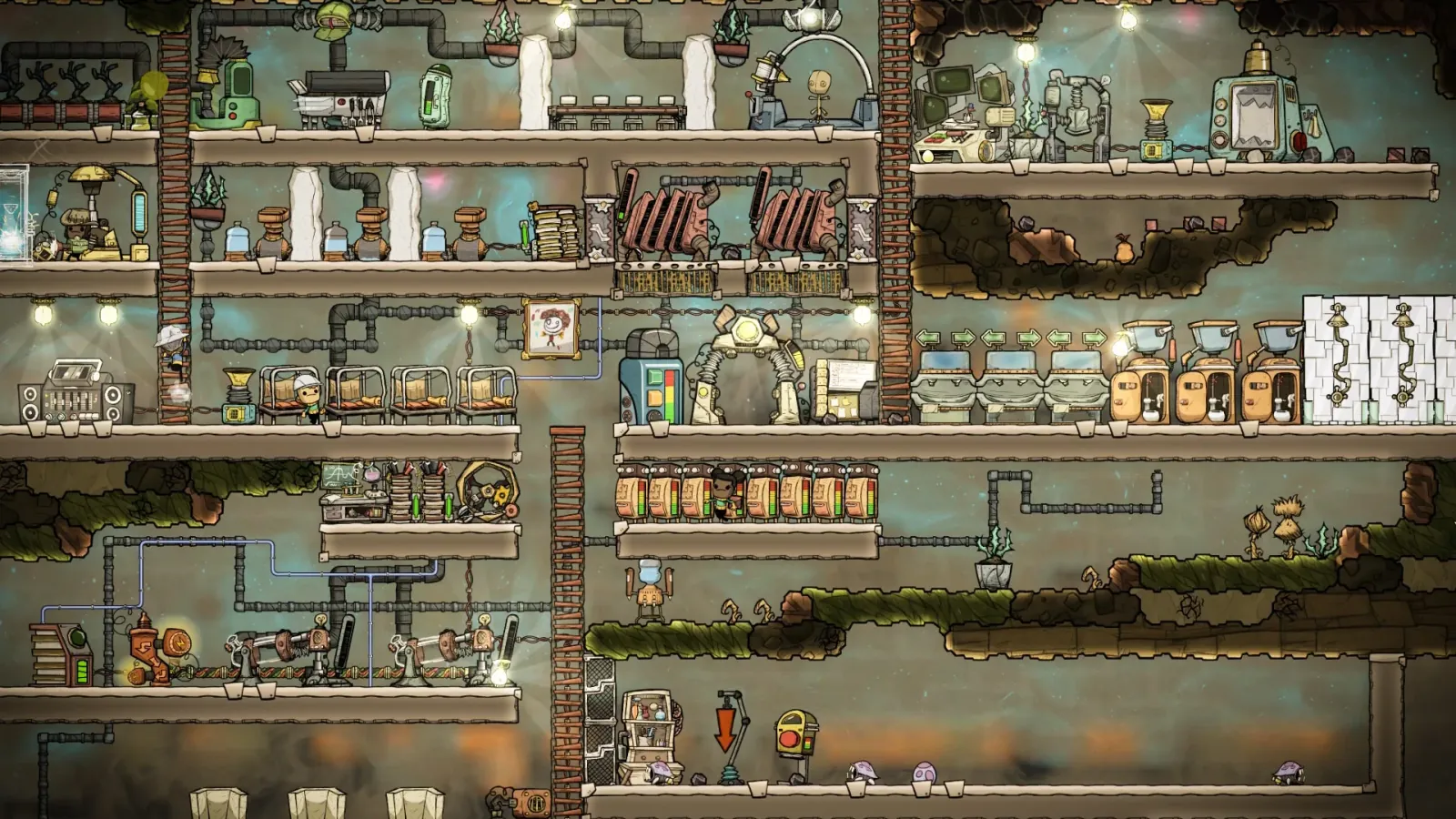
Players build production systems from extraction, transport, and processing chains, then scale the architecture.
Why it may be useful
You cannot advance without diagnosing bottlenecks and designing for throughput, real engineering habits that also show up in logistics and software. What is missing is the named vocabulary: you can build brilliant systems here without ever using the word bottleneck.
Written 2026-09-15 · editorial assessment, not a measured effect · how we rate →
What the game is
Factorio is a factory-building game by the Czech studio Wube Software. You crash on an alien planet with nothing, and by the end you are running a machine the size of a landscape: ore drills feeding belts, belts feeding furnaces, furnaces feeding assembly lines, the whole thing powered by steam or solar and fenced against the local wildlife. It left early access as version 1.0 in 2020 after years of public development, and has sold more than 3.5 million copies.
The screen is a top-down map you can zoom out from until the factory looks like a circuit board. There is no story beyond launching a rocket and no level structure, so one save file can run for a hundred hours. It plays on PC and on Nintendo Switch, supports multiplayer on a single shared factory, and takes mods written in Lua. A free demo covers the opening hours, and the Space Age expansion adds further planets for players who finish the base game.
What you actually do
You mine coal and iron by hand, then build a drill so you never have to again. That is the loop, repeated at rising scale: notice something you are still doing manually, or a line that has gone idle, and build the machine that removes the problem. Belts, inserters, splitters, pipes, trains and circuit wires are the vocabulary. The difficulty comes from your own factory rather than from enemies, and the recurring question is which of a dozen linked processes is the bottleneck, and whether to patch it or tear out the block and redesign it. Getting better looks like planning a section before building it, leaving room to expand, and reading throughput numbers instead of guessing.
What it exercises
Traces a slow production line back to the one step that limits it.
Plans a layout with room for later expansion instead of building to fit.
Computes ratios, such as how many furnaces one drill can keep supplied.
Breaks a large goal into modules with clear inputs and outputs.
Reads a system where one change causes shortages somewhere else entirely.
Why we rate it High Worksheet score 71 / 100
FitHow much real knowledge or skill does the play itself make you use?68weight 45%
Fit is 68. There is no separate lesson bolted on: the game is a systems-design problem, and you fail it by building a factory that starves itself, so bottleneck hunting, ratio arithmetic and modular planning are required rather than merely rewarded. It stays in the upper-middle rather than higher because the domain is reduced to a manageable set of levers, ore, belts, power, with none of the tolerances, safety or cost of a real plant.
TransferWill what you practise here work outside the game?55weight 30%
Transfer is 55. Throughput, buffering, dependency chains and the habit of measuring before optimizing are working ideas in logistics, manufacturing and software, and players meet them outside in roughly the same shape. It sits at the midpoint because that transfer usually needs the concept named out loud by someone else: a player can build a brilliant factory here without ever hearing the word bottleneck, so the habit forms without the vocabulary attached to it.
PracticeDoes the game make you use that skill again and again, as it gets harder?95weight 25%
Practice is 95, the strongest score in the catalog. The same design question, what is starving and why, returns every twenty minutes for hundreds of hours, at a larger scale each time, and a new save resets the problem on different terrain. Few games ask a player to solve one class of problem this many times without it going stale, which is why this sits at the very top of the scale.
Where it has been used in teaching
Documented cases of this game being used with learners. Each one links to its source.
CourseUniversity of Texas at Arlington · University · 2024
Industrial engineering instructors at the University of Texas at Arlington developed and tested an online lesson using Factorio to teach the mathematics of production and inventory flow, building visual simulations of factory cause-and-effect relationships for engineering students.
Practice-backedNo published study, but people who answer for the outcome use it: schools, clinics, museums, research labs.
The evidence level is Practice-backed. There is no study of Factorio itself, so the case for the numbers here rests on our reading of what the mechanics demand: the game cannot be advanced without diagnosing bottlenecks and designing for throughput, recognizable engineering habits. The documented teaching case is stronger: industrial engineering instructors at the University of Texas at Arlington built and tested an online lesson using Factorio to teach the mathematics of production and inventory flow, building visual simulations of factory cause-and-effect relationships for engineering students. That is real classroom use, not proof that a teenager who plays two hundred hours carries anything into schoolwork or a job. The developer, the 1.0 release, multiplayer, Lua mods, the demo and the sales figure come from the official Factorio site.
Editorial assessment - not a measured scientific effect.
Fit
68/100
Transfer
55/100
Practice
95/100
Why it makes the cut
Deep automation play stands on its own without an educational framing.
Practice-backed
Practice-backed: industrial engineering instructors at the University of Texas at Arlington built and tested a lesson using Factorio to teach production and inventory-flow mathematics to engineering students.
Prices are US store listings in USD, last refreshed 2026-09-28; regional prices and sales differ.
Age guidance
Ages 13+
Topics
Logic & strategy, STEM
Play styles
Co-op
Tags
Automation · Logistics · Co-op
It sits high because the game is a systems-design problem you fail by building a factory that starves itself, but what carries elsewhere needs the underlying idea named out loud, which never happens in play.