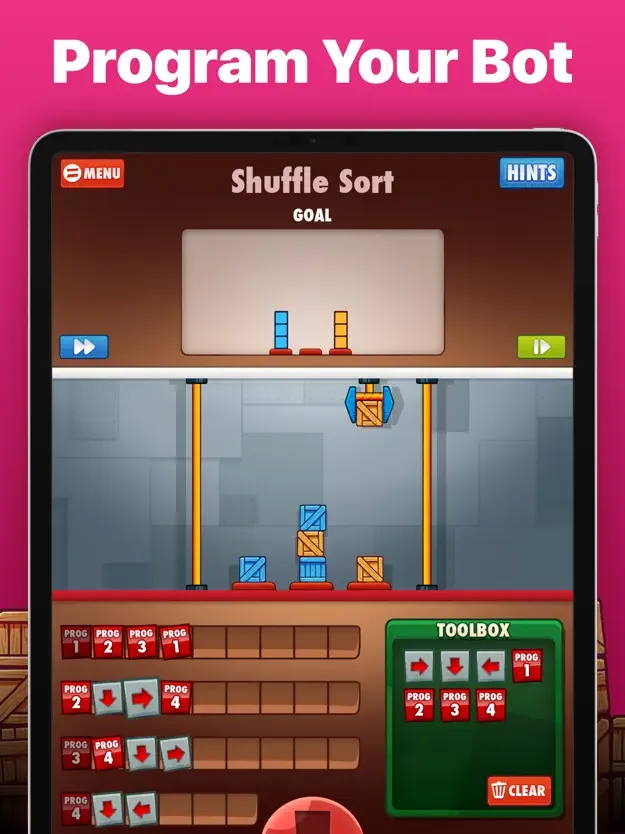
Players arrange movement, turn, jump, and light commands into short programs, reuse procedures, and refine solutions until the robot lights every target tile.
Why it may be useful
Running out of program slots is what forces you to discover procedures: grouping a repeated sequence of moves and calling it by name. That is real programming structure, sequencing, decomposition, reuse, though everything stays icons, with no syntax, data or variables to carry into an actual language.
Used in teaching
3 documented cases ↓Sheffield Hallam University · Universidad Nacional de San Agustín and Universidad La Salle, Arequipa, Peru
Keep in mind
The command icons teach the structure of simple procedures and loops, but they abstract away syntax, data, and the messier parts of real programming work.
Written 2026-09-15 · editorial assessment, not a measured effect · how we rate →
What the game is
Lightbot is a small programming puzzle first released in 2008 and now sold as an app by Lightbot Inc. The board is a little grid of raised and lowered tiles floating in space. Some tiles are blue. Your job is to get a small robot to stand on every blue tile and switch it on.
You do not steer the robot. You write a program for it. Below the board sit two strips of empty slots, one labelled Main and one a procedure, and a palette of icon commands: step forward, turn left, turn right, jump, light up, and call the procedure. You drag icons into the slots, press play, and the robot carries them out in order.
The palette is the whole vocabulary, and the difficulty comes from the shortage of slots. When Main holds eight slots and the route needs twenty steps, the only way through is to find the repeating part of the route and put it in the procedure. The official site names sequencing, overloading, procedures, recursive loops and conditionals as what the game covers, and calls it all-ages friendly and made for first-time coders. It links downloads for Apple, Android and Amazon devices.
What you actually do
You trace the route with your eye before touching anything: forward, forward, turn, jump, light. Then you drag the icons in and run it. The robot walks, misses a tile and stops, so you watch again and see that the jump came one step too early.
The squeeze arrives quickly. There are never enough slots in Main, so you look for the part of the path that repeats, put those steps in the procedure, and call the procedure from Main. Later puzzles use a procedure that calls itself, which is where a player meets a loop that runs until it cannot. Getting better means seeing the pattern in a path rather than the path itself, and it is measured in shorter programs.
What it exercises
Writes an ordered sequence of instructions and predicts the result before running it
Finds the repeating part of a route and moves it into a procedure
Watches an execution step by step to locate the instruction that failed
Rewrites a working solution to fit fewer instruction slots
Uses a procedure that calls itself to repeat a step indefinitely
Why we rate it Moderate Worksheet score 60 / 100
FitHow much real knowledge or skill does the play itself make you use?65weight 45%
Fit reaches 65. The programming concepts are the puzzle's actual constraints: the instruction limit is what forces a player to discover procedures, and the shortage of slots is what makes reuse valuable rather than merely tidy. Nothing is taught in a text box; it is discovered by running out of room, on an invented grid rather than a real programming task.
TransferWill what you practise here work outside the game?58weight 30%
Transfer sits at 58. Sequencing, decomposition and reuse are the ideas underneath any programming language, and a study comparing Lightbot with ScratchJr found the icon format does teach computational thinking. The score is held down because everything stays icons: no syntax, no data, no variables, and no experience of a program that misbehaves for a subtle reason.
PracticeDoes the game make you use that skill again and again, as it gets harder?55weight 25%
Practice reaches 55. Every level exercises the same handful of ideas on a different board, and the instruction limits keep forcing the same reasoning about reuse. It settles here rather than higher because the level set is finite: a determined player finishes it, and there is no generator to keep the puzzles coming afterward.
Where it has been used in teaching
Documented cases of this game being used with learners. Each one links to its source.
StudySheffield Hallam University · Primary school · 2017
Sheffield Hallam University researchers studied young children's approaches to programming using two contrasting tools, ScratchJr and Lightbot, examining how each tool's interface affected the children's development of computational thinking.
CourseUniversidad Nacional de San Agustín and Universidad La Salle, Arequipa, Peru · University · 2017
Instructors at two Peruvian universities used Lightbot alongside a Turtle graphics library to introduce introductory programming students to the concepts of algorithm and function, implementing the approach across both institutions' first-year courses.
Lightbot is offered as an official Hour of Code activity, the nationwide Computer Science Education Week and Code.org initiative that introduces millions of K-12 students to one hour of computer science, with teacher resources provided for classroom use.
Research-backedPublished research has studied this game, or the exact mechanic it is built on.
The evidence level here is research-backed. Researchers at Sheffield Hallam University studied young children's approaches to programming using two contrasting tools, ScratchJr and Lightbot, and examined how each interface shaped their computational thinking. Instructors at two Peruvian universities used Lightbot alongside a Turtle graphics library to introduce first-year students to algorithms and functions. Lightbot is also an official Hour of Code activity with teacher resources for classroom use. The official site also states the game has been played by more than twenty million children and used by tens of thousands of teachers, which is a developer claim about reach rather than a measured result, and is not counted here as evidence.
Editorial assessment - not a measured scientific effect.
Fit
65/100
Transfer
58/100
Practice
55/100
Why it makes the cut
Even without the coding framing, it works as a satisfying little logic puzzle language with clear goals and elegant solutions.
Research-backed
A university study compared Lightbot with ScratchJr for teaching computational thinking to young children, and instructors at two Peruvian universities used it in first-year programming courses, which supports a research-backed rating for what the icons teach.
Prices are US store listings in USD, last refreshed 2026-09-25; regional prices and sales differ.
Current iPhone and iPad availability is verified through the App Store snapshot checked on 2026-08-20.
Web availability was investigated on 2026-08-20 but was not considered sufficiently verified for publication as a current platform claim.
The Hour of Code and legacy browser material must not be used as evidence of current Web-platform status for this exact catalog entity.
Release-year confidence is lower than mobile platform confidence because present official pages foreground current access more than original launch history.
Age guidance
Ages 8+
Topics
STEM
Play styles
Single-player, Puzzle
Tags
Programming logic · Robot puzzles · Procedures
The instruction limit is what forces a player to discover procedures, since a route that needs twenty steps has to be compressed into the few slots Main actually holds, which is genuine programming reasoning even though everything stays icons.