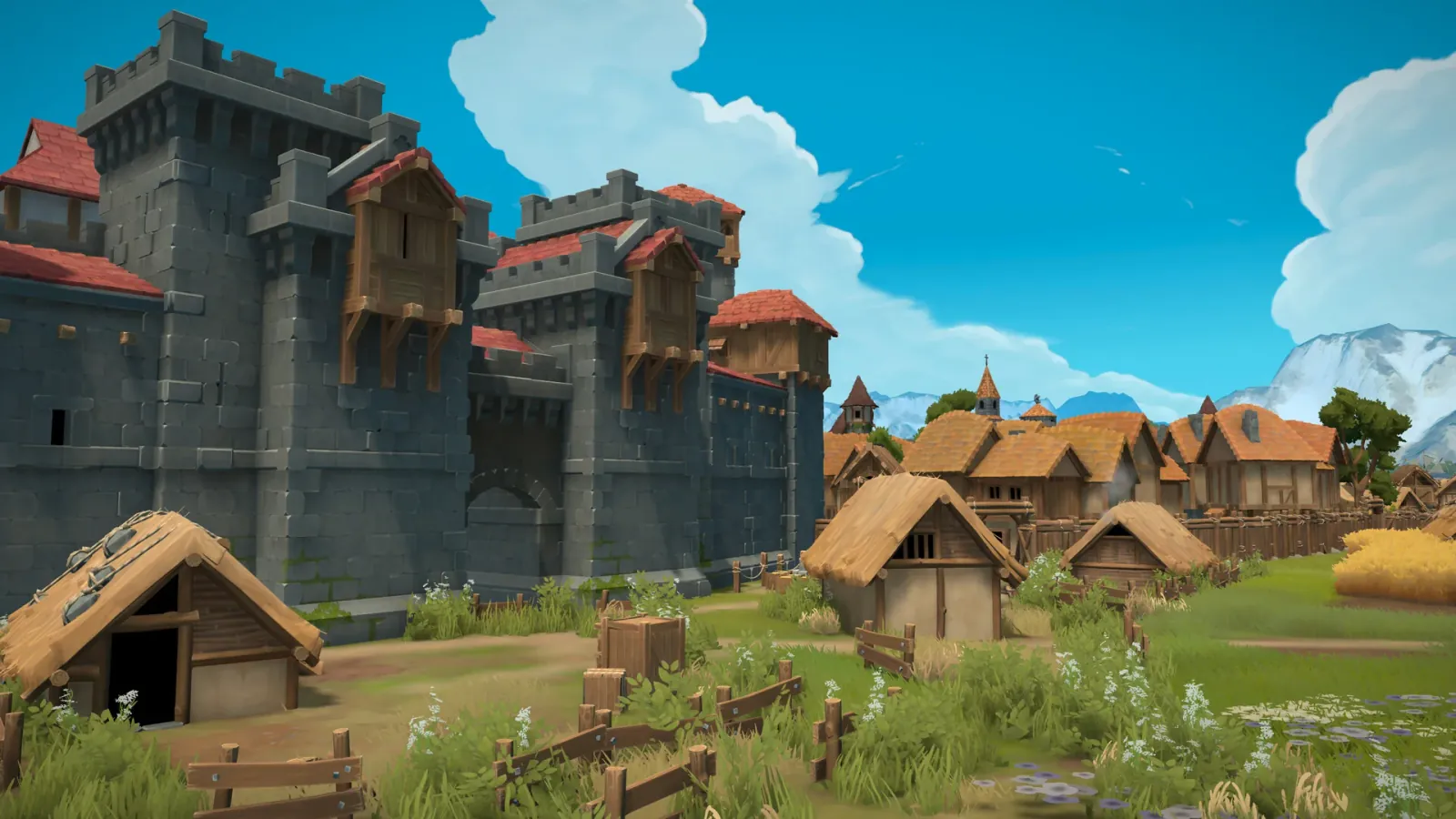
Players place buildings without a rigid grid and develop the economy of a Ukrainian town.
Why it may be useful
You get real practice planning a season ahead and tracing a shortage back to its cause, since nothing here is abstracted away. History barely travels: the town is plausible rather than documented, so treat it as design rather than as a lesson in the period.
Keep in mind
It is still in early access, and several systems that shaped real village life, such as education, religion and crime, are not modeled yet.
Written 2026-09-15 · editorial assessment, not a measured effect · how we rate →
What the game is
Ostriv is a town-building game about an 18th-century Ukrainian settlement, made almost entirely by one developer from Kharkiv who started work in 2014 and added a small team later. It has been on Steam in Early Access since March 2020 at around twenty-one euros, and it is also sold DRM-free with lifetime updates.
You are the governor. Buildings are placed freely on a three-dimensional landscape rather than snapped to a grid, and the paths people actually walk wear into dirt roads over time. There are more than sixty building types across seven maps, farming with ploughing and crop rotation, four seasons that change what is possible, and trade that arrives by road and by river.
It is genuinely unfinished, and the developer says so. The store page warns of occasional crashes and of sometimes needing to start a town over, and the roadmap still lists a campaign mode, education, religion, crime and modding as things to come. The interface is available in English and Ukrainian only.
What you actually do
You place a few houses, move families in, and give them work. Farmers plough in the right season and you set a rotation so the soil is not exhausted the following year. A workshop needs both a worker and an input, so flax has to be grown before linen can be woven, and a granary has to be full before winter arrives or people go hungry. Most of your time goes on tracing why something stopped, and the answer is always either a missing worker or a missing material somewhere upstream. Getting better means planning a year ahead instead of reacting to the shortage in front of you.
What it exercises
Plans a crop rotation so a field is not exhausted the next year
Follows one product from field to workshop to market
Places buildings by walking distance rather than by grid
Stocks food and firewood before the season that needs them
Diagnoses a stopped workshop as a missing worker or a missing input
Why we rate it Low Worksheet score 45 / 100
FitHow much real knowledge or skill does the play itself make you use?40weight 45%
Fit lands at 40. There is no combat and no abstraction layer between you and the economy: everything you do is about labor, materials, distance and time, and a town fails for reasons you can trace to a specific building. It stays modest because the interface teaches nothing, so much of the thinking is spent decoding the game rather than working the economy itself.
TransferWill what you practise here work outside the game?32weight 30%
Transfer is the weakest dimension at 32. That goods take labor and time, that storage exists because supply is seasonal, and that a shortage upstream stops something downstream are ideas with wide reach. What does not carry is history as such: nothing here is dated, named or attributable to a real place, and whole systems that shaped a real village, like religion or crime, are simply absent.
PracticeDoes the game make you use that skill again and again, as it gets harder?70weight 25%
Practice is the standout at 70. Seasons cycle without end, so the plant, harvest, store and repair loop comes round several times an hour, and every new town rehearses the whole thing from the first house. It falls short of the very top because the loop itself is a fairly small set of decisions repeated at scale.
What the evidence says
Editorial onlyNobody outside our desk has checked this. It is our reading of how the game plays.
The evidence is editorial only. The cited sources are the official game page and the Steam listing. Between them they confirm the solo Ukrainian developer, the March 2020 early access release, the eighteenth-century Ukrainian setting, the sixty-plus buildings and seven maps, crop rotation and ploughing, seasons, land and river trade, the two supported languages, and the developer's own warning about stability and unfinished systems. Neither page claims historical accuracy and neither says anything about learning. No study exists that we can point to, so the period detail should be read as plausible design rather than documented history.
Editorial assessment - not a measured scientific effect.
Fit
40/100
Transfer
32/100
Practice
70/100
Why it makes the cut
City-building and management systems are the primary attraction.
Editorial only
This is editorial: our reading of the official game page and the Steam listing, neither of which claims historical accuracy or says anything about learning. No study of this game exists that we can point to.
Prices are US store listings in USD, last refreshed 2026-09-25; regional prices and sales differ.
Age guidance
Ages 13+
Topics
History & society
Play styles
Single-player, Strategy, Simulation
Tags
City builder · 18th century · Early Access
There is no abstraction between you and the economy, and a town fails for traceable reasons, but the interface teaches almost nothing and whole aspects of period life are still missing.