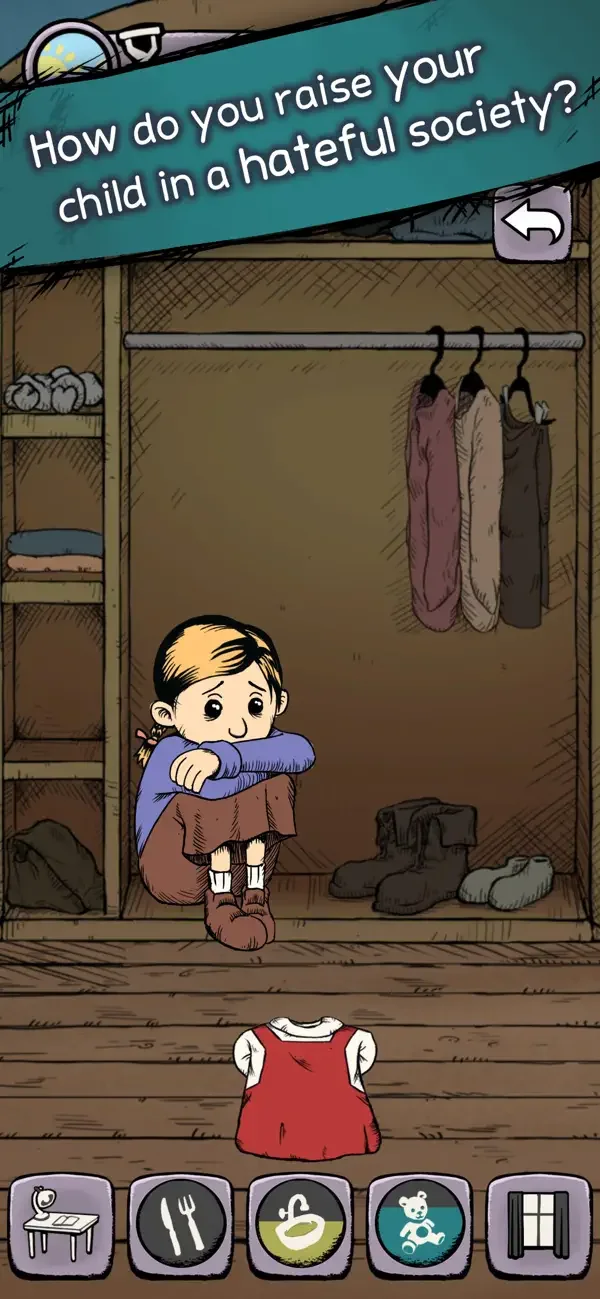
Players move through small tactile scenes, manipulate objects and memories, and follow a mother-daughter story told through visual metaphor and brief interaction.
Why it may be useful
You touch and hold small interactive scenes that dramatize a swimmer's memories of her mother, more involving than watching but asking little of you to interpret. It offers one short, reflective sitting rather than anything you practice or carry forward.
Keep in mind
Its emotional form is distinctive, but its depth as a game recommendation is limited.
Written 2026-09-15 · editorial assessment, not a measured effect · how we rate →
What the game is
A Memoir Blue is a short interactive story from Cloisters Interactive, published by Annapurna Interactive in March 2022. Miriam is a champion swimmer. A song reaches her, and the game dissolves into her memories of childhood and of her mother, who worked and drove and sacrificed to get her into the water.
It is closer to an illustrated poem than a puzzle game. Scenes are built from hand-drawn art layered with three-dimensional environments, and you move between them by touching things: turning a handle, pulling an object, guiding a swimmer down through blue. Water runs through the whole piece as the connecting image.
The record verifies the PC route on Steam, where it is a small paid purchase with menus and subtitles in fourteen languages. It is short, mostly linear, and heavily guided; there are no difficulty settings, no fail states, and nothing to buy inside. Player reception on Steam is Very Positive across several hundred reviews.
What you actually do
You direct attention rather than solve problems. A scene arrives, something in it is responsive, and you drag, hold or trace until the memory moves on. The interactions are small and physical: they ask you to do the gesture a character would do. There is almost nothing to fail and very little to work out, so the pace is set by how long you sit with each image. Getting more from it means noticing what the metaphors are doing, not getting faster or better at anything.
What it exercises
Reads a scene told in images rather than in words
Connects a visual metaphor to the feeling it stands for
Follows a story told out of chronological order
Sits with an unresolved emotion instead of fixing it
Notices what a parent gave up that a child did not see at the time
Why we rate it Minimal Worksheet score 21 / 100
FitHow much real knowledge or skill does the play itself make you use?25weight 45%
The interactions do carry meaning: you perform the gesture the memory needs, which is more involving than watching a cutscene. But the reflective work lives mostly in the images and the score rather than in anything you decide, so the useful part sits beside the play as much as inside it. That gap holds this at 25.
TransferWill what you practise here work outside the game?20weight 30%
Reading images for feeling is a real literacy, and this is an unusually clear, compact example of it. The number stays at 20 because the dose is tiny: one short piece, asking nothing of you afterward, with any lasting effect depending almost entirely on whether you talk about it with someone else.
PracticeDoes the game make you use that skill again and again, as it gets harder?15weight 25%
This is the weakest dimension by a wide margin and the main reason the overall score is low. The piece runs once, in a single sitting, with a fixed sequence. Nothing recurs, nothing is rehearsed, and a second playthrough shows the same scenes in the same order, which is why practice sits at 15.
What the evidence says
Editorial onlyNobody outside our desk has checked this. It is our reading of how the game plays.
The evidence level is Editorial only. The Steam page is our source, and it confirms the developer, the publisher, the March 2022 release, the hand-drawn and three-dimensional art, the premise of a swimmer recalling her mother, and the language support. Nothing in our sources measures any effect on a player and we claim none. We have kept the meaningfulness case unusually narrow here on purpose: this is a short authored experience, and the honest claim is that it offers reflective material and something to talk about afterward, not repeated practice at anything measurable.
Editorial assessment - not a measured scientific effect.
Fit
25/100
Transfer
20/100
Practice
15/100
Why it makes the cut
Its interactive poetic framing still presents a concise game experience.
Editorial only
Our reading based on the game's Steam page, which confirms the release, the art style and the premise. No study measures any effect on a player, and none is claimed.
Prices are US store listings in USD, last refreshed 2026-09-25; regional prices and sales differ.
Single-player play is supported.
The experience is short and heavily guided rather than systems-heavy or highly replayable.
Steam currently verifies English, French, German, Spanish, Italian, Japanese, Korean, Polish, Russian, Turkish, Traditional Chinese, and Brazilian Portuguese among its listed languages.
Age guidance
Ages 13+
Topics
Mind & well-being
Play styles
Single-player, Narrative
Tags
Interactive memory · Family themes · Visual metaphor
The gestures you perform do carry feeling, but the reflective work sits mostly in the images and score rather than in anything you decide, and the piece runs once, in a fixed sequence, with nothing to rehearse.