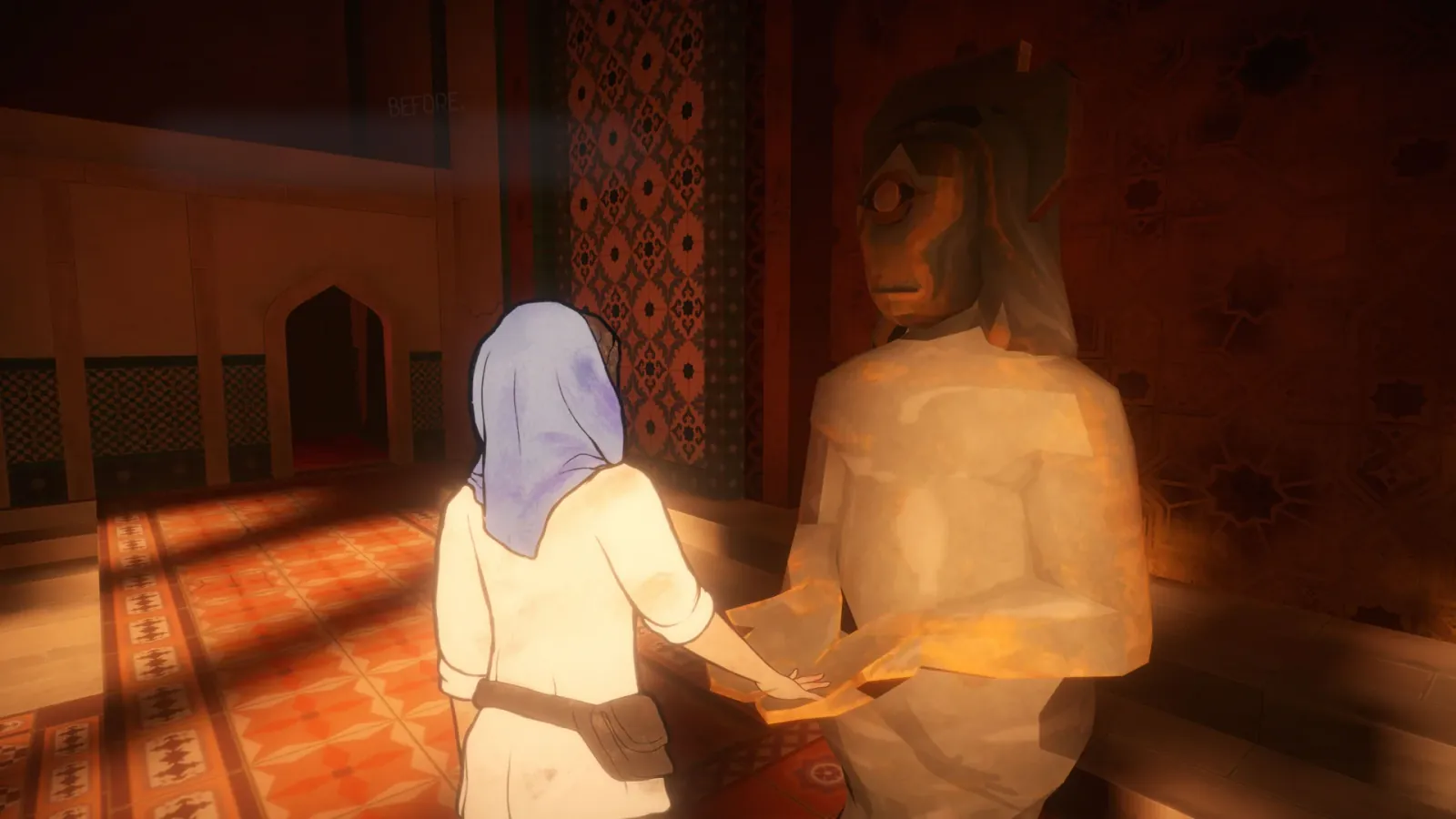
Players move through linked characters and timelines, influence thoughts and objects across eras, and connect clues about people, memory, and the Franklin expedition.
Why it may be useful
It may support historical perspective-taking and interpretive reading, because progress depends on holding multiple viewpoints and times in mind at once.
Keep in mind
The game credits research and Inuit collaboration, but it should not be treated as definitive history or cultural instruction.
Written 2026-09-15 · editorial assessment, not a measured effect · how we rate →
What the game is
Inua: A Story in Ice and Time is a narrative puzzle game released in 2022, made by The Pixel Hunt, IKO and ARTE France and published by ARTE France. It is set in the Canadian Arctic and built around the Franklin expedition, the British voyage that sailed north in 1845 and vanished with both ships and every man aboard.
Three characters carry the story across three periods: Simon, a sailor on the expedition; Peter, a filmmaker in the 1950s; and Taïna, a journalist in the present. Scenes are illustrated stills you click through, painted in cold blues and browns, with narration over them. Steam gives the length as about three hours.
The unusual part is the mechanic. You collect ideas, which may be a word, an object or a memory, from one scene and place them into a character's mind in another century, changing what they think of and therefore what they do. The store page credits extensive research with Inuit artists and the participation of Inuit advisors and an author. It is single player, on Windows and macOS, in five languages.
What you actually do
A scene opens on a fixed illustration. You click the people and objects in it, read what the narration says, and pick up ideas that are filed in a rack at the bottom of the screen. Then you switch to another character in another century and drop one of those ideas onto them. If it is the right idea in the right scene, they act on it, and the story moves forward.
Progress is interpretive rather than mechanical. Being stuck usually means you have missed a link between two moments: a name spoken in 1845 that means something in the 1950s, or an object that survives all three timelines. Getting better means paying closer attention to what each character already knows and treating the scenes as evidence rather than scenery.
What it exercises
Holds three separate timelines in mind and tracks what each character knows
Reads a historical scene for detail and treats objects in it as evidence
Connects a cause in one period to a consequence in another
Follows a narrative told out of order and reconstructs the sequence
Weighs an Inuit account of events alongside a European one
Why we rate it Low Worksheet score 40 / 100
FitHow much real knowledge or skill does the play itself make you use?45weight 45%
Fit lands at 45. Perspective-taking is literally the verb: to solve anything you have to know what a nineteenth-century sailor, a 1950s filmmaker and a present-day journalist each believe, and what would change their minds, which is unusually close to what a history lesson asks for. The number stays in the middle of the scale because the puzzles themselves are light, more about noticing a link than reasoning hard about it.
TransferWill what you practise here work outside the game?42weight 30%
Transfer sits at 42. Holding several viewpoints at once and noticing how the same story looks different from each is a habit that carries into reading history, news and fiction, and the Franklin expedition is real, so a few factual anchor points come with it. What does not transfer is method: nothing here teaches how to actually check a source.
PracticeDoes the game make you use that skill again and again, as it gets harder?30weight 25%
Practice is the lowest score, at 30. The idea-transfer mechanic repeats through every chapter, so cross-timeline reasoning does get exercised steadily from start to finish, but the whole game lasts about three hours, follows one path, and gives little reason to replay once the connections are known. This is a short, concentrated exposure rather than sustained practice.
What the evidence says
Editorial onlyNobody outside our desk has checked this. It is our reading of how the game plays.
The evidence level is Editorial only. The Steam page confirms the developers, the publisher ARTE France, the 2022 release, the price, the three-timeline structure with Taïna, Peter and Simon, the Franklin expedition setting, the roughly three-hour length, the five languages, and the credited participation of Inuit advisors and an author. That credit supports the claim that the game was made with consultation; it does not establish that the history in it is accurate, and we did not check the historical detail against academic sources. No study of this game appears in our sources, and none is claimed. The meaningfulness case here is editorial throughout.
Editorial assessment - not a measured scientific effect.
Fit
45/100
Transfer
42/100
Practice
30/100
Why it makes the cut
Its time-layered narrative puzzle design gives it clear standalone attraction.
Editorial only
Editorial: no study of Inua exists, so the case follows from what tracking three timelines and transferring ideas between them requires, not from any measured effect on historical understanding.
It rates low because holding three characters' perspectives in mind at once is real historical thinking, but the puzzles themselves are light, and the whole game lasts only a few hours with almost nothing to replay.