Players combine two characters abilities to light paths, open routes, and solve environmental puzzles together, or switch between them alone.
Why it may be useful
Played with a partner, this is a calm shared puzzle experience where finishing requires real coordination, though alone it is an ordinary character-switching puzzle game. Either way it is a short playthrough whose value is the hour itself, not a skill you carry elsewhere.
Keep in mind
The value here applies only to co-op play, and it says nothing about therapeutic or broad wellbeing benefits.
Written 2026-09-15 · editorial assessment, not a measured effect · how we rate →
What the game is
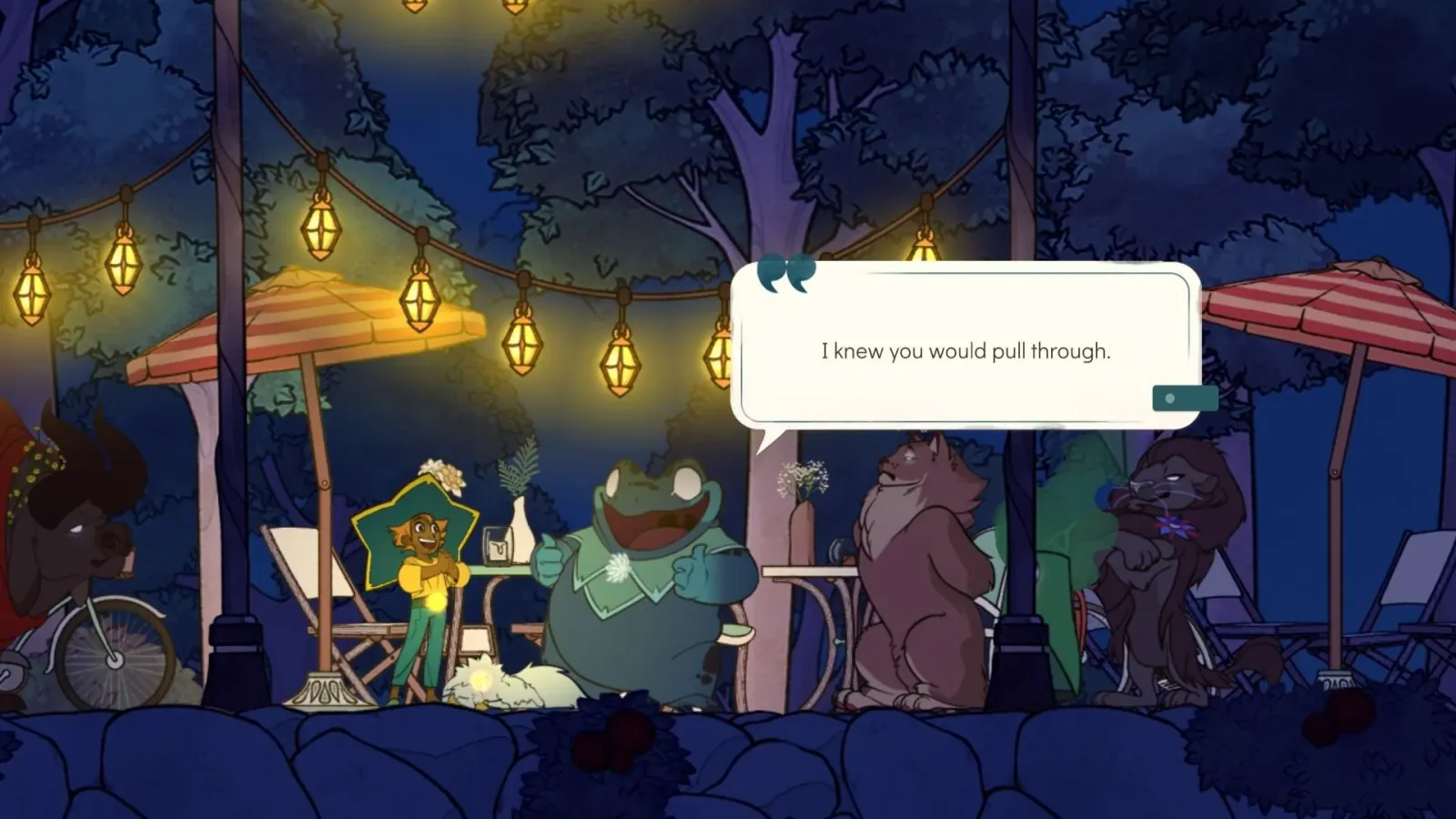
Pode is a co-op puzzle game from Henchman and Goon, a small Norwegian studio, released on Steam in April 2020 and also sold on Xbox. Two characters travel together through the inside of a mountain: Bulder, a rock, and Glo, a star that fell out of the sky and needs help getting home. The art is soft and hand-shaped, drawing on Norwegian folk decoration, and Austin Wintory wrote the score.
There is no combat, no timer and no way to die. The mountain is a series of dim caverns that light up and bloom as you pass through them, and progress means finding the way onward. It plays best with two people on one couch and a controller each, but a single player can switch between the characters at will, and Steam's Remote Play Together lets a friend join from elsewhere. It is rated for all ages, and Steam players rate it Very Positive across several hundred reviews.
What you actually do
Each character does something the other cannot. Glo gives off light that makes plants grow and crystals respond; Bulder is heavy and can smash, roll and hold things down. Almost every obstacle needs both. One player lights a wall so the other can see where to break it; one holds something down while the other crosses. The puzzles are physical and visual rather than written, so working them out means pointing at the screen and describing what you can see from where you stand. Difficulty rises by moving the two jobs further apart, so you have to say what you are doing rather than just watch.
What it exercises
Describes what is on their half of the screen so a partner can act on it.
Splits a shared problem into two jobs and takes one of them.
Waits for a partner to finish before triggering the next step.
Reads a puzzle from light, color and shape rather than from text.
Asks for help instead of trying to solve both halves alone.
Why we rate it Minimal Worksheet score 20 / 100
FitHow much real knowledge or skill does the play itself make you use?18weight 45%
At 18, fit is low because there is no subject matter here, only a mechanical requirement. In co-op, the game genuinely will not proceed unless two people coordinate, which is a real constraint, not a theme layered on top. But cooperation itself is not a discipline with content to learn, so even at its best the game asks for a behavior, not a body of knowledge.
TransferWill what you practise here work outside the game?12weight 30%
Twelve is near the floor. Taking turns and describing what you see are useful habits, but a puzzle with a guaranteed solution is a gentle rehearsal of collaboration, nothing like the real negotiation that comes with goals that actually conflict. What is most likely to carry over is simply a calm hour spent alongside someone else, not a transferable skill.
PracticeDoes the game make you use that skill again and again, as it gets harder?35weight 25%
At 35, practice reflects a short, one-time experience rather than a discipline you return to. The same act of splitting a task and describing a screen recurs in nearly every room, so a couple of hours of play does add up to real repetition, but once the story ends there is nothing left to replay except the puzzles you have already solved.
What the evidence says
Editorial onlyNobody outside our desk has checked this. It is our reading of how the game plays.
The record is Editorial only. The sources are the Steam and Xbox store pages, which confirm the developer, the April 2020 Steam release, the two characters, single-player and co-op support, the absence of combat and the all-ages rating. Nothing more. There is no research on this game, and no general study of cooperative play was borrowed to stand in for one. The claim here is deliberately narrow and applies only to co-op: the puzzles cannot be finished unless two people divide a task and talk about it. That is repeated practice in coordinating for an hour or two, not evidence of a lasting social benefit.
Editorial assessment - not a measured scientific effect.
Fit
18/100
Transfer
12/100
Practice
35/100
Why it makes the cut
It is a fully formed exploration and puzzle game whether or not players draw anything transferable from cooperating.
Editorial only
This is an editorial reading based on the Steam and Xbox store pages, which confirm the developer, release date and modes; no research exists on this game, and no general study of cooperative play was substituted for one.
Prices are US store listings in USD, last refreshed 2026-09-25; regional prices and sales differ.
Age guidance
Ages 8+ · PEGI 3
Topics
Mind & well-being
Play styles
Single-player, Co-op, Puzzle
Tags
Cooperation · Local co-op · Shared problem-solving
Coordinating with a partner is genuinely required to finish the game, but the puzzles guarantee a solution, the campaign is short, and playing alone removes the cooperative element entirely.