Players sail, craft, cook, farm, upgrade the boat, and complete personal journeys for spirits before ferrying them onward.
Why it may be useful
Cooking a dish is how you learn what a spirit misses, and losing their building is how a death costs you something, so caretaking and management are the same action. It rehearses looking after someone who will leave, which is real but is not therapy.
Keep in mind
Its grief themes are central, and emotional resonance should not be turned into a direct wellbeing outcome claim.
Written 2026-09-15 · editorial assessment, not a measured effect · how we rate →
What the game is
Spiritfarer is a hand-drawn management adventure by the Montreal studio Thunder Lotus, released in August 2020. The version sold now is the Farewell Edition, which folds in three later updates. Thunder Lotus estimates about thirty hours to finish and fifty or more to see everything.
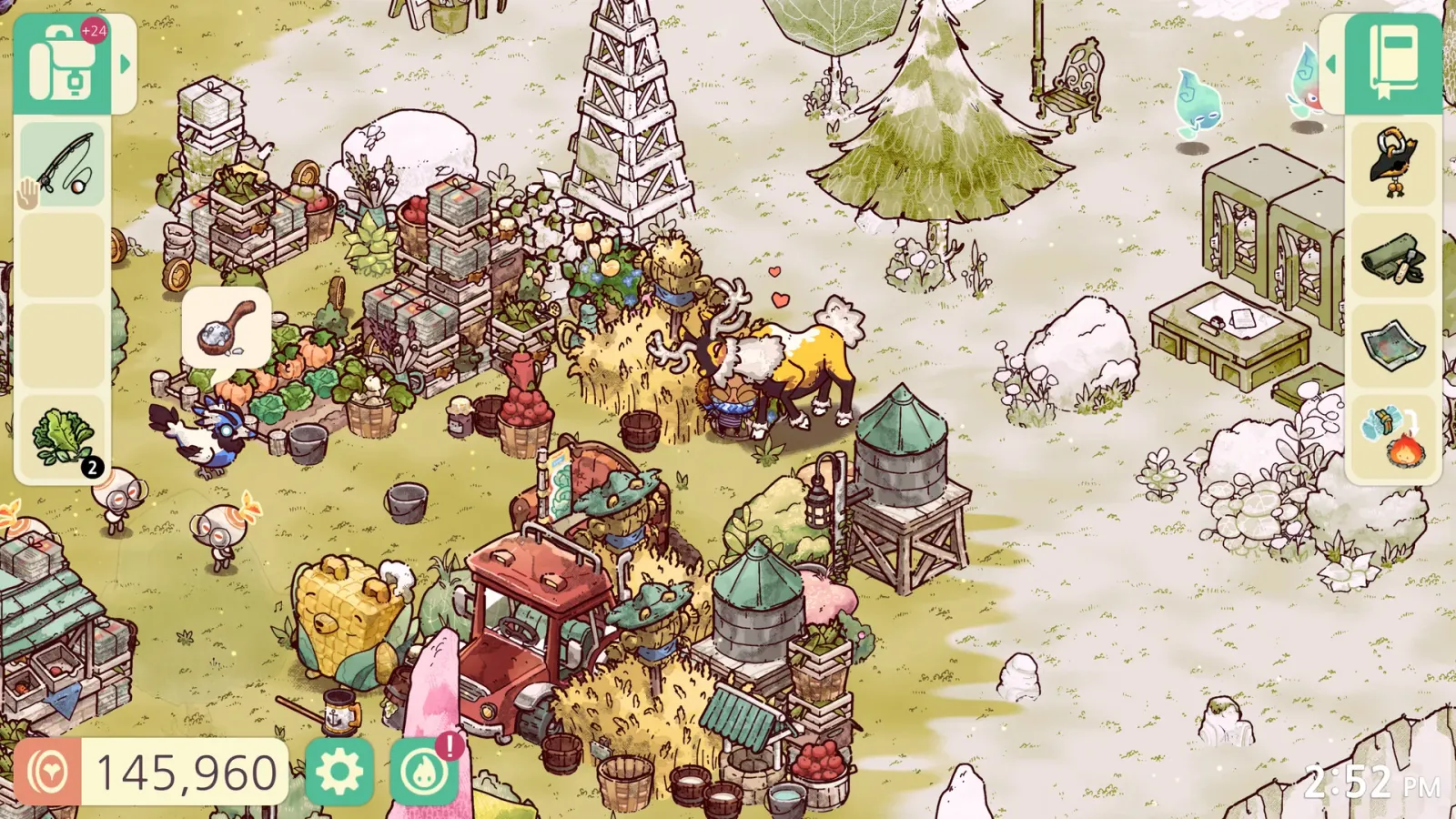
You play Stella, who takes over the job of ferrying the dead. Your boat is a floating home you keep extending: a kitchen, a garden, a loom, a sawmill, a foundry, and a guest house for each spirit who comes aboard. Spirits arrive as animals with human histories, stay a while, and eventually ask to be taken to the Everdoor, which is where you let them go.
The art is soft and the tone is warm, but Thunder Lotus states plainly on the store page that the writing deals with death, physical disability, mental illness and suicide. One player controls Stella; a second can join locally as Daffodil the cat, who helps but cannot lead.
What you actually do
The days are a routine. You sail to an island, mine or chop or fish for what you need, come back, cook a meal someone asked for, water the crops, run the loom, and improve a building. Between chores you talk to your passengers, learn what they want, and work through their requests: a favorite dish, a place they want to visit, an argument they want settled.
The management part is straightforward and the boat gets steadily better, but the game refuses to let it stay comfortable. Each spirit's story ends with them asking to leave. You sail them to the Everdoor and lose their building, their errands and their voice on the boat.
What it exercises
Runs several slow processes at once and returns to each when it is ready.
Plans a voyage around what several different people have asked for.
Reads what someone needs from indirect conversation rather than a task list.
Keeps a routine going after part of it is gone.
Why we rate it Minimal Worksheet score 24 / 100
FitHow much real knowledge or skill does the play itself make you use?18weight 45%
Fit is scored 18. The emotional work and the management work are the same actions: cooking a dish is how you learn what a spirit misses, and losing a building is how the game makes a departure cost you something, so a player cannot skip the feeling to get at the farming. It stays low because the underlying chores, gathering, cooking, building, are simple tasks rather than demanding reasoning.
TransferWill what you practise here work outside the game?15weight 30%
Transfer is scored 15. What a player rehearses is the shape of caring for someone who will leave, and of carrying on afterward, which is a real rehearsal and one that a player who has lost someone often recognizes. It is capped hard because this is not a technique and not therapy: the game offers a feeling to sit with, not a skill that moves into an actual loss.
PracticeDoes the game make you use that skill again and again, as it gets harder?45weight 25%
Practice is scored 45. The daily loop of gathering, cooking, building and talking repeats for dozens of hours, and the farewell structure repeats around a dozen times with different people, so both the routine and the loss come back often enough to become familiar. It settles in the middle because the chores themselves stop getting harder well before the hours run out.
What the evidence says
Editorial onlyNobody outside our desk has checked this. It is our reading of how the game plays.
Editorial only, our reading. The Steam page and Thunder Lotus material confirm the developer, the 2020 release, the Farewell Edition as the current product, the local co-op, the roughly thirty-hour length, and the studio's own statement about mature themes. That is where the factual claims stop. There is no study of this game, and we make no wellbeing claim: playing it is not grief counseling and should not be offered as a treatment for loss.
Editorial assessment - not a measured scientific effect.
Fit
18/100
Transfer
15/100
Practice
45/100
Why it makes the cut
PASS - Its management-adventure loop is strong enough to stand without leaning on grief discourse.
Editorial only
This is editorial only: the Steam page and developer material confirm the release, length and stated mature themes, but there is no study of this game, and it makes no wellbeing claim of its own.
Prices are US store listings in USD, last refreshed 2026-09-25; regional prices and sales differ.
Single-player is standard; local co-op is also available on the PC route.
Current PC availability is directly verified on Steam under Spiritfarer: Farewell Edition. Thunder Lotus' official site and Farewell Edition announcement confirm that Farewell Edition is the current definitive product identity and current console route.
Steam currently verifies interface support for the listed locales. Full audio is captured only where Steam explicitly marks it; subtitle coverage remains unknown unless a platform source states it separately.
Age guidance
Ages 13+ · ESRB T
Topics
Mind & well-being
Play styles
Single-player, Co-op, Simulation, Narrative
Tags
Care management · Farewell rituals · Boat building
Caretaking and management are welded into the same actions, which is a real design achievement, but what it rehearses is an emotional shape, not a skill, and it should never be read as therapy.