Players guide a largely linear conversation-and-memory story, interpret flashbacks, and watch present decisions reframed by past commitments.
Why it may be useful
The emotion wheel forces you to read a scene and commit to a tone under time pressure, which is a real exercise in interpretation. It stays modest: you form an impression and move on, with no chance to defend a reading or be shown wrong.
Keep in mind
Its Cold War setting is atmosphere for a personal drama, not factual history teaching or a reliable account of the period.
Written 2026-09-15 · editorial assessment, not a measured effect · how we rate →
What the game is
South of the Circle is a narrative adventure by the British studio State of Play, published on PC by 11 bit studios in August 2022 after an earlier release on Apple Arcade. It is single-player and takes a few hours.
You are Peter, a Cambridge academic whose plane goes down in Antarctica during the Cold War. As he walks across the ice looking for help, the game cuts back to the years that put him there: his research, his university, the pressure from people with authority over his career, and his relationship with a fellow academic, Clara. The two timelines interrupt each other, so a scene in the snow is answered by a scene in a lecture hall.
It is presented as a film. The cast is motion-captured and voiced by British screen actors, and the art is flat and strongly colored. Steam lists full English audio with subtitles in fourteen further languages. There is no combat, no inventory and no way to lose.
What you actually do
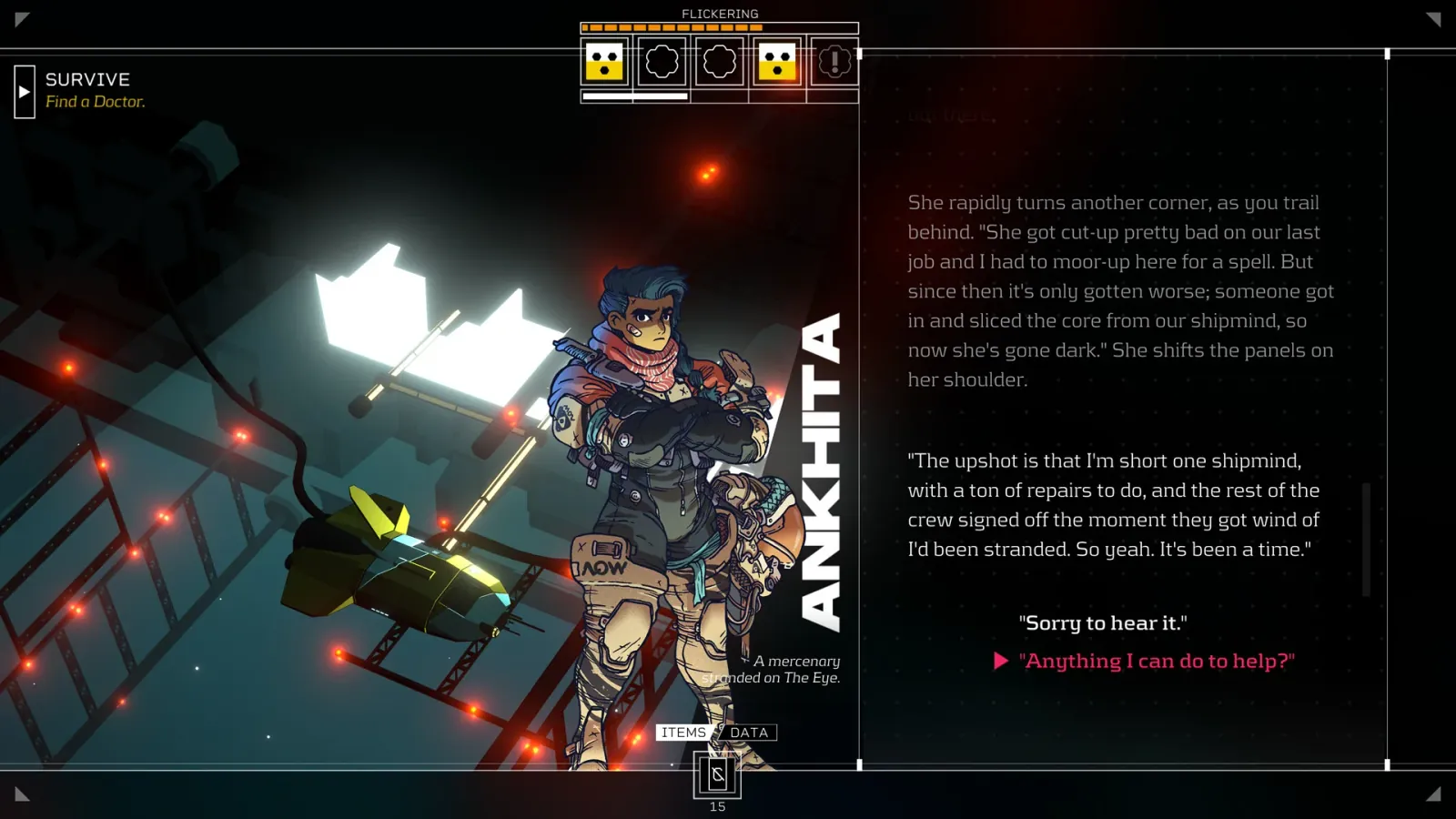
Most of the time you walk Peter forward and look at things. The decisions come in conversation, and they are not phrased as arguments. A wheel of feelings appears, and you choose the emotion Peter shows: warm, defensive, evasive, honest. There is usually a time limit, so you answer with an instinct rather than a plan.
Those choices decide who Peter is being more than where the plot goes. Because the flashbacks are interleaved, a choice about the past reframes the present scene that follows it. Getting better mostly means noticing what a scene is really about before answering.
What it exercises
Reads a scene for what is unsaid before choosing a response.
Chooses a tone deliberately and watches how another character reacts.
Holds two timelines in mind and connects a past promise to a present situation.
Sits with an ambiguous outcome rather than hunting for a correct answer.
Why we rate it Minimal Worksheet score 26 / 100
FitHow much real knowledge or skill does the play itself make you use?28weight 45%
Fit is scored 28. The emotion wheel forces a reading of the scene into a button press under time pressure, which is more than a cutscene asks of a player, and that is genuine interpretive work. It stays in the high twenties because outside those timed choices a player is mostly walking and watching, with nothing else demanding real engagement.
TransferWill what you practise here work outside the game?25weight 30%
Transfer is scored 25. Reading tone and reassembling an out-of-order story are useful skills in literature and in life, but the game gives no practice in defending a reading or being shown wrong about one. A player forms an impression and moves on, which is a weaker exercise than a classroom discussion would offer, and that gap holds the number down.
PracticeDoes the game make you use that skill again and again, as it gets harder?25weight 25%
Practice is scored 25, tied for the lowest here. The emotional choice returns throughout the story, so reading a scene and committing to a tone happens many times in one playthrough. What holds the score down is length: this is an evening or two, not a game that keeps returning a player to the same skill over months.
What the evidence says
Editorial onlyNobody outside our desk has checked this. It is our reading of how the game plays.
Editorial only: our reading of the mechanics. The Steam listing confirms the developer, the publisher, the August 2022 PC release, the single-player structure and the language support, and it describes the motion-captured cast and Cold War setting. It supports nothing about what a player takes away. There is no research on this game, and the claim about interpretive practice describes what the emotion wheel makes a player do. Nothing here is a history source; the game is fiction set against a real period.
Editorial assessment - not a measured scientific effect.
Fit
28/100
Transfer
25/100
Practice
25/100
Why it makes the cut
PASS - It is a polished narrative adventure with real player appeal.
Editorial only
This is editorial only: the Steam listing confirms the developer, release and structure, but nothing measures what a player takes from the interpretive choices, and no research exists on this specific game.
Prices are US store listings in USD, last refreshed 2026-09-25; regional prices and sales differ.
No subscription requirement was found on the verified PC route.
Steam currently verifies interface support for the listed locales. Full audio and subtitle support are only marked where a current Steam source states them explicitly.
Age guidance
Ages 15+
Topics
History & society, Mind & well-being
Play styles
Single-player, Narrative
Tags
Memory framing · Contextual interpretation · Cold War setting
The emotion wheel makes interpreting a scene an active choice under time pressure, but the game gives no chance to defend that reading or discover it was wrong, so the practice stays shallow.