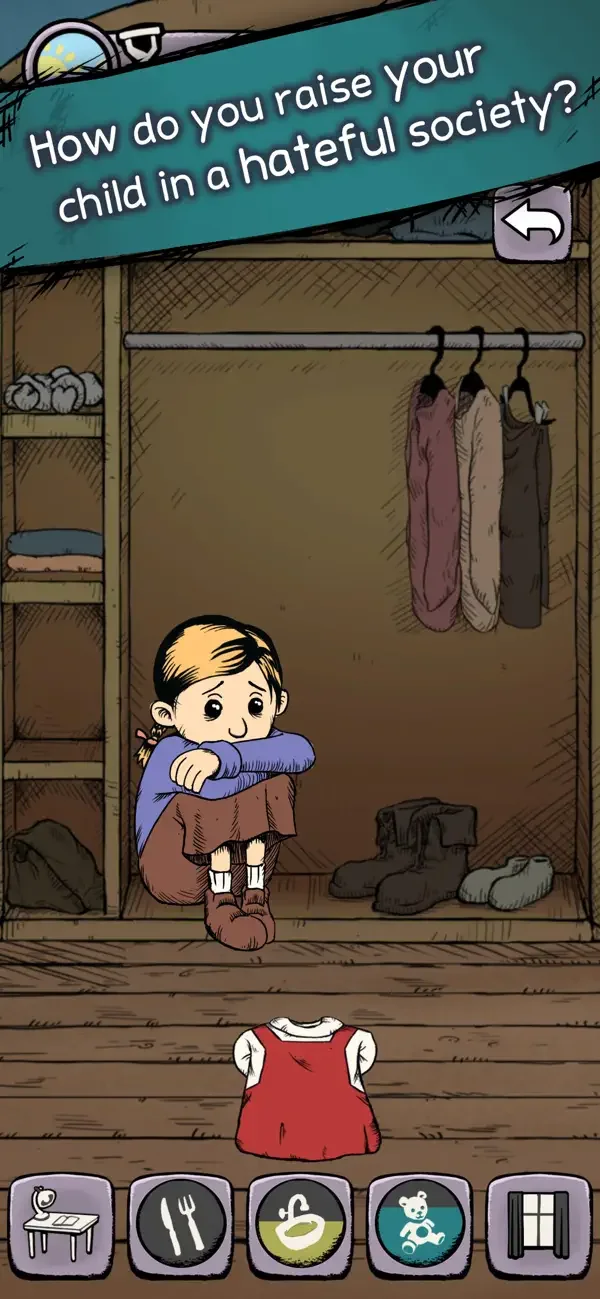
Players take items out of boxes and place them around new homes, gradually inferring the protagonist's life changes from what fits, what does not, and what gets carried forward.
Why it may be useful
Arranging someone else's belongings turns into a quiet way of learning who they are, since the functional puzzle rarely interrupts the reading of the objects. The game only runs once, and what it offers is closer to noticing than to any skill you build.
Keep in mind
The mobile route is a subscription through Apple Arcade rather than a purchase, and reflective value here is not evidence of any wellbeing impact.
Written 2026-09-15 · editorial assessment, not a measured effect · how we rate →
What the game is
Unpacking is a puzzle game by the Australian studio Witch Beam, released in 2021. It is made of eight moves, each one a new home for the same unnamed woman, spread across two decades of her life from a childhood bedroom in the late nineteen nineties to a shared adult flat in the twenty tens.
Each level is a room, or a few rooms, and a stack of cardboard boxes. You drag items out one at a time and put them somewhere. The game will not let you finish until everything is somewhere sensible: a toothbrush belongs in a bathroom, not on a bed. Beyond that it does not care, so a shelf can be arranged however you like.
Nobody speaks and nothing is narrated. The story is entirely in the objects: which things survive from one move to the next, which get left behind, whose furniture is already in the room you are moving into, and what it means when there is suddenly no wall space for a poster you have carried for fifteen years. It is drawn in warm pixel art with a great deal of attention to the sound each object makes as it lands.
What you actually do
Open a box, take out a cup, decide where cups live in this kitchen. Repeat a few hundred times. There are two layers of decision inside that: a functional one, where the game checks whether an item is somewhere plausible, and a personal one, where you decide whether the plush toy goes on the bed or into a drawer. The second layer has no rules at all.
Difficulty rises quietly, through space. Early rooms have more room than possessions. Later ones do not, and something has to be stacked, hidden, or left in the box. Getting better is not the point; what changes is attention. Players start noticing the objects themselves, and the sixth move usually lands differently once you realize what is missing from it.
What it exercises
Sorts objects into categories and decides where each belongs
Fits a set of things into a space too small for all of them
Infers a person's life from the things they own
Notices what has changed between two versions of a similar scene
Why we rate it Minimal Worksheet score 17 / 100
FitHow much real knowledge or skill does the play itself make you use?18weight 45%
At 18 the reflection is built into the action: you learn about this person by handling her belongings, and you feel the constraint of a small flat by running out of shelf space. It stays low because the functional check is loose, so a player can finish every room without ever thinking about what any of it means.
TransferWill what you practise here work outside the game?12weight 30%
At 12 organizing a real space is a genuinely transferable skill, and the habit of reading a room for what it says about the person living there is worth having, but both are gentle and hard to demonstrate afterward. This is one specific, comfortable life shown once, not a method a player practices or carries anywhere in particular.
PracticeDoes the game make you use that skill again and again, as it gets harder?20weight 25%
At 20 eight moves and several hundred objects mean sorting and placing repeats a great deal within one playthrough, but it is a short game with a fixed story. Once the sixth move is known, a second run is a much quieter experience, and there is little reason to come back a third time.
What the evidence says
Editorial onlyNobody outside our desk has checked this. It is our reading of how the game plays.
The level is Editorial only. Unusually for this catalog, two academic sources on file do study this exact game, both analyzing how it tells a story through objects and environment rather than dialogue. They are humanities analyses of the design, not measurements of any effect on players, so they support the description of how the game works and nothing about outcomes. The store listings confirm the platforms and the Apple Arcade dependency on mobile. Nothing here should be read as evidence that playing improves wellbeing, empathy or organization.
Editorial assessment - not a measured scientific effect.
Fit
18/100
Transfer
12/100
Practice
20/100
Why it makes the cut
Arranging belongings and gradually discovering a life story is intrinsically compelling play even without any wellbeing framing.
Editorial only
This is our own reading, though two academic papers do study exactly this game's storytelling method; they analyze the design rather than measure any effect on players, so no outcome is claimed here.
Prices are US store listings in USD, last refreshed 2026-09-25; regional prices and sales differ.
Current mobile availability is tied to Apple Arcade as Unpacking+.
No ads or in-app purchases were claimed on the Apple Arcade listing.
Mobile access therefore has a subscription dependency even though the core game is premium on PC and console.
Steam verifies current PC access, Nintendo verifies Switch, and the App Store currently carries Unpacking+ through Apple Arcade on iPhone and iPad.
Nintendo explicitly verifies English, French, German, Spanish, and Brazilian Portuguese. The current Apple Arcade mobile listing also reports English plus 15 more languages.
Premium on PC and Switch; subscription-gated on mobile through Apple Arcade.
Age guidance
Ages 10+ · ESRB E
Topics
Mind & well-being
Play styles
Single-player, Puzzle, Narrative
Tags
Environmental storytelling · Organizing · Life transitions
The reflection genuinely happens through the action of handling belongings, but it is one short, fixed story experienced once, with nothing to practice against afterward.